










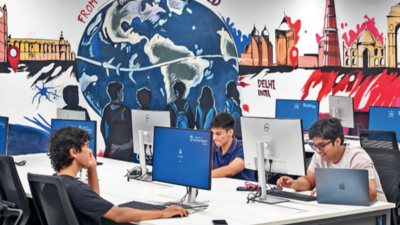
Diya Aneja had an uncommon subject combination in mind for her undergraduate. As the clock ticked on the admission cycle in 2025, the IB student from Gurgaon was ready to give up one of the troika of economics, business and psychology she was insisting on — subjects she liked and a pairing that would hopefully AI-proof her in the job market. “I didn’t find a college that gave me the major-minor combination I wanted,” says the 20-year-old, who has just completed her first year of BSc honours in economics at Southampton University Delhi.In Aug 2025, Southampton became the first international university to open a direct, full-fledged campus in India under UGC regulations after the ministry of education in 2023 opened the gates to foreign institutions (Deakin was the first foreign university to open a campus in India in 2024, at GIFT City in Gandhinagar, but comes under special financial zones rules).Diya’s course combines core economics subjects with behavioural economics and management ethics, covering all her interests. It’s one of just six undergraduate courses the India campus of the British university currently offers here, operating out of an IT Park building at Sohna in Gurgaon.The reason Shreya Sethi chose Southampton Delhi for her UG is why a majority of the first batch of students enrolled. Get a UK degree without having to leave India, amid tightening of visa regulations in the West and rising living and airfare costs. Students also see its three-year UG courses, at a time when Delhi University has transitioned to four years, as “an advantage”.“My parents thought it’ll be too early for me if I left the country after school. They wanted me to finish my graduation before I do that,” says the BSc management student. “Southampton is a leading global university offering me an international degree while letting me study in my own hometown,” says Shreya, for whom the decision was a “no-brainer”.The UK pull factorSouthampton held 111th position in the latest QS World University Rankings. The closest Indian campuses in the top 200 are IIT-Delhi at 118 (the highest ever for an Indian institute), IIT-Mumbai at 134 and IIT-Madras at 170.Shradhha Surana, a BSc accounting and finance student, says she relates to the university’s pedagogical approach that goes beyond textbooks. “We are growing along with the campus,” she says.The Delhi campus’s UG and masters programmes are all market-facing – software engineering, business management, accounting and finance, computer science, economics, and creative computing in UG, and data science, economics, finance and international management in masters.Among most students on the campus TOI spoke to on completion of their first year, the expectation of access to placements and landing an international job after graduation is strong. In particular, they are looking forward to the option of studying one semester at the main campus in Southampton, available to eligible students in the second year.A first-year student who joined the university from Hyderabad (he did not wish to be named) says, “The best performers will get the opportunity to study at the UK campus for one semester, so that also gives me motivation to do well.”Trade deal boostThis year, Southampton was joined by University of Liverpool opening its India campus, at Bengaluru. International Chamber of Commerce UK chair Lord Karan Billimoria, who recently led a Chartered Association of Business Schools delegation to India, tells TOI the UK–India Comprehensive Economic and Trade Agreement signed this July will play a big role in more British educational institutions setting up India campuses.“The agreement marks a major milestone in expanding bilateral trade, and education will play an important role in realising its potential,” he says. “The Indian govt is giving a strong signal to international institutions through National Education Policy, and individual states are actively encouraging UK universities and business schools to set up campuses in India.”The UK’s restrictive immigration measures have limited the mobility of international students, so universities there must look globally to keep teaching an international cohort of students, Billimoria admits.The quality questionSouthampton Delhi’s academic provost Elloise Phillips says the university is making sure the exact academic standards followed on the UK campus are replicated here — the same curriculum, blackboard modules, assessments and reading list. Those adept in the UK methodology of teaching have been hired as faculty members — about 60% have either studied in the UK or worked there.The staff has undergone extensive induction and training covering Southampton’s teaching, assessment and quality bars. Some faculty members are simultaneously taking the university’s PG certificate in education course, which will give them the same internationally recognised teaching qualification as their peers in the UK.“We also follow the same processes when it comes to marking and moderation of work and external examining. It’s generally the same external examiner as the one who looks at the UK and the Malaysia campus, so they can do cross-comparisons,” Phillips says.The university, according to her, is strict on quality assurance so the Delhi campus has the same credibility as the one in the UK. “We recognise that employers will want clarity, so transparency is important. Students will graduate with a University of Southampton qualification, and their records will clearly reflect the programme they have completed,” she says, adding that the university will continue to build awareness and understanding of the academic model in India.Easier on the pocketPhillips says what makes Southampton different is that it offers the combination of a UK university education with the opportunities and context of studying in India. “Students have access to an internationally experienced faculty, industry engagement, career support and a curriculum designed to develop both disciplinary knowledge and the skills needed to apply that knowledge in the workplace,” she adds.The undergraduate programme fee at Southampton University Delhi is Rs 13.8 lakh a year. On the UK campus, it is £28,000 for international students, which translates to around Rs 35.7 lakh a year.Where there is a huge difference is the campus and the presence of a diverse peer group. Southampton Delhi occupies two floors of a corporate building at International Tech Park. By that happenstance, the campus has the look of a corporate office with quirky additions to give it a college feel. There are breakout zones with cushions and a personal sitting area where students can work and read, plus a library and snack zones.The India campus accepts CBSE, CISCE and state boards marks as well as IB and Cambridge qualifications. Students can apply with Class XII results or predicted grades. A major requirement negated while applying in Delhi versus the UK is an IELTS qualification.A value questionPointing to campus infrastructure, among other things, education consultant Adarsh Khandelwal says it makes him sceptical about the value for money that foreign universities offer through their India campuses.“It’s not just about getting a foreign degree. It’s also about immersing yourself in the culture,” he says. “And since international campuses in India cannot offer this, he says, the programmes are not becoming as popular as anticipated.”What sets US and UK higher education institutes apart, Khandelwal explains, is the interdisciplinary coursework. “There are at least 30-40 courses at an undergraduate level.” With few degrees on offer here, there is no way to achieve this. When it comes to hiring in India, he adds, a recruiter will give a graduate from an international university campus and a private university the same kind of first job.Aarti Srivastava from National Institute of Educational Planning points out that the world’s top universities have still not set up campuses here. “If an Oxford or Harvard does this, their standards will be diluted. That will give rise to another kind of discrimination during job interviews where people will ask whether the degree is from Harvard India or US,” she says.Srivastava feels the quality of research on Indian campuses will invariably be compromised as compared to their foreign counterparts because of bureaucratic hurdles and problems with securing grants.While Southampton understands trust issues, the India campus is hoping the calibre of its first batch of graduates will put doubts to rest. Phillips says the university has a combined strength of 200 students for now, and plans to keep intake small to ensure more individual attention. “We are not in competition with anyone. We are just another option,” Phillips says.(With inputs from Shruti Sonal)