







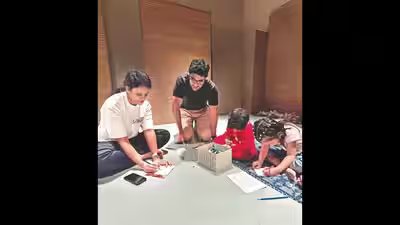
A recipe scribbled in your grandmother’s handwriting or a tradition your family has kept alive for many years holds a lifetime of memories. On a sunny weekend at Atta Galatta, families gathered to document such forgotten rituals through creative expression. “The whole idea was to form a gathering where people could connect through their own stories and get in touch with old rituals or memories they might have forgotten over time,” shares host Stuti Sareen, the founder of Mysteciti.Using prompts, the session helped participants focus on sensory details — objects, colours, sounds and spaces — that took them back in time. Some recalled how family members sat during meals, while others remembered hymns sung by their parents or grandparents. One participant could hear how the soundscape of his family home had changed over time. “When expressed creatively, rituals and memories can become immersive, and one can revisit all those sensory details,” says Stuti.‘Art can change the way we remember family history’Documenting a ritual through creative form changes what we notice. Stuti illustrates this with her grandmother’s pickles. Handed down by word or practice, the recipe would be a list of steps, she says. “But if I were to document it, I would probably create a little graphic story — not necessarily about the process, but about how her hands would move or how her face would look when she would be giving us instructions,” she explains.For Stuti, creative documentation also leaves room for family members to interpret the same story differently. “As viewers of art, we bring our own experiences to it, so the same family story can take on different meanings for different people,” she adds.Visual artist Tejal Sharan believes visual documentation is “the best practice to preserve abstract and intangible memories.” She says, “They are doorways for younger generations to connect with the past, bring in their own interpretations and carry them forward in their own unique loving way.” She experienced this herself while documenting a precious memory through a handwritten letter and handmade objects. “Expressing it through a handwritten letter and making those objects made me realise how much detail was hidden in that small memory,” she shares.‘We find new meaning in old traditions’For psychologist Suchita Srivastava, continuing a ritual that your parents or grandparents followed can create a sense of closeness with them, even years after they are gone.“It takes us back to our childhood and gives us the lightness we felt as a kid. There is a certain comfort in returning to that feeling,” she says, adding, “Traditions survive not only when we follow them exactly as they were followed before, but when we find new meaning in them. Reinventing a ritual does not mean abandoning it. Sometimes, it is simply a way of keeping its emotional essence alive while allowing it to fit the family we have today.”
Documenting gives us a feeling of nostalgia. Sometimes, when we feel lost in our daily lives and its responsibilities, these archives make us feel more grounded and close to our roots
Suchita Srivastava, psychologist
A ritual does not necessarily have to be customary or connected only to faith. It can also be connected to the geography of a place, the science of things, the way people lived, or the resources available around them
Prabhakar Dabral, a participant
‘Documenting rituals is a way to understand your roots’Prabhakar Dabral says documenting rituals can also help younger family members understand the essence of traditions. “With so much technology and distraction, a completely new culture is emerging, and it is easy for older practices to slowly disappear. Documentation can help families understand why a tradition came into being and what it really means,” he says.“As someone from the hills, I worry about losing our relationship with growing things and caring for the land. My father joined the Army, so we moved often and lived in many places. Yet, wherever we went, we always made an effort to grow something. Watching my parents do this over the years has taught me lessons that were never spoken of, only practised as a ritual. It is a precious part of my upbringing that I want to hold on to,” shares Prabhakar.