





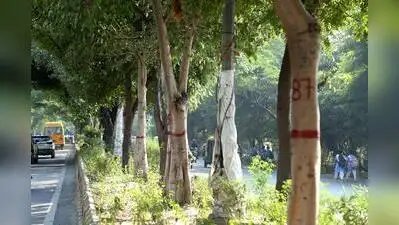
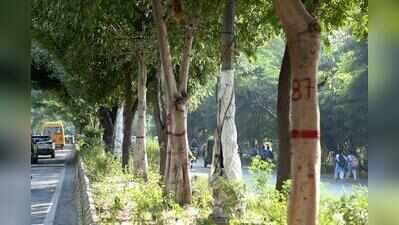
Ghaziabad: A joint survey by GDA and the forest department has identified more than 545 trees, mostly neem, peepal and ashoka, along the proposed 1.2km Hapur Chungi flyover’s alignment. Trees on both sides of the proposed flyover, spanning from ALT crossing to Diamond Flyover, have been marked ahead of the start of civil work.While trees were felled in large numbers for infrastructure projects like DME, Hindon elevated road and Namo Bharat projects, the GDA vice-chairperson said the Authority had sent a proposal to the forest department to translocate 80% of them to parks in Madhuban Bapudham township.“We have marked 545 trees on both sides of the proposed flyover, which will go all the way from ALT Centre, Shastri Nagar and Rajnagar. Most of the trees are fully grown, and this time around we plan to translocate them,” GDA vice chairperson Nand Kishore Kalal told TOI.This would be the first time that such a large-scale translocation would be undertaken to save the city’s depleting green, he said. At about Rs 50,000 per tree, translocation is costlier than felling and compensatory plantation. Only trees with a girth above 150 cm and an age over 10 years qualify.“A proposal has been sent to the forest department. We expect the consent from the department to come in a fortnight. Thereafter, we will draw up a plan to translocate trees in consultation with the forest department and GDA’s horticulture department,” Kalal said.The city has lost thousands of trees to development projects, including 375 for the Hindon elevated road, 2,760 trees and shrubs during the refurbishment of the Delhi-Meerut Expressway and 2,029 trees and shrubs for the Namo Bharat project. Ghaziabad’s green cover was 2.36% of its geographical area in the Forest Survey of India’s State of Forest Report 2023, up just 0.03% from 2021.An official from the district forest department said a proposal from GDA has been received, and the forest department, which has mapped trees, is in the process of approving translocation.“Based on the nature of trees, their survival rate is between 70% and 75%, and it is a cumbersome process,” Shahid Husain of Delhi-based AS Relocation, which specialises in translocating trees, said. “The process involves lopping up trees and the area around their roots with soil, also called a rootball, wrapped around. It is then cautiously dug up and, with the help of hydraulic cranes, it is transported to the selected site where it is planted. The survival rate also depends on the soil where the tree is replanted. Agencies and govt are prioritising translocation of trees over felling,” he said. Delhi already has a policy on translocation of trees, but UP is in the process of formulating an Entire Tree Translocation policy.