







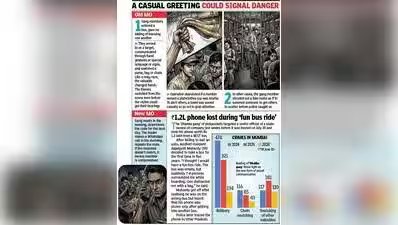
“Chacha ne salaam diya”“Aaj mausam kaisa hai?”To an outsider, these may sound like harmless banter. But as MIDC police in Andheri found out last week, these phrases carried a very different message for the ‘Dhakka gang’ of pickpockets who ran a carefully orchestrated operation and were arrested recently. It was their code language to know if everyone was safe, if anyone had been caught or if they could go ahead with the day’s planning.Cracking the gang’s communications offered police a glimpse of how secret gang communication has entered the smartphone age.DCP (west zone 3) Datta Nalawade, who led the investigations, said the communication was less about planning the theft than checking whether it was safe to proceed. “The purpose wasn’t to discuss the theft. It was to find out whether anyone had been picked up by police,” he said.For as long as criminals have worked in groups, they have needed a way to communicate without alerting the people around them—or police. Mumbai’s thieves have, over the years, used special languages, hand signals, eye blinks, towels and fake names. Today, some have moved to coded WhatsApp calls and social media messages.The leader of the Dhakka gang, whose members had specialised job titles and role assignments to execute thefts, reportedly contacted members every morning on WhatsApp using a code that changed daily. Only after the check would the gang decide where to meet and which bus route to target. After two members were arrested, the others shifted from Andheri to Juinagar in Navi Mumbai.Former police commissioner D Sivanandhan recalls gangs operating in Mumbai in the early 1990s using “special languages”. Among them were ‘Kepmari gangs’ from Tamil Nadu, who worked in groups of three or four on buses and trains. “They used a particular language to communicate and handed over the stolen booty to others. Like a relay race, the purse or bag or chain would change hands and vanish from the scene. They communicated through hand signals or special language or signs,” Sivanandhan told TOI.Over time, the signals became simpler. A blink could mean danger. A towel waved casually could signal a plainclothes policeman nearby. A particular name shouted aloud could mean abort the operation.“There was a time when gangs would meet at gardens, railway stations, bus stops or small hotels,” said Vanrai police senior inspector Abdul Rauf Shaikh, who was then assistant inspector with Mumbai crime branch’s unit-10. That was where they shared the day’s loot, decided the next day’s targets and fixed the code—be it blinking eyes after spotting danger or cops in civil dress, or flagging a towel cautioning gang members to take a back step.Shaikh said several such gangs were busted in 2017. Their members came from different parts of Mumbai Metropolitan Region and targeted commuters in BEST buses but ensured they all got off at different stops.“When I was posted with the crime branch and Trombay police station early in my career, there were gangs that used different code signs to communicate and escape. But the common feature was that they called their art of stealing ‘jaadu’ or ‘jhatka’,” said ACP (Ghatkopar division) Shailesh Pasalwar.Even in 2022, eye contact remained more useful than mobile phones for some gangs.Deputy superintendent of police (Mangaon-Raigad) Shashikant Pawar, who was then with the Mumbai crime branch, recalls gangs travelling in groups of four or five on BEST buses without speaking. Once a target was identified, two or three members created a distraction while “the machine” stole the target’s phone or wallet. They then got off at different stops. The Dhakka gang followed the same pattern.DCP Nalawade said the team that busted the gang—senior inspector Ghanshyam Nair, inspector Sunil Karande, SI Kiran Nawle and staff—found out that members stole at least five high-end phones a day and police recovered 135 phones valued between Rs 90,000 and Rs 1.5 lakh. The thieves reportedly avoided iPhones because they were harder to unlock and had limited resale value in their intended markets in Bangladesh and Nepal.