


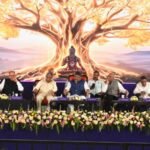




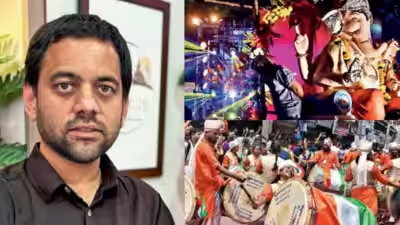
The irony is not lost on Vidyanand Bapat. He does not use Instagram, Facebook or X. WhatsApp is about as far as his social media presence goes. Yet, over the past few weeks, his image and words have travelled across online platforms, turning this little-known Narayan Peth resident in Pune and a former BPO employee into one of the most talked-about voices on noise pollution during festivals.It began with a question he has been asking long before the cameras arrived: Why should celebrating a festival mean so much noise for everyone?On Aug 24, Bapat found the opportunity to ask his question in public. At a meeting attended by Pune Municipal Corporation officials and Ganesh mandal organisers on preparations for Ganeshotsav, Pune’s biggest festival, the 37-year-old rose to speak. He came straight to the point: DJs, loudspeakers and high-decibel celebrations should not spill over to public spaces at the cost of residents’ peace and access to roads.Bapat was shouted down and eventually escorted out under police protection. A video of the episode went viral online, introducing many people to a man who, until then, had largely made his case through letters, representations and conversations with officials.For some, he was questioning set traditions and religious beliefs. For others, he was articulating a frustration they had experienced, but rarely voiced. However, Bapat said the sudden attention has little to do with why he began speaking out.“Noise pollution is not something I raised this year. I have been pursuing it for a long time and have written to local authorities, public representatives, the CMO and the PMO, seeking action,” he said.
Journey To Atheism
A native of Ratnagiri, he moved to Pune nine years ago for work after completing his commerce degree. He settled in the family house in Narayan Peth — an old neighbourhood closely associated with Ganeshotsav (Kesari Wada, Lokmanya Tilak’s residence, which hosts one of the five revered Ganapatis in Pune, is close by) and one through which unbearably noisy immersion processions pass every year.His parents, Suhas and Kalpana Bapat, live in Ratnagiri. His father, who worked in a private firm, spent more than 25 years in Pune before returning to Ratnagiri in 2002 to look after the family’s ancestral home. Vidyanand was in Class 9 when the family moved back to Ratnagiri.His mother, who grew up in Shukrawar Peth, remembers their Narayan Peth house and the festival processions. At times, she said, the sound was so intense that their walls and the utensils stacked up on the shelves would rattle.But if the noise of Pune’s festivals was something Bapat grew up with, books were what shaped the way he responded to the world around him. His father recalled his young son was often found in libraries. This reading habit, and his tendency to question, shaped his public arguments.At 12, Bapat said, he began asking why things were the way they were. He was sceptical about many ideas, particularly religion, though he did not immediately identify himself as an atheist.At 20 came the book that, in his words, gave his doubts a direction — Richard Dawkins’s ‘The God Delusion’. “The book gave me conceptual clarity and eventually led me to identify as an atheist. Before that, I was not very religious, but I had a family and there was some impact of religion on me,” he said.Bapat is associated with rationalist Narendra Dabholkar’s Andhashraddha Nirmoolan Samiti. Over the years, he studied the history and practices in Hinduism, Islam, Christianity and Judaism.
‘Shashi Tharoor Of Marathi’
He switches comfortably between Marathi, Sanskrit and English and frequently uses “logical fallacy”, “ad hominem fallacy” and “bandwagon fallacy”. His command over Marathi became an unexpected talking point after his videos went viral, with some users dubbing him the “Shashi Tharoor of Marathi”. Chief minister Devendra Fadnavis also praised his mastery over the language.One Sanskrit verse he quoted, “Ghatam bhindyat, patam chhindhyat, kuryad gardabha-rohanam” (Break pots, tear clothes, or ride a donkey — by any means necessary, a person should become famous) — a satirical line suggesting that a person should do whatever it takes to become famous — spawned a stream of reels and memes.His fondness for less common Marathi words also became a talking point online. The phrase ‘savang prasiddhi’, which he used to describe cheap publicity, was picked up by social media users and soon became content.
For Festivals, Against Noise
At the heart of the controversy is an argument Bapat says is often misunderstood.“I do not oppose Ganeshotsav. My objection is to the additions that have become attached to public celebrations over time, particularly loudspeakers, DJs and the occupation of public roads,” he said.He falls back on history to point to the origins of Ganeshotsav that Tilak started in 1893 to foster social unity and nationalism during British rule.“Back then, there were no loudspeakers or DJ systems at all because there was no electricity, at least in Pune. They came into use only 50 to 60 years ago and were gradually incorporated into festivals,” he said.For Bapat, that history is important because it demonstrates that a festival can retain its identity even when the manner of celebrating it changes.“Society has already moved away from oppressive practices like child marriage and sati because they were unacceptable. Celebration of festivals must evolve as society changes,” he said.His argument, he stresses, applies across religions.“I object to public nuisance being justified in the name of a festival celebration, no matter which religion or which festival. The rules should be the same for all,” he said.The issue, he says, is ultimately about public space.“Roads are for people to move and commute. They should not be occupied by pandals or used for playing loud music and for musical performances in a manner that disturbs others. If a celebration infringes on someone’s right to live peacefully or move freely, then traditions also have to adapt to changing times,” he said.Initially, Bapat’s campaign largely remained a paper trail — letters to authorities, representations to public representatives and appeals for action. The Aug 4 confrontation changed that.Critics accused him of being against tradition and hurting religious sentiments, but supporters began organising protests and demonstrations that backed peaceful celebrations.Marathi actor Subodh Bhave threw his weight behind Bapat, while music director and singer Avdhoot Gupte wrote and produced a song in Bapat’s praise. BJP Rajya Sabha MP Medha Kulkarni, too, said celebrations in the name of tradition should not cause public nuisance or inconvenience.
Then Came The Slap
Bapat was speaking to a television reporter on the arterial Tilak Road in Pune, when he was slapped by a dissenter. An FIR was registered, the attacker was arrested and the state govt provided Bapat with round-the-clock security.The assault changed the nature of the noise pollution debate and a resolute Bapat said, “Those who cannot counter an argument with an argument often resort to physical assault.”He cited Galileo, Giordano Bruno, Socrates and Dabholkar while talking about ideas that faced resistance.On whether he feared another attack, Bapat’s answer reflected the way he sees the issue.“I would be worried if the cause I am fighting for was under threat and not my own life,” he said.
The Sound Of Silence
Bapat’s conviction that celebrations can be held differently was strengthened during an unexpected period of silence — Covid pandemic. With gatherings, and large-scale celebrations suspended, Pune’s streets became quieter. For Bapat, it provided a glimpse of a city without the familiar din.It also changed his understanding of what was considered inevitable.“It made me realise that quiet celebrations are possible and loudspeakers and DJ can be stopped but the willpower is missing,” he said.He drew on Solapur’s Ganeshotsav celebrations in 2025 conducted without DJ systems, as another example.“Solapur has shown that festivals can be celebrated without DJs and loudspeakers. The absence of DJ systems also discourages large processions, helping ease traffic congestion. It proves that people can celebrate without causing inconvenience to others,” he said.His alternative is not to take festivals out of public life altogether, but to redesign the way they occupy it — those who want loud music could use auditoriums, he suggests, while processions without noise could be moved to designated routes outside cities.
Accustomed To Inconvenience
In Pune’s Peth areas, residents leave their homes during the 10 days of Ganeshotsav to escape the disruption, while a vast number simply tolerate it.“For years, people adjusted to whatever inconvenience they faced and, instead, increased their tolerance. The current debate has encouraged many to question that acceptance and speak about what they believe is right,” he said.For Bapat, that conversation is less about opposing festivals and more about asking who gets a say in how public spaces are used.“Festivals should be occasions of happiness, not a punishment for people living around the celebration. Citizens should not feel that they are paying the price for someone else’s celebration. If that feeling continues, the divide between organisers and other citizens will grow wider,” he said.