








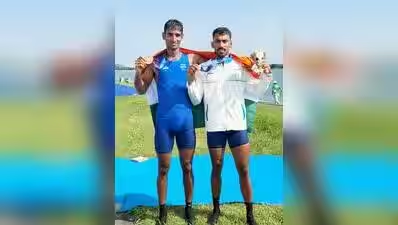
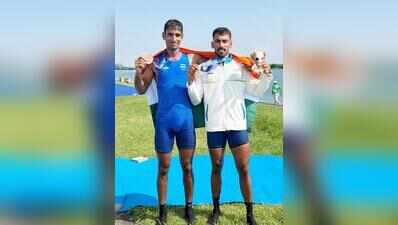
Manuja Veerappa and Fazal Khan | TNNNagoya/Lucknow: For a year, Salman Khan drove a cab on one of the country’s busiest thouroughfares, shutting out the noise — the honking, the mad rush, the constant spectre of roadrage — as he sought some kind of sanity to life. On Thursday, on the serene waters of the Nagara River in south central Japan, in a sculling shell, he was happily trading it all for an Asian Games bronze.Imagine a life, at just 19, navigating a battered Wagon-R on the mostly unforgiving Delhi-Gurgaon Uber route to make ends meet because your farmer father untimely death leaves you suddenly responsible for his mother and five younger siblings.That, to rush hour on the Nagaragawa Regatta Course.Salman’s journey also showed that when life gives you different partners, you make the most of it. If it was his once-trusted taxi on the roads of the Capital, in Nagoya Indian Navy sailor Satnam Singh stood by him, both thrown together to row for only the first time.For once, the Indian duo made double sculls a working class sport and they had a head-earned medal to show for it.For Salman, who trains at the Army Rowing Node in Pune, the medal was also a validation of a life that had rarely followed a straight course.Rowing was never part of his original plan. “I didn’t want to do rowing. I’ve struggled a lot in my life,” Salman, a resident of Purey Dhani Khairahna village in Amethi’s Tiloi area, told TOI on Tuesday. “After my father Kasim Khan’s death, I had to move to Delhi and drive an Uber. One of my friends told me try for the army. I prepared and was enlisted. I promptly sold my taxi once I joined.”On Thursday, on Day Five of the Aichi-Nagoya Games, Salman and Satnam’s first-ever double sculls bronze for Indian added to four other medals won by country’s athletes — two silver and three bronze.Wushu fighter Roshibina Devi bagged silver in the women’s 60kg sanda, shooters Anantjeet Singh Naruka and Parinaaz Dhaliwal claimed bronze in mixed team skeet, long-distance runner Seema Kumari won bronze in the women’s 10,000m while the mixed 4x400m relay quartet of Manu TS, Poovamma MR, Vishal TK and Vithya Ramaraj added another silver.But the story of the day belonged to our former cabbie.Joining the army wasn’t all ducks and water. Picked directly from the training centre because of his physique and height, Salman was a reluctant rower. Waves frightened him and he feared the boat might capsize. “I didn’t even know how to swim. I didn’t want to do rowing. I was literally dragged into it. I always feared that the boat might overturn. Early on in my training, the boat did overturn once, and I was terrified,” the 28-year-old Naib Subedar with the 122 Engineer Regiment said.Salman’s journey in rowing began unexpectedly, as coaches pushed him into the sport during his Army training. “When I joined the Army, the coaches practically dragged me into rowing training. My coaches worked extremely hard with me, and I gradually I got used to it. It is because of their efforts that I have reached this stage. Today, I feel proud of my country, the Indian Army, SAI TOPS, and Uttar Pradesh. The coaches ,” he said.The journey to the Asian Games medal didn’t come without its hurdles.Salman was paired with Satnam only a few days before the race, which made preparation difficult. “Just five days before the event, I was given a new partner. We sat in the double sculls boat just five days ag,” he said.“It created major difficulties in the double sculls event because our combination was completely disrupted. It was my first time pairing with Satnam. Satnam also tried hard. Our strength and conditioning coach, Najeebul Sir, played a huge role in preparing us.“When the decision to split up our group was made, it made all of us nirash. My earlier partners were Jakar Khan and Balraj, and I had trained with them for six to seven months. If the pairing had not been changed and this boat combination had been formed earlier, India might have won the gold medal,” he said.After winning bronze, the first people Salman he called were his mother Jaburunnisha and wife.“My mother and my wife had been praying for my medal since the night before. After winning it, they were the first people I called,” he said.Salman recalled the advice his coaches gave him before the race: “Salman, aisa chappu maro ki nadi ka paani bahar aa jaye. (Row your oars with such force that the water overflows from the river.)”The line brought a smile to his face. “You get so motivated with such words that you can row with a stone as well,” he said.But Salman, consummate team man, stopped to thing of his mates. “What happened to Balraj Panwar and Jakar Khan, we can’t even imagine. We could have won gold…”