




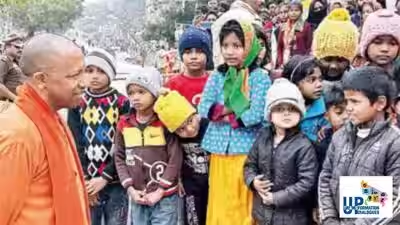
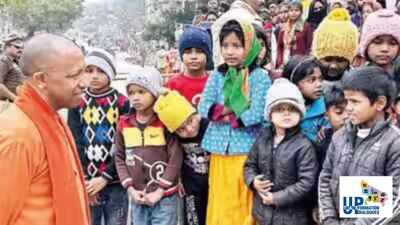
The impact of Uttar Pradesh Government’s emphasis on the safety, protection, welfare and secure future of children is increasingly visible in the state’s expanding child-protection mechanism. Over the last nine years, the approach has gradually moved beyond responding to individual cases of distress to building a wider support system encompassing child protection, family reunification, nutrition, education, financial assistance, institutional care and opportunities for vulnerable children.The functioning of the Child Helpline is one of the clearest indicators of this approach. According to the latest data, 58,293 child-related cases were received through the Child Helpline between January 1 and August 1, 2026, of which 50,589 cases had been resolved. Missing children accounted for the largest category. Around 20,500 cases relating to missing children were reported during the seven-month period, with 18,123 cases successfully resolved.The helpline also received information concerning 9,146 children who had been found, of which 8,419 cases were resolved. These figures indicate the role of the helpline not merely as a reporting channel but as an important link between children, families, field-level authorities and the broader child-protection system.According to Women Welfare Department Director C. Indumati every piece of information concerning missing children is being treated seriously and forwarded to the appropriate level for action. The emphasis, she said, is not limited to locating children but also includes their safe recovery, reunion with families and counselling or rehabilitation wherever required.This is significant because child protection is not only about preventing crime or tracing missing children. It also involves ensuring that children who have lost parental care, suffered abuse, become vulnerable because of family circumstances or require institutional support are not left without assistance.A system that combines response with rehabilitationThe transformation in the child-protection framework is reflected in the government’s effort to create mechanisms that connect identification, rescue, restoration and rehabilitation. Once a child is found, the objective is to ensure safe handover to the family wherever that is appropriate. In cases where a child requires additional support, counselling, institutional care or rehabilitation, the system provides for further intervention.The Child Helpline therefore represents one component of a larger network. Its importance lies in the ability to bring cases to the attention of the administration and ensure that information does not remain confined to an initial telephone call.The government has also been strengthening the institutional framework for vulnerable children through schemes under the Women and Child Development Department and through convergence with other departments and institutions.The 2026–27 Uttar Pradesh Budget proposed approximately Rs 18,620 crore for Women and Child Development schemes, an increase of about 11 per cent over the previous year. Within this allocation,Rs 252 crore was proposed for the Uttar Pradesh Mukhyamantri Bal Seva Yojana, while Rs 80 crore was proposed under the Mukhyamantri Bal Ashray Yojana for construction of buildings.The scale of these allocations indicates that child welfare is being addressed through both immediate assistance and longer-term institutional infrastructure.Support for children who have lost parental careOne of the major interventions of the Yogi Government has been the Uttar Pradesh Mukhyamantri Bal Seva Yojana, introduced to provide support to children who lost parental care during the Covid-19 pandemic. According to government data presented in 2025, 18,990 children were receiving Rs 4,000 per month under the scheme, while 6,348 children had received laptops. Financial assistance had also been provided to eligible girls for marriage. Under the Mukhyamantri Bal Seva Yojana (General), 66,753 children were receiving Rs 2,500 per month along with other facilities.The significance of such interventions lies in preventing vulnerable children from being pushed further into deprivation after losing family support. Financial assistance can help meet basic needs, while educational support and other services can reduce the risk of children dropping out of school or becoming dependent on unsafe forms of livelihood.The state’s policy direction has therefore increasingly treated child protection as a combination of economic support, education, care and social rehabilitation.Building secure institutional spacesFor children who cannot immediately return to a family environment, institutional support remains an important part of the protection system. This is where child-care institutions, shelter arrangements, rehabilitation services and the emerging infrastructure under the Bal Ashray framework become relevant.The 2026–27 Budget’s proposed Rs 80 crore for construction under the Mukhyamantri Bal Ashray Yojana reflects an effort to strengthen physical infrastructure for children requiring care and protection. The broader objective is to ensure that a child rescued from an unsafe or vulnerable situation is not merely removed from immediate danger but is provided an environment in which education, emotional support, healthcare and rehabilitation can continue.Nutrition: protecting children before vulnerability becomes deprivationChild protection also begins with health and nutrition. A hungry, malnourished or frequently ill child is more vulnerable to educational deprivation and social risks. The government’s child-welfare framework therefore includes the extensive network of Anganwadi centres and supplementary nutrition programmes.According to the 2026–27 Budget, approximately 1.57 crore beneficiaries were being covered through supplementary nutrition programmes, while the Hot Cooked Meal Scheme was providing freshly prepared meals at Anganwadi centres to around 34.49 lakh children in the three-to-six-year age group.The significance of these interventions extends beyond food. Anganwadi centres provide an important interface between young children, families and the public welfare system. Nutrition, early childhood care, health awareness and preschool activities together create a foundation for children’s physical and cognitive development.The launch of the ninth National Nutrition Month in Varanasi in September 2026, with the participation of the Chief Minister and the Union Minister for Women and Child Development, further underlined the importance being attached to nutrition and early childhood development.Protecting the girl child from birth to educationThe Yogi Government’s child-welfare strategy has also placed considerable emphasis on the girl child. The Mukhyamantri Kanya Sumangala Yojana, launched in 2019, links financial assistance to important stages in a girl’s life, including birth, immunization and education. The official scheme describes it as a conditional cash-transfer programme intended to support the girl child while addressing social problems such as discrimination, female foeticide and child marriage.The assistance has subsequently been enhanced. Under the revised structure, the scheme provides support at six stages, beginning with birth and extending through educational milestones. The official scheme documents record a Rs 5,000 benefit at the birth stage from April 1, 2024, Rs 2,000 following full immunisation and Rs 3,000 on admission to Class 1, among the staged benefits.The programme has also increasingly adopted digital verification and family-based identification. The official portal records integration with Aadhaar, birth-registration data and Family ID, intended to strengthen identification and streamline delivery.Government data show the expansion of the scheme: 17.82 lakh beneficiaries had been covered between 2019–20 and 2023–24, according to the state’s 2024 annual publication.Thus, the objective is not simply financial assistance at birth but encouraging a continuum—from survival and immunisation to schooling and higher educational progression.Education as the strongest form of protectionFor vulnerable children, continued education can itself become a powerful protection mechanism. Keeping children in school reduces the likelihood of early entry into labour and creates a pathway towards economic independence. The state’s expansion of residential educational opportunities is therefore relevant to its wider child-protection strategy.A notable example is the Atal Awasiya Vidyalaya programme, under which free residential education is being provided from Classes 6 to 12. According to the 2026–27 Budget, all Atal residential schools had been inaugurated and 10,876 students were enrolled.These schools are particularly important for children from vulnerable worker families because residential education combines schooling with accommodation and other support. The government’s broader educational expansion—including improvements in school infrastructure, digital learning, scholarships, uniforms, books and direct benefit transfers—also contributes to reducing the economic pressures that can cause children to discontinue their education.Mission Shakti and a safer environment for girlsThe protection of children, particularly adolescent girls, also intersects with the state’s wider women-and-girls safety architecture. Mission Shakti has developed into a major awareness and institutional initiative addressing women’s and girls’ safety, dignity and empowerment. Government data reported that by 2025, 10,645 activities had reached around 18.32 lakh women and girls, while approximately nine crore people had been covered through Mission Shakti awareness activities.In September 2025, Mission Shakti 5.0 also saw the launch of Mission Shakti Centres in all 1,647 police stations of Uttar Pradesh, according to government-linked material. For adolescent girls, such interventions create a wider ecosystem in which awareness, access to support and institutional response are brought closer to communities.Protection from exploitation and social vulnerabilityChild protection also requires action against conditions that expose children to exploitation, including poverty, unsafe migration, child labour, trafficking, abuse and abandonment.This is why the government’s welfare architecture increasingly relies on convergence between departments rather than treating child protection as the responsibility of one department alone. The Child Helpline’s role in forwarding cases to the appropriate authorities is part of this convergence. Similarly, education, nutrition, police response, social welfare, health services and rehabilitation mechanisms can become interconnected when a child’s circumstances require multiple forms of intervention.The objective is to ensure that a vulnerable child does not have to navigate several government institutions independently.From immediate relief to a secure futureThe evolution of child welfare in Uttar Pradesh over the past nine years can therefore be viewed through three broad layers. The first is immediate protection—responding to distress calls, tracing missing children, rescuing children from vulnerable situations and ensuring safe reunification.The second is care and rehabilitation—providing counselling, institutional support, financial assistance, nutrition and education to children who cannot immediately return to a secure family environment. The third is prevention and empowerment—ensuring that children, particularly girls and children from economically vulnerable families, remain healthy, educated and protected from social practices that can limit their future.The figures from the Child Helpline provide a concrete picture of the first layer. The 58,293 child-related cases received and 50,589 resolved between January 1 and August 1, 2026 demonstrate the volume of cases being brought into the formal response system. The resolution of 18,123 missing-child cases out of around 20,500 reported during the seven-month period is particularly significant for families seeking the safe return of their children.But the larger story lies beyond these numbers. A child who is traced needs a family. A child without family support needs care. A child in poverty needs nutrition and education. A girl facing discrimination needs an opportunity to continue her education. And a child who has suffered trauma may need counselling and rehabilitation before returning to a normal life.Over the last nine years, Uttar Pradesh’s child-welfare architecture has increasingly attempted to address these interconnected needs through helplines, financial assistance, nutrition programmes, educational institutions, girl-child schemes and institutional care.The state’s 2026–27 allocation of approximately Rs 18,620 crore for Women and Child Development schemes, together with dedicated provisions for Bal Seva and Bal Ashray, provides evidence of the scale at which this welfare framework is now being supported.The central idea running through these initiatives is that child protection cannot end with rescue. The ultimate measure of protection is whether a child is able to return to a safe environment, continue education, receive adequate nutrition and healthcare, and move towards a secure and dignified future.For Uttar Pradesh, the strengthening of the Child Helpline and the wider child-protection system represents an effort to make that support structure more responsive—from the moment a child or family seeks help to the point at which the child is safely reunited, rehabilitated and able to resume the journey towards adulthood.