









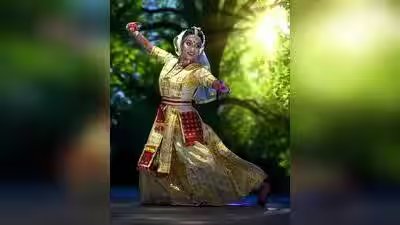
Guwahati: At a time when cultural conversations are often reduced to headlines and social media posts, Farjana Yasmin has chosen a quieter, more demanding path — one shaped by years of discipline, study and a deep engagement with India’s classical dance traditions.The 42-year-old Bangladeshi dancer has spent the past eight years learning and researching Odissi, Kuchipudi and Sattriya — three of India’s eight classical dance forms. Now, as she prepares to return to Bangladesh, Yasmin hopes to pass on what she has learnt to a new generation of dancers.Yasmin’s tryst with dance began when she was three or four years old, under the guidance of her mother in Bangladesh. Her formal training began at the Bangladesh Shishu Academy in Chittagong. After moving to Dhaka, she continued at Nrityanchal, where she learnt Kathak under guru Shibli Mohammad and Odissi under Benazir Salam.She began learning Odissi in Bangladesh in 2012. Five years later, her interest in Indian classical dance took her to India on an Indian Council for Cultural Relations scholarship in 2018.Odissi was her first Indian classical dance form, but her curiosity soon led her beyond it. She was drawn to Kuchipudi, the classical dance tradition of Andhra Pradesh whose roots can be traced to the 17th century, and to Sattriya, Assam’s distinctive classical form that emerged in the 15th century through the work of neo-Vaishnavite saint Srimanta Sankardeva.Yasmin began training in Kuchipudi in 2020 under Hyderabad-based guru Amrita Singh. The following year, she began learning Sattriya under Sreemoyee Borah in Golaghat, Assam.She says she had never watched either form being performed live before deciding to study them.“I had never seen Kuchipudi or Sattriya live before. My deep curiosity and fascination with their grace and unique movement vocabularies drove me to learn and master these traditions under my revered gurus,” she said.Yasmin claims to be the first Bangladeshi dancer to formally learn Kuchipudi and Sattriya. Her journey, however, is not merely about adding two more forms to her repertoire. For her, each tradition has opened a window into a different cultural and spiritual world.“My engagement with Sattriya has given me an opportunity to explore one of Assam’s distinctive classical dance traditions, while training in three major Indian classical forms has broadened the understanding of the diverse performance traditions of the country,” she said.Her years in India have involved sustained training, performance and research. Through Odissi, Kuchipudi and Sattriya, Yasmin has encountered different movement vocabularies, histories and performance practices — experiences she now wants to carry back to Bangladesh.“When I return to Bangladesh, my vision is to share everything I have learnt in India with the next generation through training. I aim to serve as a university professor and researcher, while continuing to perform Odissi, Kuchipudi and Sattriya on national and international stages to build deeper appreciation for these classical forms,” she said.For Yasmin, the journey home will not mark an end to her engagement with Indian classical dance. Instead, it will begin a new phase — one in which the knowledge she gathered across India’s dance traditions can travel further, reaching students in Bangladesh and creating a deeper cultural bridge between the two neighbouring countries.