






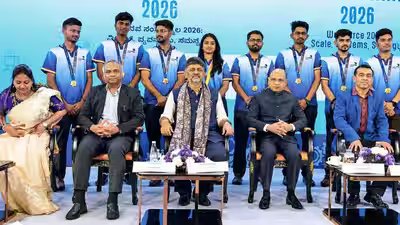
By- Chetan KrishnaBENGALURU: At the WorldSkills 2026 competition in Shanghai, Bengaluru-an Smriti Nambiar had two days, a mini-kitchen and a theme handed to her by the organisers — Chinese New Year, Year of the Horse. In that window, the challenge before the Koramangala resident was to turn out 15 different breads, from croissants to an 80cm-tall bread showpiece, and make every one of them speak to the theme.For Smriti, it was the moment she had been preparing for. She returned from Shanghai with a silver medal in bakery, one of the six silvers India won at the 48th edition of the global championship, often called the “Skills Olympics”, held from Sept 22 to 27.The 70-member Indian contingent, competing across 63 skills, also won 20 medallions for excellence, placing the country in the global top 10 for the first time.And Karnataka was at the heart of it. By sending 16 competitors, the most by any state according to the Team India list, Karnataka made up nearly a quarter of the national team.Besides Smriti’s silver, competitors from the state won eight medallions for excellence, awarded to those who cross the international benchmark score in their skill.The state contingent comprised candidates from Shivamogga, Hassan, Bidar, Mysuru, Tumakuru, Gadag, Dharwad, Gangavathi and Bengaluru. Their stories show how far Indian talent has come.
From 39th place to rank 10
At WorldSkills London 2011, India competed in just 15 skills and finished 39th. Fifteen years later, in Shanghai, the country competed in 63 skills and finished at 10th place. India’s first WorldSkills gold came at Kazan in 2019.Much of that rise is credited to IndiaSkills, the national competition run by the ministry of skill development and entrepreneurship (MSDE), with the National Skill Development Corporation (NSDC) as the implementing agency.The ladder is steep. Candidates compete at the district or state level, then at regional rounds, and subsequently at the IndiaSkills nationals. National winners face further assessment and elimination until only the strongest competitor or team in each skill remains.They then go through months of intensive training under WorldSkills India experts and training partners before flying out. Unlike an exam, WorldSkills is entirely practical. Competitors work on time-bound test projects that simulate real workplaces and are judged on accuracy, quality, speed and safety.
Factory floor to software
Karnataka’s strongest showing came where manufacturing meets code. Seven of its eight medallions for excellence were won in additive manufacturing, industry 4.0, mechatronics and robot systems integration. The eighth came in electrical installations.The state’s participants also competed in CNC milling, cybersecurity, autobody repair (Tejas Bachenahalli Shanthakumara), mechanical engineering CAD, optoelectronic technology (Dhanush Mahadevappa), visual merchandising and welding (Praveen Yankappa Hunakunti).Most arrived in Shanghai as national champions. Eleven of the 16 had won gold at IndiaSkills 2025-26.
The silver story
For Smriti, the task module landed at the end of June, soon after she won IndiaSkills gold. That, she says, gave her three months to rehearse a marathon.“I knew the Shanghai challenge would be making 15 different kinds of breads in 16 hours,” she says. The list included three types of croissant, two sourdoughs, enriched breads, 100% whole wheat breads, baguettes and the showpiece.A few “mystery elements” were revealed only two days before the contest, she says.Each country sends just one baker, who works alongside an expert in a self-contained kitchen with ovens, a proofer, dough mixers and refrigerators.The journey got tougher at every step, she recalls. The state round was easy, but from the South India regional onwards it was “good competition”.A graduate of IHM Pusa, New Delhi, with a BSc in hotel management, Smriti trained at an academy in Indiranagar and has since joined it.“I’ve always wanted to be a chef,” she says. Asked how Indians are placed against medal-rich nations, Smriti thanks her training set-up, which closely matched what she found in Shanghai. “My expert has really thought about everything,” she says. “I wasn’t really stumped.”
Cost of a broken part
Not everyone had Smriti’s luck with equipment. For Pavan Bhadravathi Suresha, one moment on an unfamiliar 3D printer decided his result.The additive manufacturing medallist and IndiaSkills gold winner, a native of Bhadravathi in Shivamogga district, was asked to redesign the end effector of a robot arm, the clamp that picks up sheet metal, to cut its mass.On the first four models, he lost between half-a-mark and one-and-a-half marks. Then the fifth part broke. “In that single model, I lost 15 marks,” he recalls.While rivals from China, Australia and other countries were already familiar with the scanner and printer used at WorldSkills, Pavan had trained on a different machine.Additive manufacturing, essentially industrial 3D printing, lets companies build and test prototypes before committing to mass production. “The major advantage is less cost and material wastage.”His road was long. After training at the Toyota Technical Training Institute from 2018 to 2021 and finishing his ITI, he joined Toyota Kirloskar Motor and completed a diploma while working.Pavan says he has been preparing hard to compete on the WorldSkills stage since 2022.
Access to tools matters
For Dhanush Madhugiri Govindaraju, the gap was in the toolbox, but that didn’t stop him from landing a medallion for excellence in Shanghai.The electrical installations medallist from Madhugiri in Tumakuru district did staircase wiring, PLC and motor-control wiring and industrial control wiring in Shanghai.Competitors from other countries, he says, are used to advanced tools from brands such as Stanley and DeWalt.Specialised cutters for PVC trunking, pipe benders, cable cutters and mesh-tray tools are hard to come by in India. “If we get them, there is a waiting period of six to seven months,” he says. With such tools, he believes, “we can achieve more medals, bronze and silver”.Dhanush works at a govt institute whose WorldSkills department fields competitors in 14 skills, and is also pursuing a BE degree in automation and robotics. He won a national silver in 2024 and a medallion for excellence representing India in Taiwan, and entered the 2025 nationals as a wildcard.
Classmates to india team
In industry 4.0, there was nothing to present. Everything had to be built on the spot. RV College of Engineering classmates Mallinath and Suhan Mascarenhas, IndiaSkills gold winners, put together a working smart manufacturing set-up over four days: a machine-learning camera for quality inspection, then data dashboards, cybersecurity and networking, and finally all three combined.“We actually won’t present anything. We build the manufacturing system over there,” says Mallinath, who handled software.Born in Bidar and later raised in Mysuru, he studied mechanical engineering but always leaned towards software. “The multi-disciplinary aspect is what drove me to this skill,” he says. Placed with Maruti Suzuki, Mallinath says he’d like to mentor future competitors.Suhan, from Hassan, built the pneumatic system and installed devices. “We both really love the networking aspect of industry 4.0,” he says.
Rivals to partners abroad
In robot systems integration, Vinay Muttayya Hiremath and Abhishek Somanna Shignalli were rivals at IndiaSkills. Abhishek’s pair took gold and Vinay’s took silver. A three-round selection afterwards picked the two strongest performers, and the new team went on to win medallions for excellence in Shanghai.Vinay, from a village in Gadag district, works at Toyota Kirloskar Motor. He planned the robot cell in simulation while Abhishek installed the mechanical elements. Both programmed, and Vinay built the HMI (Human-Machine Interface, the control panel operators use to run a machine) and wrote the documentation.The task mirrors how integrators install robots in real factories, from planning to handover. Asian competitors, he says, tend to skip the theory.
Why participation matters
Seven of Karnataka’s 16 came home without a medal. But for them, being in Shanghai itself was a huge learning experience. “WorldSkills was a once in a lifetime opportunity,” says Anuja Ajay Vare, a final-year NIFT Bengaluru student who competed in visual merchandising.“As a student of this age, I’m excited that I got this level of exposure.”Her surprise brief on day one was IKEA, promoting a podcast on cookware and dinnerware for health-conscious customers. Working alone, she designed the display in 3D software and Illustrator, and then spent three days cutting every element in wood with a jigsaw, painting it and installing it on a blank wall.She had trained full-time from April to Sept, including a bilateral programme in Korea under an NSDC arrangement. What stayed with her was watching other countries answer the same brief in their own way. “It’s very cultural.”Others came back with personal bests despite limitations. Charan Kogre Surendra, a CNC programmer at the Government Tool Room and Training Centre (GTTC) in Bengaluru, finished two models and half of a third in a 7.5-hour milling task.Saiteja Godavarthi from Gangavathi, who works with TCS, spent four days hardening servers, analysing malware and defending and attacking networks in cybersecurity alongside his Kerala counterpart.He almost did not enter until a college junior registered him. Now, he says, college cyber clubs are springing up everywhere, aimed at participation in WorldSkills. “Competition is growing.”Siddharudha Basavaraj Kallihal from Dharwad, a BRICS gold medallist, finished 19th in mechanical engineering CAD with 699 marks, despite new mathematical calculations and a robot-manipulator task he had never seen before.
The industry pipeline
One thread ran through several medallions: Toyota Kirloskar Motor. Additive manufacturing medallist Pavan Bhadravathi Suresha, robot systems integration pair Vinay and Abhishek, and mechatronics medallists Deepu Mudigerepalya Srinivasa and Jayanth Kariyappa, all IndiaSkills gold winners except Vinay (silver), trained through the company’s institute.IndiaSkills leans on such partnerships, with industry and institutions providing equipment, mock competitions and mentoring. The national team is a cross-section of India, drawn from ITIs, polytechnics, universities, training institutions and industry.“The training set-up had prepared me well for the competition kitchen in Shanghai”— Smriti, silver for bakery“Multi-disciplinary aspect is what drove me to this skill (industry 4.0). It brings mechanical engineering, software and automation together”— Mallinath, industry 4.0, medallion for excellence
How indiaskills boosts talent
What indiaskills is: A nationwide platform for young people to show their skills and pursue excellenceHow it works: Competitions move from district to state, regional and national levelsPreparation: Offers expert mentorship, rigorous assessments and world-class trainingThen (london 2011): India competed in 15 skills and ranked 39thBreakthrough (kazan 2019): India won its first WorldSkills gold medalNow (shanghai 2026): 70 competitors in 63 skills won 6 silver medals and 20 medallions for excellenceMilestone: India placed in the global top 10 for the first timeImpact: It builds young people’s confidence, raises the status of vocational careers and develops talent that meets global standards