







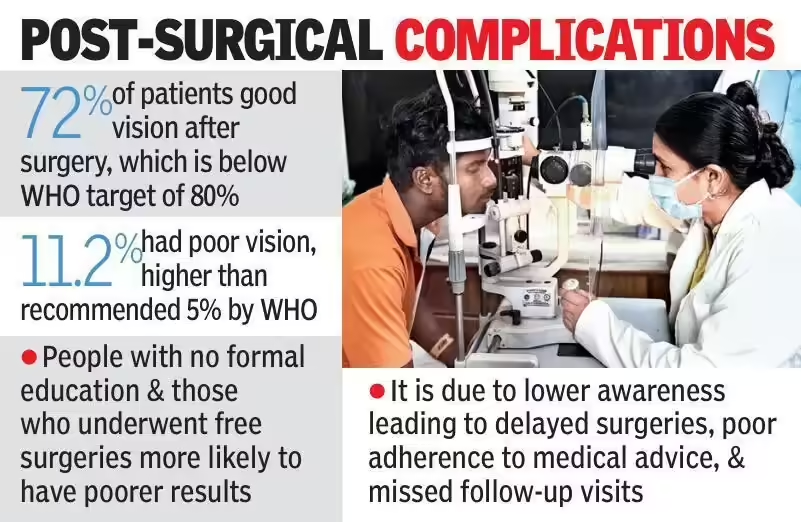
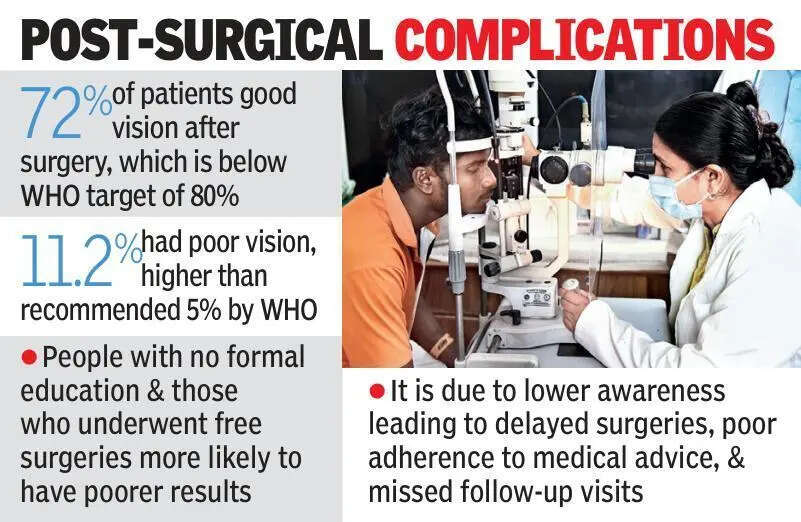
Hyderabad: Cataract screening and surgery camps in Telangana, often the state govt’s main strategy to tackle blindness, may not be delivering the expected results, according to a study by LV Prasad Eye Institute (LVPEI). The study, published in Ophthalmic Epidemiology, examined cataract surgery outcomes in four districts of Telangana. After analysing over 11,000 people in Adilabad, Mahabubnagar, Khammam and Warangal, doctors found that patients treated in govt hospitals and camps were more likely to have poor or unclear vision after surgery, indicating that post-surgery outcomes still need improvement.About 72% of patients had good vision after surgery, which is below the WHO target of 80%. Around 11.2% had poor vision, higher than the recommended 5% by the WHO. The study also found that people with no formal education and those who underwent free surgeries were more likely to have poorer results, due to lower awareness leading to delayed surgeries, poor adherence to medical advice, and missed follow-up visits.Cataract remains the leading cause of blindness worldwide. According to the Union health ministry, India has made major progress in reducing blindness since launching the National Programme for Control of Blindness in 1976. The programme primarily focuses on cataract, a condition in which the eye’s clear lens becomes cloudy, affecting vision. The prevalence of blindness in the country has declined from 1.4% in 1976 to 0.36% in 2019, marking a reduction of nearly 70%-75%.The study further noted that many post-surgical complications were due to other eye diseases or the need for proper glasses, both of which are treatable. Noting that cataract surgery is not a one-time intervention, experts said that it is significant for patients to go for regular follow-ups rather than relying solely on initial screening camps. They also pointed out that social and economic factors play a role in recovery.Refractive errorsA previous LVPEI study called Hyderabad Ocular Morbidity in Elderly Study (HOMES) and others in Telangana show that cataracts account for roughly 50% to 70% of blindness and severe visual impairment. Echoing this, health department data shows that cataracts account for 62.6% of blindness in the state, followed by uncorrected refractive errors. The data also showed that Hyderabad has a higher prevalence of vision impairment (2.24%) compared to other districts, particularly among school-going children.Dr Srinivas Marmamula, lead author and chief optometrist, LVPEI, said cataract surgery is not a one-time solution. “The main reasons for poor vision after surgery were other eye problems and the need for proper glasses. These issues can often be treated if patients return for follow-up care. Patients need regular check-ups after surgery to correct vision and treat other eye conditions. Improving follow-up care is important to ensure better results and long-term benefits for patients,” he added. Surgical interventionsA senior official from the Telangana health department said that under the National Programme for Control of Blindness and Visual Impairment, the state has reduced blindness prevalence to 0.36%, significantly lower than the earlier national average of 1%. “Along with regular screenings, we are focusing on surgical interventions and cornea collection. Between Jan 2025 and Oct 2025, over 2.14 lakh cataract surgeries were performed, achieving 92% of our target. We are also expanding eye care services to underserved areas and strengthening institutional capacity to ensure access to high-quality eye care for all.”Responding to the findings, a senior official said the state has significantly expanded access to free cataract surgeries through govt hospitals and outreach programmes. “Our focus has been on reaching the last mile, especially in rural and vulnerable populations. We are now strengthening quality by improving surgical standards, training doctors, and ensuring better post-operative follow-up,” the official said.He added that screening camps remain important as they help identify patients early, particularly in remote areas where people may not seek care on their own. “Camps are the first step in bringing patients into the system. But we are also working to ensure proper referral, safe surgeries, and regular follow-up so that patients get lasting benefits,” the official said.