






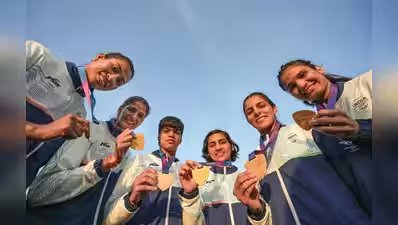
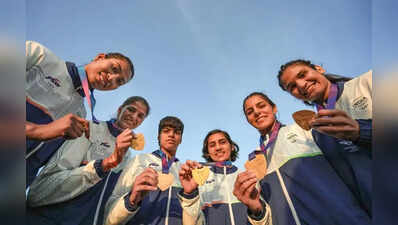
Chandigarh: Army personnel won eight of India’s 13 gold medals at the Commonwealth Games — half of them women.With mind and sinew steeled in the rigours of military training, the Pune-based Army Sports Institute (ASI) shaped them up with a scientific athlete development programme that tracked their performance at world championships for a year, analysed the data and put it to use in an AI-driven biomechanics lab.The institute, established in 2001, has emerged as one of India’s leading high-performance centres, producing athletes who continue to deliver at the Olympics, Commonwealth and Asian Games, like Lt Col (honorary) Neeraj Chopra who won a silver in javelin.At the Glasgow Games, 16 of the 20 ASI athletes won medals – an 80% conversion rate and a whopping 41% of the country’s overall.Army boxers packed a punch, winning eight medals, and forming the core of India’s campaign. All four women gold medallist — Naib Subedars Preeti Panwar (54kg) and Jaismine Lamboria (57kg), and Havildars Sakshi Chaudhary (51kg) and Arundhati Choudhary (70kg) – were talent-spotted by Army and offered the Olive Green uniform. It led to India’s best show in the ring, with six gold and two silver medals.“What differentiates an Army athlete from another is their ethos, discipline, and the way he or she is groomed,” ASI Commandant Colonel Mohan Rao told TOI on Sunday.The Glasgow campaign was built over a year, he said. “The strategy was quite science-driven, with a lot of research involved. We had a dedicated team that went into finding out the best boxers in each weight category — and getting on with their positives and negatives,” he told TOI.“It all started building up almost a year ago with the run-up to various World Cup stages, the World Championship, Asian Championship and also the Liverpool Boxing Championship. We collected all this data, analysed it and implemented it on the ground,” he said.The institute combines coaching with sports science, biomechanics, strength and conditioning, nutrition, psychology, physiotherapy and performance analysis under one system. Athlete workloads are monitored, recovery is planned scientifically and training programmes are adjusted using performance data.Col. Rao said technology has become an important part of athlete preparation. “We involved our in-house sports science specialists in getting the tools, including an AI-generated tool in the biomechanics lab.”He cited the decision to shift Sakshi from 54kg to 51kg category as an example of planning backed by performance assessment. “She was a World Champion in the 54kg category but Preeti came out stronger than Sakshi, and that talent cannot be just left in thin air. So we got Sakshi into the 51kg category, and it worked wonders,” said Col Rao.Sakshi said ASI provides an environment that is difficult to match elsewhere. “India’s best boxing training happens at ASI. For women, it’s even better because we spar with men. We get a chance to fight with different partners, and the discipline there is at its peak. The training environment and support system are unmatched.”A Colonel spotted Sakshi and urged her to join Army in 2022. “I didn’t think twice. I knew I had to go to the Army,” she said, adding: “Army provides the best platform for me to pursue my biggest ambition – an Olympics gold medal.”Jaismine, India’s flagbearer at the concluding ceremony, said: “After winning my Commonwealth Games bronze in 2022, I received the offer to join Indian Army as the first-ever woman boxer inducted into the force. I was deeply inspired by the Army team.”“Sports science plays a massive role in Indian sports today. Earlier, scientific approaches weren’t adopted as heavily, but now they are essential. They give us complete clarity on how we perform and show us the exact areas where we need to improve,” she said, adding that sports psychologists play a vital role in keeping their “mindset aligned” and to handle high-pressure scenarios while modern strength testing machines at ASI allow athletes to precisely understand their physical baseline.Arundhati said: “I didn’t have a good academy to train at in Kota. If I hadn’t joined the Army, where would I have trained?”The institute’s contribution extended beyond boxing. Naib Subedar Gulveer Singh became the first Indian to win a Commonwealth Games silver in the men’s 10,000m before adding bronze in the 5,000m, the country’s first medal in the event. He also became the first Indian track and field athlete to win two medals at a single Commonwealth Games.Naib Subedar Sarvesh Kushare won silver in men’s high jump, India’s first CWG medal in the event, while Havildar Ajaya Babu took silver in weightlifting, setting a new snatch record.