








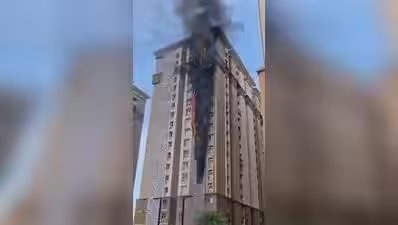
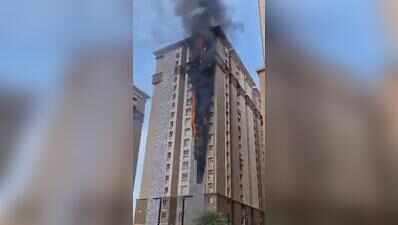
Hyderabad: Following Thursday’s fire at a high-rise building in Puppalaguda, concerns have once again surfaced over fire safety preparedness in Hyderabad’s rapidly expanding vertical landscape.With the fire department’s hydraulic skylifts capable of reaching only about 30 metres (approximately 9 to 10 floors), external firefighting and rescue operations become increasingly difficult in taller buildings. This makes functional internal firefighting systems and effective evacuation mechanisms critical.According to fire officials, under the National Building Code (NBC), buildings above 15 metres are classified as multi-storeyed buildings, while those measuring 24 metres and above are categorised as high-rises under revised norms, compared with the earlier threshold of 18 metres.Fire safety requirements, including extinguishers, pump rooms and sprinklers, vary depending on a building’s height. An official said limited manpower makes it difficult for the department to inspect and monitor every building regularly.“Each Residents’ Welfare Association (RWA) is responsible for maintaining fire safety equipment and conducting mock drills at least once every six months. However, compliance remains a concern. In several buildings, adequate attention is not given to the maintenance of fire extinguishers, pumps, sprinklers and smoke detectors. Some RWAs also hesitate to spend on annual maintenance, leaving critical systems potentially non-functional during emergencies,” the official said.However, in Thursday’s fire at Pacifica Hillcrest, officials said most of the building’s fire safety equipment was in place and played a crucial role in containing the blaze.“Installed hydrants and internal fire protection equipment helped contain the blaze and prevent greater damage,” the official added.With more than 850 high-rise buildings in the pipeline across Hyderabad, these concerns assume greater significance. The list includes a proposed 72-storey tower in Ghatkesar that has received provisional approval and is being touted as one of South Asia’s tallest buildings.Pujitha Balireddy, a high-rise resident and treasurer of the United Federation of RWAs (UFERWAS), Cyberabad, flagged the use of combustible fibre-reinforced plastic (FRP) sheets to conceal external utility pipes. “Combustible materials could accelerate the vertical spread of flames. Fire safety is not merely about obtaining a Fire NOC or installing equipment; regular maintenance is equally important,” she said.At Pacifica Hillcrest, AC compressors inside ducts were covered with FRP sheets, which are suspected to have contributed to the fire spreading from the eighth to the 18th floor.“There is currently no alternative to covering these ducts, but they need to be maintained properly. The gas pipelines installed as per safety norms remained unaffected as the fire was contained in time. Sprinklers were installed in halls and bedrooms, but not in bathrooms and kitchens, where the fire originated,” said Ganesh Reddy Keesara, general secretary of Hillcrest.Keesara urged residents to learn how to operate fire extinguishers and participate actively in emergency preparedness, noting that mock drills conducted by the fire department must be complemented by resident awareness.Experts also warned that some developers compromise on safety during construction, while RWAs subsequently neglect maintenance to cut costs. Annual fire safety maintenance, they pointed out, could cost just an additional 25–40 paise per square foot.Citing Dubai as an example, experts said strict compliance and reliable safety systems help limit casualties despite thousands of fires being reported annually.“There is a need for both professional and public awareness. In the second phase, we will also involve RWAs and residents,” said Srinivas Valluri, national president of the Fire and Security Association of India (FSAI).He urged builders and RWAs to adopt FSAI’s voluntary Suraksha Index (FSI), a fire and security rating system that evaluates buildings through audits by accredited professionals.SP Anchuri, vice-president of the Council for Fire & Life Safety Professionals (CFLS), stressed that fire safety must extend beyond statutory compliance to building design, construction and maintenance, with reliable internal protection, smoke management and evacuation systems.