









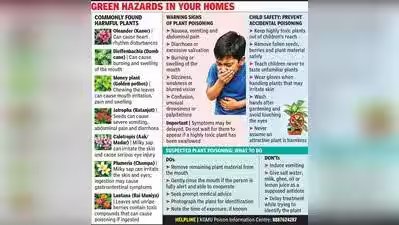
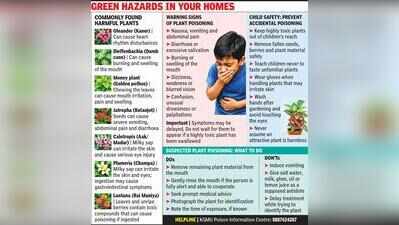
Lucknow: That attractive money plant hanging by your window, the peace lily brightening your living room or the oleander blooming in your garden may be decorative but also pose health risks if their toxic parts are swallowed, experts from King George’s Medical University warned on Thursday.At an awareness programme, department of forensic medicine and toxicology’s Prof Shiuli Rathore said toxic substances in several ornamental plants often go unnoticed.Toxins in oleander, popular as kaner, can affect the heart, causing changes in its rhythm. Dieffenbachia, or dumb cane, can trigger severe burning and swelling in the mouth if chewed, while the milky sap of plumeria (champa) can irritate the skin and eyes.Latex in calotropis (aak or madar) can irritate skin and injure eyes seriously, while the seed of jatropha (ratanjot) can cause severe nausea, abdominal pain and diarrhoea. Experts also warned about lantana leaves and unripe berries, clematis, allamanda and adenium.Prof Rathore said children are vulnerable to accidental plant poisoning as they often put leaves, flowers, fruits or seeds in the mouth. Their lower body weight can make the effects of toxins more severe, while they may not even be able to tell what they have swallowed.KGMU vice-chancellor Prof Soniya Nityanand said the university recently inaugurated a Toxicology Garden, Kashyap Upvan, to create awareness about poisonous plants and visits to the garden can be arranged with prior permission.Early symptoms of poisoning may include nausea, vomiting, abdominal pain, diarrhoea, excessive salivation, dizziness and weakness. Depending on the plant involved, poisoning can blur vision, cause delirium, drowsiness, palpitations and changes in heart rate.In suspected poisoning cases, parents should remove any remaining plant material from the child’s mouth and seek medical advice without delay. Experts advised against inducing vomiting or using home remedies such as salt water, milk, ghee or oil.They said a photograph of the plant may help doctors identify the source of poisoning, but treatment should not be delayed.KGMU’s Poison Information Centre can be contacted at 8887624287 for poisoning-related guidance, while people experiencing severe symptoms should seek emergency medical care immediately.