









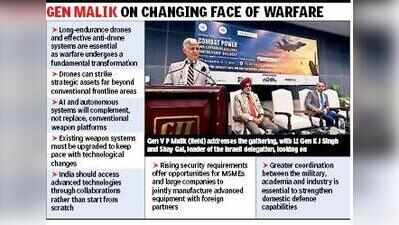
Chandigarh: In a multi-institutional initiative between Gyan Setu Think Tank and Chandigarh Citizens Foundation (CCF), a Combat Power and Capability Building Partnership Dialogue between Israel and India institutions was held at CII Headquarters on Thursday.This initiative aimed at examining the industrial and partnership architecture required to sustain India’s overall combat capability and further the atma nirbharata (self-reliance) mission. It brought defence planners, procurement specialists, industry and researchers together around three critical decisions: What India must control, what it can assure through partnerships, and what it must be able to substitute before a crisis.The Israeli delegation was led by Shay Gal, founder and principal of Line of State, a strategic practice working with govts, institutions and decision-makers on strategy, risk, access and security.The Indian side was represented by a galaxy of Indian military professionals including Lt Gen K J Singh, the convener and director of Gyan Setu, retired military Commanders, media and academic professionals besides industrialists. He emphasised the requirement of technology partnership as also working on retrofitting to extend the lifespan of legacy platforms.Delivering the keynote address, Gen V P Malik (Retd), former Chief of Army Staff and CCF chairperson emphasised the changing nature of warfare and the need for Indian security apparatus to keep pace with the growing threats to India’s security.He flagged recent confrontations on our borders and underscored the need for the military, academia and the industry to work in sync towards making India Atma-Nirbhar in its weapons and equipment supply chains.Gen Malik said India’s defence industry is poised for significant growth, with rising security requirements creating opportunities for MSMEs as well as large corporations to collaborate with foreign companies and manufacture advanced equipment jointly in India.He stressed that India should leverage foreign partnerships to bring state-of-the-art technologies into the country rather than start from scratch or retrace technological ground already explored by others.The focus, he said, should be on taking a leap forward in capabilities, with govt support helping the domestic industry achieve that transition. Identifying drone warfare as a major area of investment, Malik said the battlefield had undergone a fundamental transformation, making both long-endurance drones and effective anti-drone systems essential.Citing the Ukraine conflict, he noted that drones can strike strategic assets far beyond conventional frontline areas, making such capabilities increasingly important for India. He also emphasised the growing role of artificial intelligence and autonomous systems, while cautioning that these would complement rather than replace conventional weapons platforms. Existing weapons systems must continue to be upgraded and made more capable to keep pace with technological change.India, he said, should strengthen cooperation with countries that have stood by it, adding that international partnerships would be crucial to building a stronger and more self-reliant defence ecosystem.The exchange was focused on four priority areas- Indigenisation, multi-domain integration, strategic partnerships and technology transfer and wartime sustainment.The event was conducted over four very absorbing sessions.Session 1 focused on lessons from the Iranian attacks and preparation for sustained operations – Shay Gal gave an expose on the Israel – Iran war and the development of Israeli sovereign combat capability, constraints encountered, air and missile defence, technological change, and experience with US technology cooperation and transfer. He spelt out operational lessons with integration, repair, replenishment and the ability to adapt during a conflict.Session 2 on air defence was delivered by Lt Gen VK Saxena, ex DG AAD and Maj Gen Mandip Singh, Strategic Advisor of DC&T Defence. It covered the major shift in Air Defence strategies and application of Counter Unmanned Autonomous systems (CUAS) in contested air spaces. In particular, both made emphatic points about the disruptive and transformational impact of drones and autonomous systems in recent wars, forcing militaries to review their doctrines and methods of war fighting.Session 3 focused on weapon systems and munitions. It was chaired by Lt Gen Anil Ahuja and co-chaired by Lt Gen Sanjay Verma. Discussions revolved around weapon systems, especially ISR systems and munitions that have been inducted in militaries as a consequence of recent wars.The major realisation has been the devastating impact of drones and missiles and the advent of multi-domain operations (MDO) that has widened the envelope of the battlespace to include space, cyber and cognitive domains, in addition to the traditional land, sea and air. New developments in these domains provided an interesting opportunity for the industry to understand areas requiring R&D and manufacturing in the defence space.Session 4 on takeaways for the industry was chaired by Lt Gen J P Singh. It focused on developing an understanding between the military’s needs and the industry’s capacities and capabilities. Areas of joint cooperation and transfer of technology with Israeli industry was discussed with industrialists from the Northern region. The Israeli delegation also spelt out areas of cooperation and collaboration that could mutually benefit both countries.“Such events act as a platform to bring all stakeholders together on one table”, said Lt Gen K J Singh. He emphasised that “self-reliance is sine qua non for India and the military has to place its faith and trust in our vast industrial complex to achieve the goal of Atma-Nirbharta”. Representatives from various defence organisations in the region like TBRL and BRD were also present along with the representatives from various academic institutions.BOX 1 | Gen Malik on changing face of warfare— Long-endurance drones and effective anti-drone systems are essential as warfare undergoes a fundamental transformation— Drones can strike strategic assets far beyond conventional frontline areas— AI and autonomous systems will complement, not replace, conventional weapon platforms— Existing weapon systems must be upgraded to keep pace with technological changes— India should access advanced technologies through collaborations rather than start from scratch— Rising security requirements offer opportunities for MSMEs and large companies to jointly manufacture advanced equipment with foreign partners— Greater coordination between the military, academia and industry is essential to strengthen domestic defence capabilities