








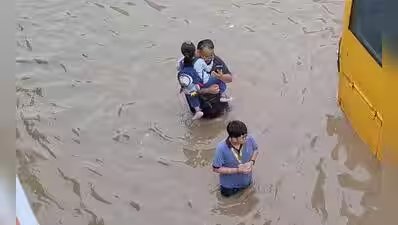
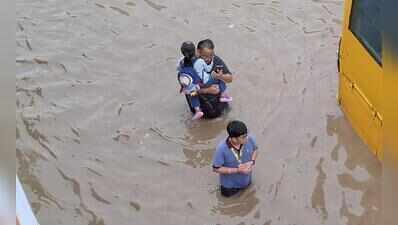
Gurgaon: A six-year-old on his mother’s shoulders. Schoolchildren crying in buses, hungry and desperate to reach home. Commuters inching through flooded roads, taking hours to cover a few kilometres.For the city’s residents, the frustration was not with Monday’s rain. But with what followed — waterlogged roads, paralysed junctions and an absence of coordinated traffic management that turned routine journeys into hours long ordeals. In a city of gleaming towers, corporate offices and some of the country’s highest property prices, getting home safely, they said, should not become an endurance test every time the skies open up.“If the city consistently fails to keep its roads moving when it rains, what exactly are we paying taxes for?” asked Gursimran Singh, a resident of Peaceful Homes.For Vaibhav Chauhan, a CHD Avenue 71 resident, the answer was visible on Sohna Road, where he spent 1.5 hours covering barely 1km. “A smooth commute is the minimum civic guarantee a city should provide. But Gurgaon is unable to provide even that,” Chauhan said.“Cars were submerged, buses were lined up and there was complete chaos. You cannot expect people to spend one and a half hours covering a kilometre. We are not saying authorities should control the rain. Heavy rain can happen. But a city like Gurgaon has to be prepared. People have jobs, children have schools and families have responsibilities. Getting home safely should be the bare minimum,” he added.For schoolteacher Shalini Kulshrestha, who has worked in the city since 2009, the ordeal was more distressing because of the children travelling with her. A 17km journey after school gave over took nearly 4.5 hours.“I have seen traffic jams in Gurgaon over the years, but never anything like this. Imagine children sitting in a bus for so long. They were hungry and needed to use the washroom. The younger children started crying. We could not stop anywhere because the roads were flooded and there was no safe place to take them,” she said.
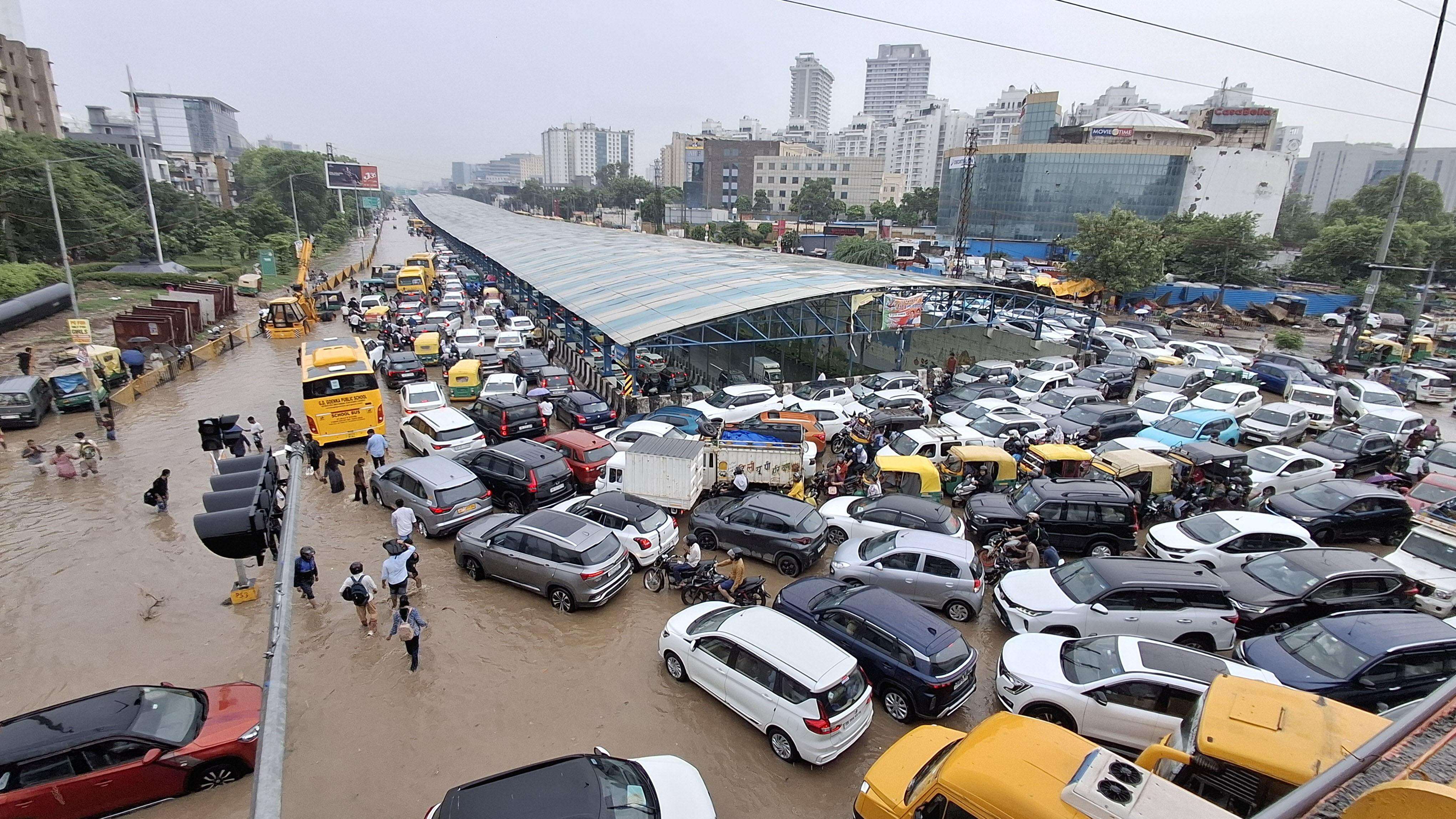
As vehicles moved at a snail’s pace, many spent hours on the road on their way back home
Older students sang to distract the younger ones, but the ordeal dragged on. “How long can you expect a child to sit in a bus like that?” she asked.Several school buses were caught in similar snarls, causing some children to reach home only around 8pm. “As parents and citizens, we expect the bare minimum — that our children should reach home safely. We cannot keep shifting to online classes every time it rains. Rain cannot be allowed to disrupt both children’s education and safety,” Kulshrestha said.For Malibu Towne resident Namisha Parihar, the crisis became personal when she had to leave her car and carry her six-year-old son through knee-deep water.Parihar, who works in Delhi, reached Sector 46 around 4.30pm after picking up her son from daycare. A journey that normally takes 10 minutes spanned almost two hours.“The rain had stopped, but the water was still there. It was not receding. I had no option but to park my car and carry my six-year-old on my shoulders for around 500 metres through knee-deep water,” she said.“Why should a mother have to carry her six-year-old through knee-deep, dirty water just to get home? This is Gurgaon, not some remote place without basic infrastructure. At some places, traffic police were present. But there was no coordinated traffic management. Everyone was simply left to fend for themselves,” Parihar said.For Sector 70A resident Priyanka Srivastava, the worst part was knowing her daughter was stranded in a school bus near Subhash Chowk and being unable to reach her. “At one point, I called 112 five times and shared the location of the bus. But there was no immediate help. As a parent, you feel completely helpless,” she said.Her husband tried reaching the bus on a two-wheeler, but knee-deep water made even that impossible. “Imagine knowing that your child is sitting somewhere in a stranded bus and you cannot even get to them,” Srivastava said.Teachers kept the children calm with biscuits and activities. “I am grateful to them. But teachers should not have to become the emergency response system. Parents should not have to call police repeatedly. And seven or eight-year-old children should not be sitting in a bus for hours because the city’s roads have become impassable,” she said.