









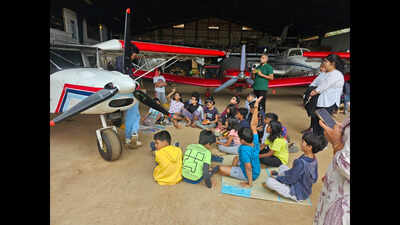
While most children spend their days in classrooms, Bengaluru’s homeschoolers are often found in parks, libraries, community halls and parents’ homes — notebooks, craft supplies and questions in hand.A growing number of parents in the city are embracing homeschooling not as a solitary pursuit, but as a shared, community-driven approach to education. From informal meet-ups and parent-led science clubs to webinars, mentoring sessions, field trips and treks, families are building networks that combine flexibility, peer interaction and alternative learning.“Recently, I organised a market day for children,” says Supriya Narang, mother of 13-year-old homeschooler Sam and curator of the Bangalore Homeschooling and Unschooling Community, which has around 700 WhatsApp members.Community As A Support System For 12-year-old Dhruv Dangarikar of Whitefield, a small local group of five to six children and their parents has become an important support system.“The activities are planned together by the children and parents. It is not rigidly parent-led,” he says.Dhruv’s family chose homeschooling during the Covid years after finding that learning through play, reading and everyday activities worked well for him. His mother, Unmeshi, who was then a homemaker, spent long hours with him. She now runs a drug-testing lab and cosmetics business, and Dhruv sometimes accompanies her to work.“We don’t follow a fixed curriculum. Instead, we build learning around Dhruv’s interests — cricket, chess, board games, science, history and geopolitics,” Unmeshi says.Before the pandemic, community gatherings at Cubbon Park gave children opportunities to learn, play and socialise.Learning At Their Own PaceFor Nisha Purushothaman, mother of two daughters aged 18 and 13, being part of Bengaluru’s homeschooling community feels like raising a child with the support of a village.Her elder daughter was homeschooled for two years after Covid, while her younger daughter continues to be homeschooled.“The community has given my children access to tutors in crocheting, painting, clay modelling, cooking, baking, s i n g i n g , drumming and even French. More importantly, you meet like-minded parents who help guide and nurture your child,” she says.Many families do not strictly follow the National Institute of Open Schooling (NIOS), Cambridge International General Certificate of Secondary Education (IGCSE) or state board curricula. Instead, they use textbooks as reference material while allowing children to read and explore beyond prescribed syllabi.“We use those textbooks for structured learning, but a significant part of the education comes from reading beyond textbooks,” Unmeshi says.She adds that those who want to pursue higher education can choose IGCSE or NIOS that even help keep options like engineering and medicine open.For Purushothaman’s daughters, Ronika and Tashi, learning has often happened outside textbooks. During a farm visit, they learnt how dragon fruit is grown, packaged and sold. Homeschooling has also given Tashi the space to study at her own pace. “I chose commerce with statistics, accounting and business studies, and was able to self-study without much difficulty. Homeschooling has helped develop my research and analytical skills,” she says.Letting Passions UnfoldFor many parents, homeschooling is also about allowing children’s interests to develop naturally. “The journey becomes simple and natural when one is open to unlearning and relearning,” says Tejaswini, mother of an 11-year-old homeschooler and a member of several city homeschooling groups.“Children come into the world with a deep sense of wonder and curiosity. The challenge is to recognise it and nurture it in whatever form it takes,” she says.Bengaluru fitness trainer Suma has homeschooled her nine-year-old son, Yuvaan, from the start, encouraging his interests asthey emerge. “Yuvaan is interested in Lego and Hot Wheels, and is exploring dance and painting. He is also learning about aeroplanes from an older homeschooled student,” says Suma, a member of the Bangalore Home-schooling Community.She says interactions with experienced parents help reassure families who are new to homeschooling.Narang, who supports the countrywide homeschooling network Swashikshan, says these communities make homeschoolingmore sustainable by helping families exchange ideas, resources and reassurance.For parents like Purushothaman, the experience has reinforced their choice. “Given a chance, I wouldn’t have it any other way,” she says.…………………………………………………………………………………………………………………………………………………………The homeschooling community has introduced me to activities such as carpentry and rocket-building. Homeschool markets give children a chance to sell handmade items, while sports days help us learn about teamwork and competition. I enjoy homeschooling because it gives me time to explore the activities I loveSupriya Narang | CURATOR, BANGALORE HOMESCHOOLING AND UNSCHOOLING COMMUNITYThe homeschooling community has introduced me to activities such as carpentry and rocket-building. Homeschool markets give children a chance to sell handmade items, while sports days help us learn about teamwork and competition. I enjoy homeschooling because it gives me time to explore the activities I loveYuvaan | 9, SESHADRIPURAMWe took part in an aviation workshop at Jakkur aerodrome, where we learnt about the parts of an aircraft, key instruments, the cockpit, the runway and the importance of pre-flight checks. A noodle-making project at a hydroponics farm helped us understand hydroponics, cooking and teamworkRonika |13, INDIRANAGARI don’t have to worry about traffic. I wake up around 8.30 am, eat a proper breakfast, and have time for reading and physical activity. In the mornings, I meet my friends, play cricket and board games. We go to farms and bakeries, attend pottery workshops, get books from shops on Church Street, and share them with each otherDhruv Dangarikar | 12, WHITEFIELD