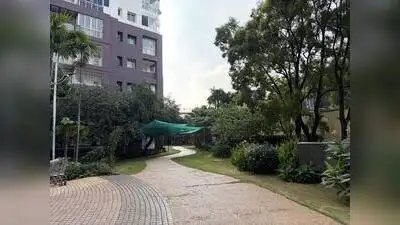






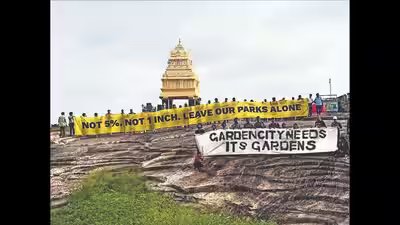
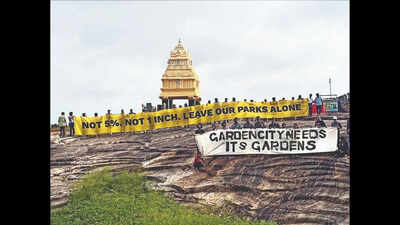
The debate over Karnataka’s decision to allow up to 5% of government park and garden land for public infrastructure and the Hebbal–Central Silk Board tunnel road has intensified, leading citizens and environmental groups to form a human-chain protesting the amendment.The Karnataka legislature passed the Karnataka Government Parks (Preservation) (Amendment) Bill, 2026, on August 24, allowing up to 5% of the total area of a government park or garden to be alienated for specified public infrastructure and utility projects. The Bill was passed by both Houses amid Opposition protests and without substantive debate.The timing has drawn particular attention in Bengaluru because the proposed Hebbal–Central Silk Board tunnel road is expected to pass through a portion of Lalbagh. While critics have alleged that the amendment could help clear a legal hurdle for the project, the state government has maintained that the provision is intended for public utility projects and comes with safeguards, including scrutiny by a high-level committee.Citizens take the protest to LalbaghThe opposition is now moving beyond political statements, with citizens, walkers’ groups and environmental activists acting against the parks amendment.A human chain of citizens, resident groups and organisations came together at Lalbagh on Thursday morning calling the protest – #BLRRising, to defend Bengaluru’s parks against the proposed Parks Amendment that would allow 5% of a park or garden to be used for infrastructure and utility projects.A citizens’ campaign seeking withdrawal of the amendment has also gathered thousands of signatures, with residents arguing that Bengaluru needs more accessible green spaces rather than provisions that could allow portions of existing parks to be diverted.‘Tunnel will pass under a small corner of Lalbagh’Defending the amendment, Chief Minister DK Shivakumar has sought to downplay its impact on Lalbagh, saying the tunnel would pass under only a small corner of the botanical garden.“The tunnel road is proposed to pass beneath one small corner of Lalbagh. We may need park land temporarily for deploying machinery for six months to one year. After that, we do not need the park land,” he said on Wednesday.‘A dangerous precedent’Adding weight to the concerns, earlier this week, former Karnataka forest, ecology and environment secretary, AN Yellappa Reddy has urged Chief Secretary Shalini Rajneesh to reconsider and drop the proposed amendment.In the letter the retired forest officer noted that what appears “harmless on paper” will have larger consequences. “Once a general principle is introduced permitting portions of protected parks to be made available for infrastructure, what begins as an exception today can slowly become an administrative practice tomorrow. Today it is 5 percent, tomorrow somebody may find a justification for 10 per cent, 20 per cent or even 50 per cent,” he added.Further, he noted that Lalbagh and Cubbon Park are not commodities and their ecological value must not be ignored. “This is not a supermarket where public assets can be offered at a 5 per cent discount today and a larger discount tomorrow. Nature cannot be negotiated in percentages. Once an old tree is gone, a landscape fragmented or an ecological system disturbed, no accounting exercise can restore what generations took to create,” he added.BOX | What exactly does the Bill mean?*The proposed amendment would: Allow up to 5% of the total area of a government park or garden to be alienated for specified public purposes.*Permit alienation through sale, lease, gift, exchange or mortgage.*Restrict the provision to government departments, statutory authorities, state-owned companies and local authorities.*Allow the land to be used for public infrastructure or utility projects.*Provide for scrutiny of proposals through a high-level committee.*The 5% ceiling would take into account park land that may already have been alienated, rather than automatically creating an additional 5% quota.*In simple terms: If a park is 100 acres, up to five acres could potentially be diverted for an eligible public project, subject to the proposed approval process.