







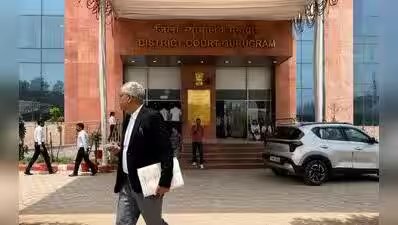
Gurgaon: More than a decade after a man was accused of impersonating an SBI customer to withdraw Rs 3.7 lakh using forged signatures, a city court has acquitted him, holding that the prosecution failed to establish his involvement through legally admissible and conclusive evidence. Additional chief judicial magistrate Manish Kumar acquitted Fakir Chand alias Sanjay, a Faridabad resident, of charges of cheating, impersonation and forgery, observing that the CCTV footage relied upon by investigators was inadmissible in the absence of a mandatory certificate, while the forensic report failed to conclusively link him to the forged signatures.In Nov 2015, two withdrawals of Rs 1.8 lakh and Rs 1.9 lakh were made on consecutive days from the savings account of Madan Mohan at SBI’s Shivaji Nagar branch. Both withdrawal forms bore signatures purportedly belonging to the account holder. When Mohan approached the bank, he denied making the transactions and alleged that someone had impersonated him. Following a complaint by the then branch manager Vinay Singhal, an FIR was registered in Jan 2016. Police arrested the accused — Fakir — the following month and claimed to have recovered Rs 20,000 at his instance.However, the court flagged the absence of an independent bank witness identifying the accused, lack of independent corroboration of the Rs 20,000 recovery and discrepancies in the investigation, including cuttings in the date recorded beneath the investigating officer’s signature on a disclosure statement. Holding that suspicion, however strong, could not substitute proof beyond reasonable doubt, the court extended the benefit of doubt to Fakir Chand and acquitted him of all charges.The prosecution argued that the account holder’s testimony, CCTV footage, forensic examination and recovery established the accused’s involvement. The state maintained that the FSL report confirmed that the signatures were imitations and that the possibility of the accused having written the questioned material could not be ruled out.However, defence counsel DC Gupta argued that the CCTV footage could not be admitted as evidence because the prosecution had failed to produce the mandatory certificate under Section 65-B of the Indian Evidence Act. The bank vendor who extracted the footage was also never examined. He contended that the FSL report did not positively identify the accused as the person who forged the signatures. Agreeing with the defence, the court held that the CCTV footage could not be used to establish the accused’s identity. It also noted that the forensic expert had declined to express an opinion linking the questioned signatures to the accused’s specimen signatures.