







Great Barrier Reef: Scientists mapped the invisible microbiome of the Great Barrier Reef and found more than 500 new bacterial species and over 300,000 viruses in its waters

The Great Barrier Reef near the Whitsunday, Australia, region is viewed from the air (AP photo) Scientists have completed the first comprehensive survey of the microscopic life living in the open waters of Australia’s Great Barrier Reef. They have uncovered hundreds of bacterial species which were not know previously and hundreds of thousands of viruses.The…

Read More

These 95-million-year-old flowers bloomed before bees existed and still attract beetles |

Image(s): Smithsonian Gardens Magnolia trees are admired around the world for their large, fragrant flowers, but they also preserve one of the oldest evolutionary stories in the plant kingdom. Long before bees, butterflies or many modern flowering plants appeared, magnolias were already blooming across prehistoric landscapes. Fossil evidence suggests the ancestors of modern magnolias evolved…

Read More

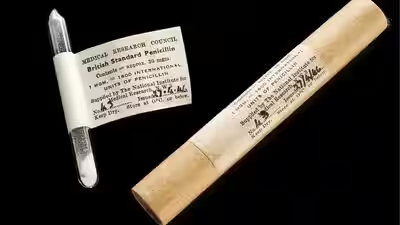
Quote of the day by Alexander Fleming: “I did not invent penicillin. Nature did that. I only discovered…” – why one accident changed the history of medicine |

Two scientists can notice the exact same odd result in a failed experiment and walk away from it completely differently. One sees a ruined sample, clears it off the bench, and moves on to the next attempt. The other stops, looks closer, and asks what could have caused something that was never supposed to happen….

Read More

Meet Evan Budz: The 16-year-old Canadian who built an AI-powered robot turtle to detect microplastics with 94% accuracy |

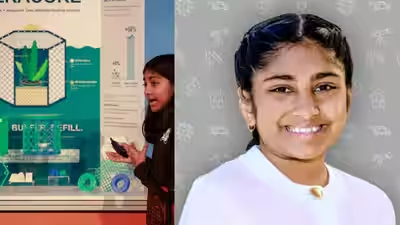
At just 16 years old, Canadian student Evan Budz has developed an autonomous AI-powered robot turtle that could help scientists tackle one of the world’s fastest-growing environmental problems: microplastic pollution. Inspired by the graceful swimming of a snapping turtle he encountered during a family camping trip, Budz spent nearly 4,000 hours designing and refining a…

Read More

Thousands of idle ships trapped near the Strait of Hormuz could become floating nurseries for invasive marine species and spread them worldwide when trade resumes |

(Representative Image) Image source: Getty Images Having escalated into open hostilities on February 28, 2026, the current United States and Iran war has been going on for nearly five months. In this period, the Strait of Hormuz, the only open-ocean exit for major producers like Saudi Arabia, Iran, Iraq, Kuwait, and the UAE has been…

Read More

Orcas in the Gulf of California were filmed using a coordinated ramming technique that made a giant sunfish break into thousands of pieces, possibly to help a juvenile feed

The animals worked together to hold and ram giant sharp-tail sunfish. (Picture: Live Science) Orcas have been filmed using a hunting technique that scientists say has not been recorded before. Researchers observed the marine predators working together to hold and ram a giant sunfish so forcefully that its body broke into thousands of small pieces.The…

Read More

Arctic: Climate change is making Beavers expand into Canada’s Arctic, where their dams are changing the landscape

North American beavers began colonising parts of Arctic in 2008. (Getty images) Beavers who are normally found in forests and woodlands, are steadily moving farther north into the Canadian Arctic. A new study has found out when they reached different parts of the Arctic by studying scars on shrubs and comparing them with satellite images…

Read More

A fossil remained trapped inside a Japanese museum rock for 30 years. Scientists now think it may belong to an unknown sea reptile

Remains of an undiscovered species of mosasaur Let us accept it: science never fails to amaze the human mind, and sometimes, the greatest science isn’t happening in deserts or deep oceans. It’s hiding in museum collections, waiting for a second look. That’s exactly what happened in Japan, where a fossil remained buried in a rock…

Read More