






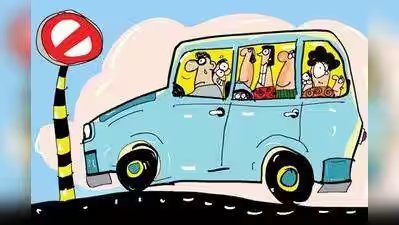
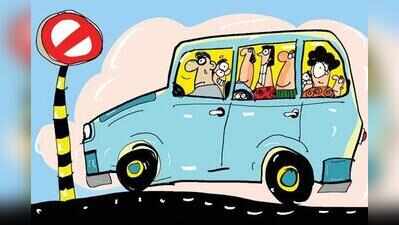
Noida: A family visit, a daily office run or a trip to India Gate on a winter morning could soon mean a change of vehicle, a longer commute or an extra bill for many NCR residents.With non-BS-VI petrol and diesel vehicles set to be barred from entering Delhi from Nov 1, commuters are weighing travel options to keep their plans on track – from carpooling to two-wheelers and the metro.“My family was supposed to visit me after Diwali, but now what? I will have to book a cab every time and show them around Delhi,” said a Noida resident whose car will soon not be eligible to enter the capital. For him, a family outing has turned into an additional expense even before the visit begins.For daily commuters, the bigger challenge is finding an alternative that fits into an already tight morning schedule.Brajesh Sharma, a Sector 78 resident who owns a BS-IV car, said he and two colleagues from the same society were considering travelling together in one BS-VI vehicle. All three work in the same office.“What option do we have? We will share a car. There are three of us living in the same society in Noida and working in the same office. One of us has a BS-VI vehicle. So, we will travel together. But this is not sustainable in the long run. It feels autocratic,” Sharma told TOI.Metro is another option, but not necessarily a convenient one for everyone. Sharma said changing lines and walking between stations during the morning rush could add to the strain of getting to work on time.“Many people suggest taking the metro, but changing stations and walking around crowds first thing in the morning is not something you want to do. We are already running late in the morning,” he said.The uncertainty is not limited to just office journeys. Residents who use their own cars for shopping, appointments and social visits to Delhi will have to consider whether to take public transport, hire a cab or arrange a lift in a compliant vehicle. Some are also considering two-wheelers for local travel, although that may not be practical for every journey or family.The restrictions, announced by Commission for Air Quality Management (CAQM), are part of efforts to tackle worsening air pollution during winter, when emissions combine with unfavourable weather conditions to trap pollutants over the region. The entry curbs are on non-BS-VI petrol and diesel vehicles registered outside Delhi. The same curbs are not across entire NCR.The scale of the challenge is evident from transport department’s figures. Ghaziabad has around 5.4 lakh vehicles that are not BS-VI-compliant, spanning different emission categories, including BS-III and BS-IV. Noida has around 7 lakh BS-VI-compliant vehicles, while nearly 1.5 lakh fall under BS-III and BS-IV categories. Of these, around 1 lakh are BS-IV vehicles and 51,000 are BS-III.Ashok Kumar Srivastava, assistant regional transport officer (administration) in Ghaziabad, urged transport businesses, unions and vehicle owners to familiarise themselves with the rules. He advised owners to check their vehicles’ Bharat Stage emission categories and understand the restrictions before travelling to the capital.Some residents, meanwhile, have questioned whether carpooling and valid pollution-under-control (PUC) certificates could be considered while framing the restrictions.“Why can’t govt allow us to carpool? If two or more people are travelling in a BS-IV car, how is that a problem? And what about the PUC certificate issued by govt? The objective is to keep polluting vehicles off roads. If my vehicle has a valid PUC certificate, how does it matter whether it is BS-III or BS-IV?” asked Jitendra Kumar, a resident of Mahagun Moderne in Noida.