






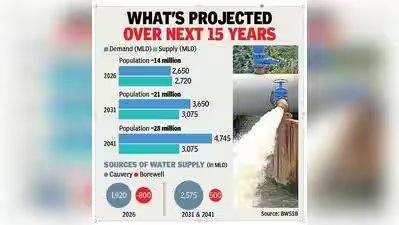
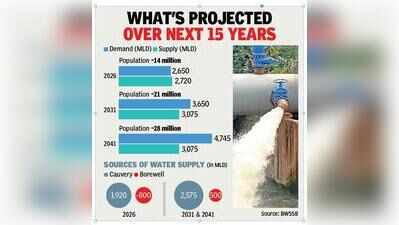
Bengaluru: The city’s water utility has added 2,196sqkm of service area to its jurisdiction, nearly three times the roughly 800sqkm it previously served, significantly expanding its responsibility for water supply, sewerage and drainage.Bangalore Water Supply and Sewerage Board (BWSSB) must now plan services for the new areas while nearly half of Bengaluru’s 2,580 MLD of sewage remains untreated or improperly treated.The utility’s existing jurisdiction covers the core city, the erstwhile seven city municipal councils, one town municipal council, and 110 villages. A master plan for the added areas will assess current and future populations, topography and geography, and create a GIS-based database of water, sewerage and drainage networks.The newly merged villages and peripheral layouts require transmission mains, distribution networks, reservoirs, pumping stations and service connections. BWSSB has not given a timeline for full coverage.Cauvery water travels nearly 140km and is pumped about 450 metres, making Bengaluru’s urban water system among the country’s most energy-intensive. BWSSB said demand for Cauvery connections has increased as groundwater levels fell and borewell yields became unreliable. Its Sarala Cauvery initiative offers EMI-based payments for new domestic and non-domestic piped connections.Supply & reuseThe recently commissioned Cauvery Water Supply Scheme Stage V has added 775MLD and extended services to peripheral areas. Stage VI, expected to add 500 MLD, is in the planning stage, while Yettinahole is being considered as a longer-term supplementary source.According to BWSSB, continued dependence on Cauvery transfers is unsustainable. About 805 MLD of treated wastewater, roughly 60%, is reused for minor irrigation, lake rejuvenation and industry. The board is also promoting rainwater harvesting, groundwater recharge and reduced distribution losses.BWSSB expects near-complete sewage treatment by 2029 through 45 new sewage treatment plants with a combined capacity of 1,163 MLD. Existing and proposed capacity would total about 2,511.5 MLD, still below the present sewage generation of 2,580 MLD.The board has not disclosed how many plants fail quality standards or operate below capacity, or whether contractors face penalties for repeated violations. An independent audit is under way, while Indian Institute of Science is assessing the quality framework. A real-time dashboard monitors treated water against Karnataka State Pollution Control Board standards, but BWSSB did not say whether plant-wise results would be published. The annual operation and maintenance expenditure is Rs 200 crore.Demand outlookThe city’s demand is 2,650 MLD, against supply of 2,720 MLD, including about 800 MLD from borewells. With population projected to hit around 21 million by 2031 and 28.3 million by 2041, the deficit is expected to reach 575 MLD and 1,670 MLD, respectively.