







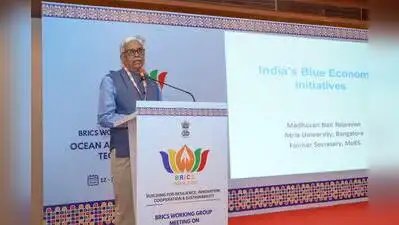
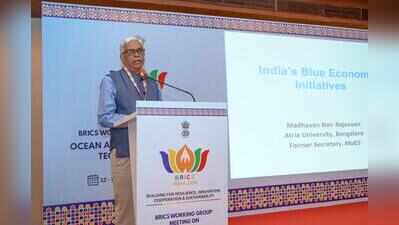
Panaji: The three-day meeting of the BRICS Working Group on Ocean and Polar Science and Technology (OPST) began on Wednesday, with delegates from 11 member countries discussing a medium-term roadmap for cooperation in marine sciences and polar exploration.“The purpose of this particular workshop will be to discuss more areas where we could find common platforms and, most importantly, areas where we can do something in an integrated way,” said National Centre for Polar and Ocean Research (NCPOR) director Thamban Meloth.The meeting aims to establish short- and medium-term goals for OPST cooperation among BRICS nations. “Currently, we are mostly doing it (studies and collaboration) in a bilateral way, so can we make it in a larger way with specified areas and specific goals? This is something which we want to discuss here,” Meloth said.He said while all BRICS members depend on the oceans, not every country has expertise in comprehensively exploring polar regions and ocean depths.“We hope to come up with some kind of a solution, as it may not be possible that every BRICS member has expertise in every area. So there could be some bilateral collaborations happening on the sidelines of this meeting as well as some multilateral collaborations,” said Meloth, who represents India on the International Arctic Science Committee council, Scientific Committee on Antarctic Research and Antarctic Treaty Consultative Meeting.Delegates from Brazil, Russia, India, China, South Africa, Egypt, Ethiopia, Iran, Saudi Arabia, the UAE and Indonesia are participating.Former earth sciences ministry secretary and climate scientist Madhavan Nair Rajeevan stressed the need for sustainable marine exploration.“While we focus on economic activity related to the blue economy, it is important to ensure sustainability and protect the oceans,” he said, citing concerns over marine pollution, rising ocean temperatures, coastal erosion, changing currents, rising sea levels, ocean acidification and global warming.