









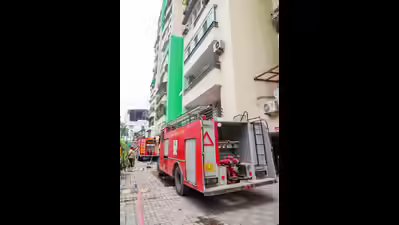
Ghaziabad: Owners of buildings exceeding 15 metres in height or having a floor area above 500 square metres (sqm) but lacking a valid fire no-objection certificate (NOC) will have to bear the full cost of any firefighting operation, chief fire officer Rahul Pal said on Monday. The warning came as the fire department issued notices to 43 housing societies across Indirapuram, Crossings Republik, Raj Nagar Extension, among others, for lacking fire safety equipment or having systems that are non-functional.Over the past 15 days, officials inspected more than 165 societies and found multiple violations, including encroachments and blocked access for fire tenders — a drive triggered by a fire at Gaur Green Avenue in Indirapuram, where a blaze on the ninth floor of a tower gutted eight flats across five floors. A probe flagged unauthorised constructions blocking emergency access to the tower and failure to maintain fire safety systems as factors that allowed the fire to spread rapidly across floors.Pal said more than 40% of buildings inspected held a fire NOC but had poor firefighting arrangements on the ground. Those served notices — including Rio Heights in Indirapuram and Ajnara Gen-X in Crossings Republik — have been given 15 days to rectify deficiencies, after which action will follow.A senior official said the absence of NOCs in many buildings came down to two factors: owners unwilling to spend on equipment or meet compliance norms before applying, and older buildings in congested areas lacking the space for emergency exits or four-sided fire tender access.Under department guidelines, buildings below 15 metres and under 500 square metres are exempt from mandatory NOC and equipment requirements, though Pal said the department was directing even these structures to install basic fire safety measures.For buildings above the threshold — over 15 metres in height or more than 500 square metres in floor area — owners without a valid NOC will be liable to bear the costs incurred by the fire department during any firefighting operation under the Uttar Pradesh Fire and Emergency Services Rules, the CFO said.Pal, meanwhile, identified short circuits as the leading cause of fire incidents. “Nearly 90% of fires break out due to short circuits in houses, industrial units and other places. During summer, people use more electrical appliances, including fans, coolers and air conditioners. The increased load causes overheating, and the atmospheric heat compounds the problem, triggering sparks and fires,” he said.He advised RWAs or AOAs to conduct regular electrical audits and ensure fire safety systems were properly maintained. Emergency exits, he stressed, must be kept unobstructed, and air conditioning units should be periodically switched off and serviced. “Use ISI-marked switches and appliances instead of cheaper local alternatives, install copper wiring, and do not leave electrical appliances running unattended. In most fire incidents, residents were out but their appliances were on. Homes should also have MCB, RCCB and ELCV installations,” Pal said.The department has also moved court against five societies that failed to act on earlier notices and has identified 42 buildings — residential complexes, hospitals and hotels — as unsafe. Of 51 flagged between 2017 and 2022, nine have since upgraded their systems, while proceedings against the remaining 42 are ongoing.