











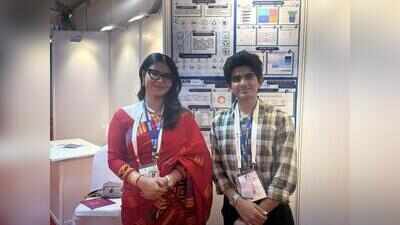
Bengaluru: Health took centre stage at the tech conference as researchers showcased nanotechnology-driven innovations that could transform the early detection and treatment of diseases.The 14th edition of Bengaluru India Nano 2026 under the theme ‘Nanotech’s Next Frontier: AI & Beyond – Conceive, Converge, Commercialize’, organised by Karnataka’s department of science and technology, Karnataka Science and Technology Promotion Society (KSTePS), and Jawaharlal Nehru Centre for Advanced Scientific Research (JNCASR), had researchers highlight the role of nanotechnology in healthcare advancements during the sessions under ‘Nano in Health’. They highlighted how advances in nanotechnology and AI could make healthcare more accessible, affordable and effective.One such study focused on an AI-enabled nanosensor capable of screening people for pre-diabetes using a person’s breath. Paramita Kar Choudhury, senior scientist, Embedded Devices and Intelligent Systems (EDIS), TCS Research, said India has an estimated 136 million people with pre-diabetes, many of whom remain undiagnosed until the condition progresses to diabetes. Since pre-diabetes can often be reversed through lifestyle changes if detected early, she said a simple, non-invasive screening tool could significantly improve early intervention.The handheld device analyses multiple breath biomarkers and uses AI to classify individuals as non-diabetic, pre-diabetic or diabetic in under a minute.Another study explored how nanotechnology could improve cancer immunotherapy. Prakriti Tayalia, professor, department of biosciences and bioengineering, IIT-Bombay, presented the research on nanoparticle-mediated immunotherapy, focusing on strategies to enhance cancer treatment using nanomaterials.She explained while existing CAR-T cell therapy has shown success in treating blood cancers, it remains expensive and has limited effectiveness against solid tumours because immune cells struggle to penetrate tumour tissue. To address this challenge, the team has developed biomaterial scaffolds, embedded, that can genetically modify immune cells directly inside the body, eliminating the need to extract, engineer and re-infuse cells in specialised laboratories.Researchers said such platforms could pave the way for more affordable, off-the-shelf immunotherapies, while also opening possibilities for treating autoimmune diseases such as rheumatoid arthritis using similar nanomaterial-based technologies.A digital passport for every gadget?From forgotten mobile phones lying in drawers to discarded laptops gathering dust, millions of electronic devices never make it to authorised recyclers. Seeking to change that, Adrija Anyat Borgohain and Daksh Jain from Jain deemed-to-be University have developed a prototype that assigns every electronic product a unique QR code linked to a mobile app. The system tracks a device from manufacture to recycling, helping recover valuable materials through authorised recyclers while improving compliance with extended producer responsibility (EPR) norms.“Our objective is not profit-making. It is about sustainability, traceability and ensuring e-waste reaches legitimate recyclers,” Adrija said.