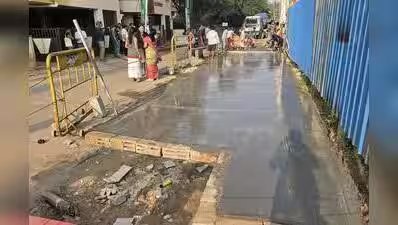











Wednesday’s rain left Bengaluru’s roads flooded and drains overflowing, but the massive amount of water was but a little problem compared to the bigger one: that it all went to waste.Hydrologists estimate the rain delivered 20–22 million cubic metres, but only a fraction of it recharged the groundwater. The rest ran off through drains and sealed surfaces, as it almost always does.Fifteen years after rainwater harvesting (RWH) became mandatory for new buildings, the city still loses far more water than it saves.Box-1: BWSSB earns crores from weak compliance Bengaluru has nearly 2.4 lakh RWH structures, as per Bangalore Water Supply and Sewerage Board. Yet, 49,958 properties remain non-compliant. For BWSSB, this is not much of a problem, because these properties generate around Rs 4.5 crore every month in penalties.RWH was made mandatory under Karnataka Groundwater (Regulation and Control of Development and Management) Act, 2012, and Rules, 2013. New buildings had to provide 60 litres of storage per square metre of roof area, and 30 litres per square metre of paved surface. Unpaved and garden areas were exempt.Experts also say compliance alone means little if systems are poorly maintained or surrounding land stays heavily paved.Box 2: Ground sealed water-proofBengaluru’s concretisation has crippled its ability to absorb rainfall. The Groundwater Resources 2025 report shows rainfall contributes 10.2 billion cubic metres (BCM) to Karnataka’s annual recharge of 19.3 BCM — roughly 53%. Yet Bengaluru’s two districts rank among the most stressed in the state.Bengaluru Urban’s annual recharge stands at 34,265.4 hectare-metre, but extraction runs at 177.3% of the extractable resource, the highest in Karnataka. Bengaluru Rural’s recharge is just 18,678.6 hectare-metre, with extraction at 146.8%.Water conservation expert Vishwanath S says nearly 80% of the city is now paved. “Short, high-intensity rainfall leaves little time for percolation. Roads and buildings seal the ground and prevent infiltration,” he said.Box 3: Rainwater turns into runoffHydrogeologist Devaraj puts it starkly: roughly 90% of Bengaluru’s rainfall runs off the surface, only 10% percolates. Despite receiving around 900mm annually, enough to generate over 1.1 lakh litres per household, only a fraction is retained.KC Subhash Chandra, former member of Karnataka Groundwater Authority’s expert panel, said the city generates nearly 17,000 hectare-metres of runoff annually — enough to serve 1.7 million people if conserved. A 2012 study he cited found that plugging leakages alone could serve 9.5 million people, and that less than 3% of water from a heavy rainfall events infiltrates the city’s soil. Around 25% is lost through stormwater drains, often mixed with sewage.Restoring lakes, separating sewage from stormwater, and expanding permeable surfaces, experts say, are non-negotiable.Box 4: Borewell dependence deepensThe city now has an estimated 3.7 lakh active borewells, with drilling demand rising sharply in peripheral areas. Without stronger RWH enforcement and recharge planning, experts warn dependence on tanker water and deep borewells will only deepen.Box 5: Official responseBWSSB chairman Ram Prasanth Manohar said a pilot in south Bengaluru using 60-micron filters has successfully improved harvested rainwater quality to Cauvery standards. The board plans to scale it up. “Penalties alone have not led to behavioural change,” he said.A senior water resources department official said good rainfall last year improved groundwater levels and recharged tanks ahead of summer. Technical support to local bodies continues, though implementation rests with individual govt agencies.—–GFX■ Bengaluru has nearly 2.4L rainwater harvesting structures■ 49,958 properties penalised for non-compliance■ Penalties generate around Rs 4.5 crore monthly■ City receives 830-900mm of rain annually■ Experts estimate nearly 90% of rainfall runs off the surface■ Nearly 80% of the city’s ground is paved■ B’luru Urban groundwater extraction: 177.3% | Rural: 146.8%■ Estimated active borewells in city: 3.7L