









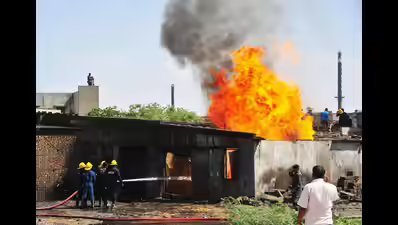
Ahmedabad: A state govt notification issued in 2021 has left the city’s fire service in a bind. Its crews are called to battle blazes in industrial estates at Vatva, Naroda and Odhav, yet they have no power to inspect fire safety equipment in those units or issue the no-objection certificates (NOCs) meant to enforce it. When fire strikes a unit within a GIDC estate, the Ahmedabad Municipal Corporation (AMC) fire and emergency services department arrives without maps or blueprints of the building, and with no record of what fire safety equipment, if any, has been installed. To plug the gap, private fire stations are now being set up in GIDC areas, and the department says it plans to train its staff.On May 2, 2025, a fire broke out at Jayshree Chemical in Phase-4 of Vatva GIDC at around 2.30pm. Firemen needed eight hours to bring it under control, and two people suffered severe burns. That blaze, along with fires at two other factories, revived the debate over industrial fire safety, but no resolution has emerged. Experts trace the problem to a policy reversal roughly four years ago, when the state stripped the AMC of its authority to issue fire NOCs to industries within the urban area. “Fire safety law still requires industrial units in urban zones to install safety equipment, but no authority now has the power to inspect that equipment or certify it, sharply raising fire risk across the estates,” an expert said.The legislative trail is tangled. The state passed the Gujarat Fire Prevention and Life Safety Measures Act in 2013, amended it in 2014, framed rules in 2016 and revised regulations in 2018. By one account, the Act has been amended 12 times since it was enacted.An official, speaking on condition of anonymity, explained the sequence: an NOC exemption originally applied only to residential buildings up to 15 metres tall, while NOCs were mandatory for commercial and occupied properties across eight building categories. “A Jan 2021 notification amended the Act and added a schedule; then in July 2021, a further notification exempted urban industries from the NOC requirement altogether. Those industries still must install fire safety equipment, but no longer need certification for it,” he said.With no authority clearly responsible for inspection or monitoring, compliance has become voluntary in practice. Larger firms that grasp the stakes equip themselves, while others install nothing at all. He added that while units engaged in production are exempt from the NOC, those operating as godowns (warehouses) are still required to obtain one.Ajit Shah, president of the Sanand Industries Association (SIA), said exporters face compliance hurdles. “For the last five years, there has been no fire NOC system. When a company exports, buyers ask for a fire NOC. Since there is none, we have to share govt notifications to explain it,” he said. “There should be self-declaration or clear guidelines for industries on fire system installation.”Shah added that the absence of a fire NOC also complicates insurance claim settlements after accidents. He called for a decentralised system where local fire stations issue NOCs.SIA has proposed building a fire station inside the Sanand estate. “We submitted our plan to the GIDC, but there is no progress,” Shah said, noting that two fire vehicles currently handle roughly 35 calls a year and the estate needs a dedicated disaster management facility.Girish Patel, president of the Chhatral GIDC Industries’ Association, said, “In our estate and surrounding areas, there are around 2,000 units. We frequently counter fire incidents,” he said, noting that help currently comes from Kadi or Kalol. He argued a fire NOC system is needed for genuine compliance, “because without strict monitoring, many units may fail to meet safety requirements.”