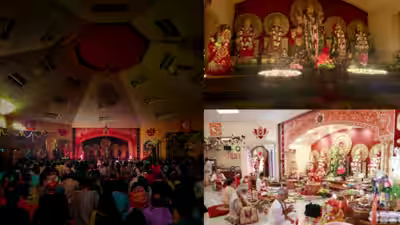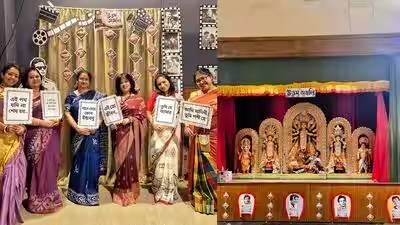







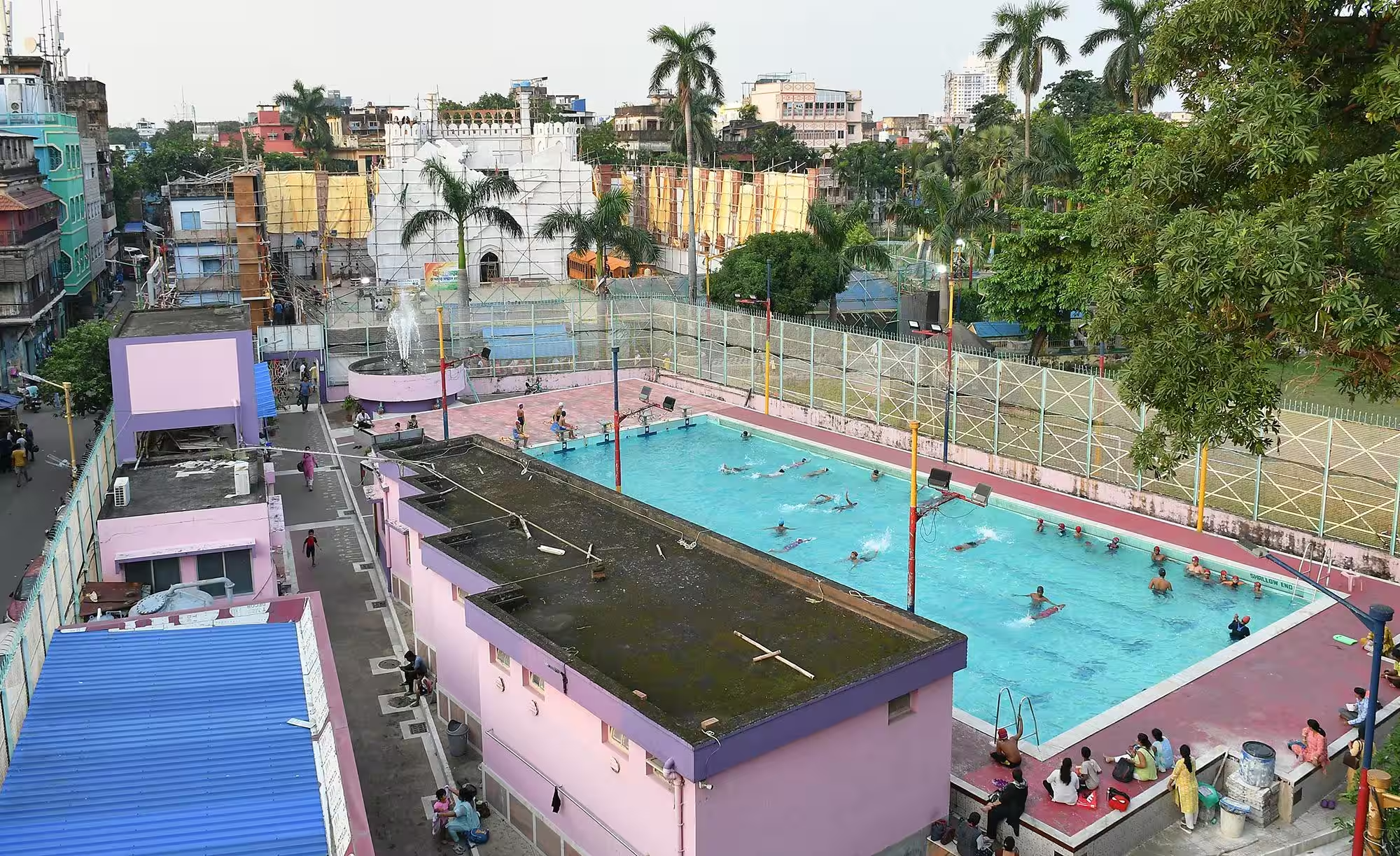
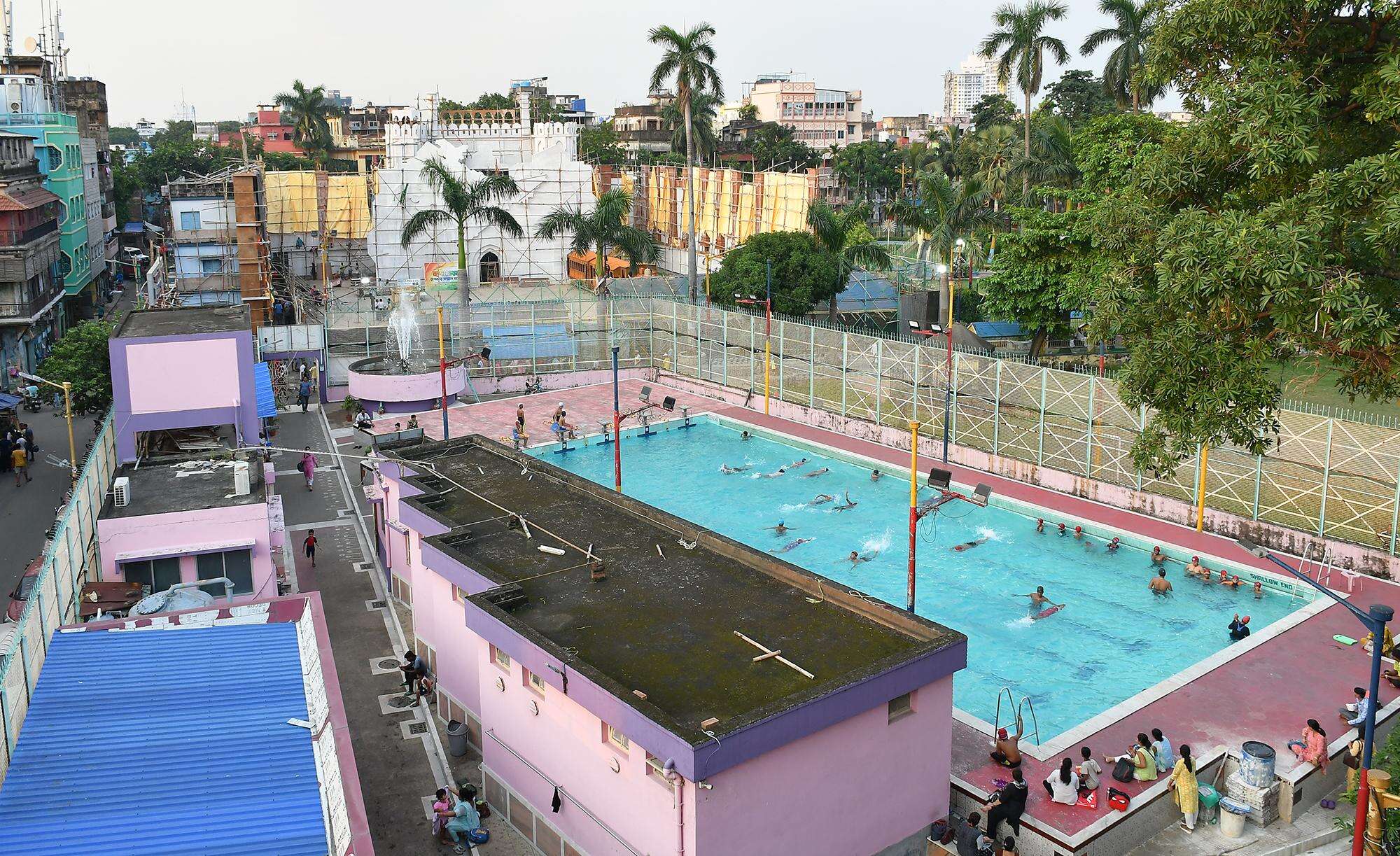
For commuters walking from Sealdah to Dalhousie Square, Lebutala park seems an ordinary landmark. Yet, radiating from this are some of Kolkata’s most historical, educational, and cultural milestones.St James to Santosh Mitra SquareBefore its famous Durga Puja, Lebutala park was St James Square, named for an Anglo-Catholic church. According to Kolikatar Rajpath, Huzurimal excavated a Bowbazar pond, later filled to create Clerks’ Garden. “The clerks of the East India Company used to live in this garden, which is why it came to be known as Clerks’ Garden. It’s ownership went to Robert Lazarus De Oliveira. Later, when Bishop Middleton took the initiative to build a church in 1814, Lazarus De Oliveira donated this garden for its construction. The new church was inaugurated in 1823 and was named St James Church,” said heritage enthusiast Swarnali Chattopadhyay.After white ants led to the collapse of its roof in 1858, the church relocated. Chattopadhyay added, “Following the church’s relocation, a portion of the area was bought by Lazarus’s grandson, H A Elliot, and the rest by a Bengali man. Perhaps due to the abundance of lemon trees, the place gradually came to be known as Lebutala or Nebutala. Elliot’s portion became St James Square. After 1947, St James Square was renamed Santosh Mitra Square in memory of the freedom fighter.”Born nearby in 1900, Mitra founded Swaraj Sevak Sangha. Arrested for revolutionary activities, he was confined to Hijli Detention Camp and martyred by British police firing in 1931 — a tragedy Rabindranath Tagore vehemently protested. A memorial honours him today.Cradle of science & educationAt 210, Bowbazar Street, Mahendra Lal Sircar founded the Indian Association for the Cultivation of Science (IACS) in 1876, championing self-reliant research. The National Council of Education (NCE) was also founded in protest against colonial educational control. Bengal National College started classes in 1906 at 191/1, Bowbazar Street with Sri Aurobindo Ghosh as principal and Tagore lecturing on literature. In 1910, NCE absorbed the Society for the Promotion of Technical Education and its Bengal Technical Institute, evolving into the College of Engineering and Technology. The college relocated in 1924 to land leased by mayor Chittaranjan Das, officially becoming Jadavpur University in 1955.Nerve-centre of nationalist activitiesThis neighbourhood was a freedom-struggle hub. Raja Subodh Chandra Mallick’s ancestral house sheltered revolutionaries like Sri Aurobindo. Bow Bazar Street, renamed Bepin Behari Ganguly Street, honours the founder of the Atmonnati Samiti. The revolutionary group Jugantar, led by Barin Ghosh, operated from 93/A, Bowbazar Street while the publishing house Basumati Sahitya Mandir, established by Upendranath Mukhopadhyay in 1881, functioned as an intellectual weapon.The office of the nationalist English paper ‘Bande Mataram’ edited by Aurobindo Ghosh was at Creek Row.Winding paths & forgotten watersBordering the park is a narrow, twisting alleyway, aptly named Serpentine Lane while Fordyce Lane earned the nickname ‘Gala kata gali’ or ‘cut-throat lane’. Creek Row traces its name to a navigable creek connecting the Hooghly river to salt lakes, which silted up after a 1737 cyclone wrecked a ship there. Nearby lanes like Dinge Bhanga (Broken Boat) and Jelepara (fishermen) echo this aquatic past. Known as the city’s ‘Harley Street’, Creek Row housed prominent doctors, including eye surgeon Nihar Munshi and paediatrician Kshirode Chaudhury. Ishwar Chandra Vidyasagar frequently visited Creek Row to discuss homoeopathy with Rajen Dutta, considered the father of Indian homoeopathy. Metropolitan Institution (Bowbazar branch) was founded here in 1884 by Vidyasagar, where a young Swami Vivekananda briefly served as headmaster. Mother Teresa lived briefly on Creek Lane.A social movementThe area is also associated with the Association of Voluntary Blood Donors West Bengal, a pioneer of India’s blood donation movement. Executive member Sudeb Mitra said, “The organisation was established on Jan 20, 1980, at 20A, Fordyce Lane. Its main objective was to ensure that no person dies due to lack of blood. We have exclusively advocated for govt blood banks. We run campaigns from the school level to university level to create future blood donors.”Durga Puja & JhulanEstablished in 1936, Santosh Mitra Square Puja Committee is renowned for thematic pandals. Sajal Ghosh, committee president and BJP MLA, said, “The puja is 91 years old. This year, the committee wanted to honour the legacy of Vande Mataram, which became a clarion call inspiring India’s freedom movement. This is the 150th year of Vande Mataram. Hence, we want to portray that journey through this year’s pandal.”Heritage enthusiast Kinjal Bose shared, “There are some very old houses in the neighbourhood, which have unique Durga idols and have been celebrating the festival for centuries. One such is the Dewanji Barir Thakurbari of Hidaram Banerjee Lane, where the goddess is worshipped as Karunamoyee following Shakta rituals. Nilmoni Dey Thakurbari of 45, Hidaram Banerjee Lane, founded by Nilmoni Dey in April 1897, is another century-old puja in the neighbourhood. The puja is performed following Vaishnav rituals. In both these houses, the idol is of ‘astadhatu’.”The neighbourhood is also famous for Jhulan, Bose said. “Jhulan Bari of Ramkanai Adhikary at Baburam Sil Lane has maintained this tradition for seven generations. Here, Jhulanyatra is celebrated in a grand way coupled with five days of classical music programme. Vocalist Jadu Bhatta had performed here and he used to stay here for five days of the festival. Jhulan festival at Balai Das’ Thakurbari on Crouch Lane is also accompanied by a classical music festival. Jhulanyatra of Sree Gouranga Mandir and Srimanta Villa are also very old.”Markets, craftsmanship & recreationAdjacent to Sealdah lies Koley Market, Kolkata’s largest wholesale produce hub. In the narrow lanes of Sonapatti, skilled karigars handcraft intricate Bengali bridal jewellery, continuing a colonial-era legacy. Santosh Mitra Square also houses Kolkata’s oldest kite shops. “The oldest kite shop in the area is Kolkata Kite. Since the father has become aged, his son now runs it for a couple of months during the season. Our shop is 58 years old and is the second-oldest. The trend of kite-flying might have seen a dip in central Kolkata but there is massive demand in the suburbs,” said Saikat Dutta of India Kite.