








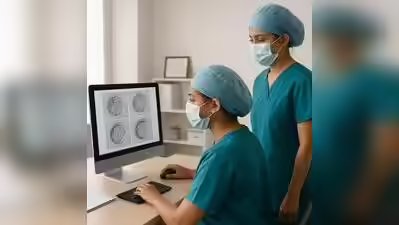

Pune: India’s fertility sector is being reshaped by artificial intelligence, with clinics increasingly using algorithms to help select embryos, assess sperm quality and improve IVF decision-making.In fact, time-lapse embryo imaging, embryo-ranking systems and sperm-selection software are helping doctors identify the most viable embryos and reduce variation in lab assessments.Pune Municipal Corporation (PMC) officials said that currently, 164 centres facilitate assisted reproductive technologies (ART) in the city. Civic assistant health officer Dr Rajesh Dighe said, “There are various levels of ART based on services provided. As per our records, there are 60 level I ART centres, 66 level II ART centres, 18 egg and sperm banks and 20 surrogacy centres.” While level I handles basic fertility evaluations and IUI, level II manages advanced lab technologies — like IVF and embryo cryopreservation, he added.Head of reproductive health and IVF centre in-charge at KEM Hospital Dr Mugdha Parasnis said, changing family patterns and lifestyle pressures were driving more couples to fertility treatment. “Over the last decade, we have seen a shift in the profile of couples seeking fertility treatment. Delayed marriage, postponement of pregnancy for career or financial reasons, rising stress levels, obesity, metabolic disorders and environmental factors are all contributing to reduced fertility. It is important to understand that AI does not replace the clinician or embryologist. It acts as a decision-support tool that reduces subjectivity, improves consistency and helps us take informed decisions.”World IVF Day is observed on July 25 to spread awareness about IVF and encourage innovation in fertility treatment. Newer platforms are also being used to analyse blastocyst images and, in some cases, support single-embryo transfer, lowering the risk of multiple pregnancies.Infertility patterns are changing across the country. Male-factor infertility accounts for an estimated 40% to 50% of cases, either alone or alongside female infertility, pushing more men to seek evaluation earlier. At the same time, India’s fertility rate continues to fall. The latest available national data put the total fertility rate at 1.9 in 2023, below the replacement level of 2.1.Consultant gynaecologist and IVF specialist at Lilavati Hospital in Mumbai Dr Hrishikesh Pai said AI is helping doctors make better choices rather than replace them. “AI does not create perfect babies. It helps doctors make an informed choice. AI tools sift through thousands of embryo images, tracking cell division timing and growth patterns to estimate which embryo is most likely to implant. Earlier, this process depended solely on an embryologist’s eye under a microscope. Newer systems go further, analysing genetic markers to generate a polygenic risk score — an estimate of the probability an embryo may develop certain conditions later in life. A risk score is not a diagnosis and patients need to hear that clearly before they put too much weight on a number.”Founder and director of The Nurture IVF Centre Dr Archana Dhawan Bajaj said AI cannot guarantee success. “It narrows the odds and does not remove them. Sperm quality is turning out to be one of the more overlooked stories in Indian fertility care. For years, IVF was spoken of almost exclusively as a woman’s journey. That is changing.”Head of urology at VNA Hospital Dr Vineet Malhotra said, “Five years ago, men came in after their partner had been through several tests. Now they are often the first ones to seek an evaluation. Sedentary routines, stress, obesity and simply delaying parenthood are showing up in sperm parameters, unlike a decade ago.”