









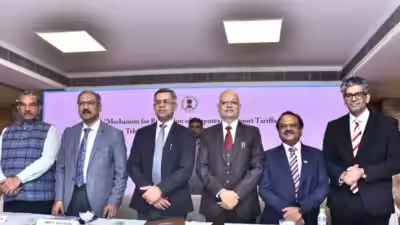
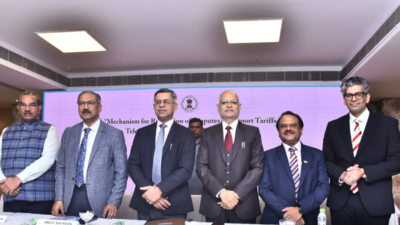
HYDERABAD: Chief Justice of Telangana Justice Aparesh Kumar Singh noted that adjudicatory bodies must maintain a balance between regulatory autonomy, specialised expertise and judicial accountability, while cautioning against allowing adjudication to substitute regulation or, conversely, placing regulatory decisions beyond effective scrutiny.Addressing a seminar on “Mechanisms for Resolution of Disputes in Airport Tariffs, Telecom, Broadcasting and Cyber Sectors”, organised by the Telecom Disputes Settlement and Appellate Tribunal (TDSAT) at Hyderabad on Saturday, Justice Aparesh Kumar Singh also drew attention to emerging challenges in the cyber and artificial intelligence domains.Rapid technological development has increased the complexity of cyber-related disputes, fraud and questions of accountability and oversight. “While technology and artificial intelligence can assist adjudicatory processes, they cannot replace judicial reasoning, accountability and human oversight,” he emphasised.Justice Aparesh Kumar Singh said that timely disposal of disputes is equally important, as prolonged litigation can undermine regulatory objectives and create uncertainty for industry and consumers.He further emphasised the need for effective, timely and specialised mechanisms for resolution of disputes arising in the rapidly evolving sectors of telecom, broadcasting, airport tariffs and cyber technologies, while also highlighting the growing importance of specialised adjudicatory institutions in dealing with technically complex regulatory disputes.Referring to the constitutional framework governing tribunals, Justice Aparesh Kumar Singh underlined that specialised adjudication must operate within the rule of law. He noted that judicial review exercised by the High Courts and Supreme Court forms part of the basic structure of the Constitution and that tribunals complement the judicial system while remaining subject to constitutional judicial scrutiny.Justice D. N. Patel, Chairperson, TDSAT in his opening remarks highlighted the Tribunal’s role in providing specialised and time-bound dispute resolution across the telecom, broadcasting, airport tariff and cyber sectors. He explained that TDSAT’s jurisdiction has evolved alongside technological and regulatory developments, including its appellate jurisdiction in cyber matters and its role in airport tariff disputes.Justice D. N. Patel stressed the need for greater awareness among policymakers, regulators, industry, legal professionals and other stakeholders about available dispute-resolution mechanisms.Highlighting the mechanism for resolution of cyber disputes, Justice D. N. Patel explained that under the Information Technology Act, civil remedies are initially adjudicated by the designated adjudicating officer, with claims for compensation up to Rs 5 crore.Justice P. Sam Koshy of Telangana High Court, A. Sudershan Reddy, Advocate General, and S. Surender Reddy, President, Telangana High Court Bar Association also addressed the seminar.