










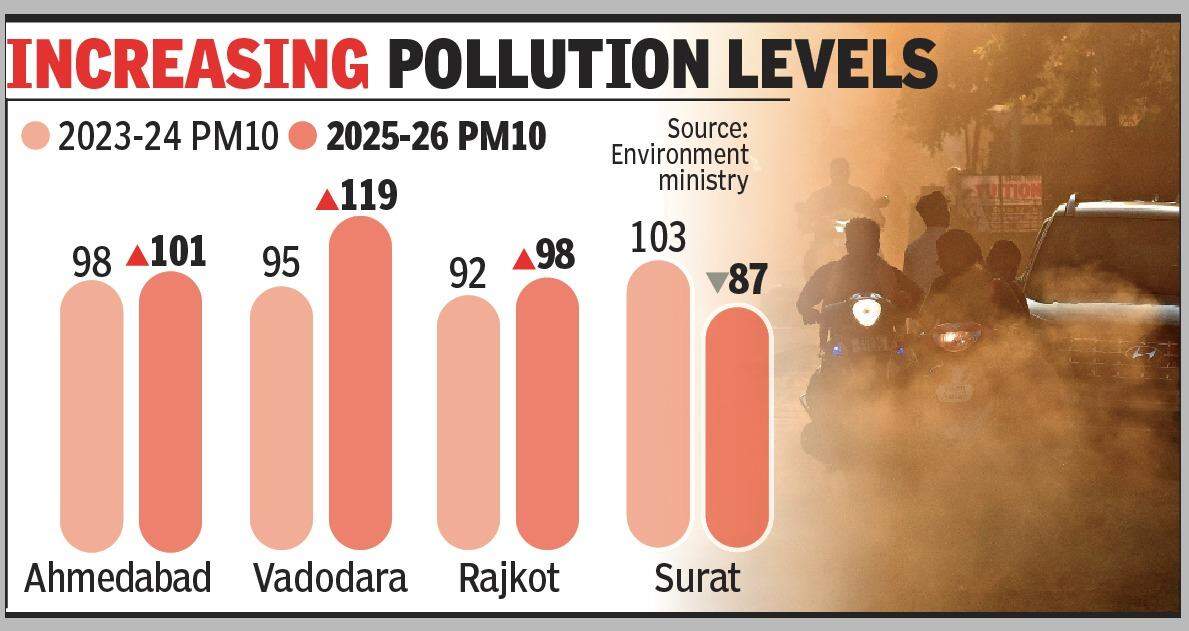
Ahmedabad: After years of steady improvement in air quality, Ahmedabad’s progress in reducing particulate pollution appears to have slowed, with the city’s annual PM10 concentration rising in the latest assessment after registering sharp gains under the National Clean Air Programme (NCAP).According to data by the Union ministry of environment, forests and climate change (MoEFCC), Ahmedabad’s annual average PM10 level increased to 101 µg/m³ in 2025-26, up from 98 µg/m³ in 2023-24.The increase comes after the city had reduced PM10 levels by 38.4% from the NCAP baseline of 164 µg/m³ in 2017-18, making it one of the better-performing cities under the programme during that period.The latest figures indicate that while those gains have largely been retained, maintaining the downward trend is proving more difficult.
Ahmedabad pollution graphic
Public health expert Dr Dileep Mavalankar said the rise is consistent with increasing dust-generating activities across the city. “PM10 mainly comprises larger particulate matter generated by construction activity and the re-suspension of road dust by moving vehicles. With rapid construction across Ahmedabad, these emissions are expected to increase unless dust control measures are strictly enforced. Higher PM10 levels are associated with respiratory problems, including persistent cough, frequent upper respiratory irritation and infections. They can also cause eye irritation, particularly among children, the elderly and people with existing respiratory illnesses,” he explained.The trend is seen across other cities in Gujarat as well. Three of the state’s four NCAP cities reported higher annual PM10 levels than two years ago. Vadodara recorded the sharpest increase, with PM10 rising from 95 µg/m³ in 2023-24 to 119 µg/m³ in 2025-26, while Rajkot’s annual average climbed from 92 µg/m³ to 98 µg/m³. Surat emerged as the exception, improving further from 103 µg/m³ to 87 µg/m³.Environmentalist Mahesh Pandya said the city’s deteriorating road conditions and dependence on private vehicles were worsening dust pollution. “Areas within Ahmedabad have virtually no industries, yet PM10 levels remain high. That tells us road dust is a major contributor. Roads are repeatedly dug up and resurfaced, leaving loose dust that gets re-suspended by traffic. Public transport is still inadequate, forcing more people to rely on private vehicles, which further aggravates the problem. The city also continues to lose tree cover without adequate replacement, reducing a natural barrier that helps trap dust.”With the increase, Vadodara has overtaken Ahmedabad to record the state’s highest annual PM10 as well as PM2.5 concentration, while Ahmedabad now ranks second among the four NCAP cities.Ahmedabad’s annual PM2.5 concentration stood at 39 µg/m³, just below the national annual standard of 40 µg/m³, whereas Vadodara exceeded it at 49 µg/m³.Despite the improvement achieved since the NCAP baseline year, Ahmedabad, Vadodara, Rajkot and Surat all continue to exceed the annual PM10 standard of 60 µg/m³, keeping them among the country’s non-attainment cities under the programme. Cities fall into the non-attainment category if they regularly fail annual PM10 standards, the parliamentary reply stated.