









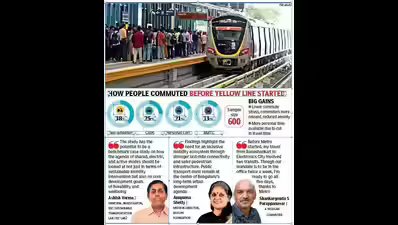
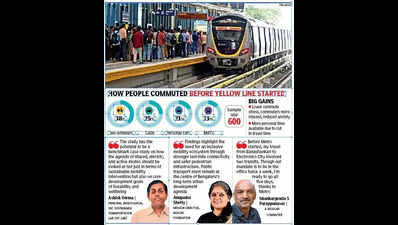
Bengaluru: Calisthenics was last on the trade-off list when lakhs of motorists decided to switch from own or hired vehicles to Metro rides from RV Road to Bommasandra, a line that snakes through Bengaluru’s famed tech corridor — otherwise a byword for traffic jam.Many regular commuters on the 18.9km route — which reduces travel time from a pollution-filled 2.5-hour ride to a breezy 30 minutes — admit they are now clocking 10-15 minutes of daily walk for Metro and related commutes, according to an IISc study funded by Biocon Foundation and ELCIA (Electronics City Industries’ Association). These commuters earlier had a largely sedentary lifestyle, mainly thanks to long commutes.Daily walks to Metro stations and offices add up to 50-75 minutes of moderate physical activity every week, giving commuters an unexpected fitness boost along with a faster ride to work. The study, conducted between July 2025 and Feb 2026, spoke to 600 commuters.The inference was drawn from a comprehensive baseline survey done ahead of the Aug 2025 inauguration of Yellow Line and followed by a phone survey of the same commuters conducted six months after the inauguration.Some 83% of respondents had expressed willingness to switch to Yellow Line once it became operational. Before the line was launched, 38% respondents used to travel by two-wheelers, 25% by cabs, 21% by private cars, and the rest by public road transport. A huge concern reported by 58% of the respondents was minimal physical activity, well below the WHO-recommended minimum of 600 MET (Metabolic Equivalent of Task) minutes a week. On the lifestyle diseases faced, 15% admitted to hypertension, 18% diabetes, and 4.6% respiratory illnesses.The modal shift to Yellow Line has delivered clear gains: Increased physical activity, mental wellbeing, and reduced exposure to polluted air. The two-wheeler riders who were absorbing high doses of PM2.5 earlier are now travelling in climate-controlled, enclosed environments, experiencing near-zero direct outdoor pollution exposure.Respondents reported feeling less tired, more in control of their daily routines, and better work-life balance. Added benefits included increase in social interaction during daily journeys, reduced travel delays, lower fatigue, and greater energy for personal and family responsibilities.