








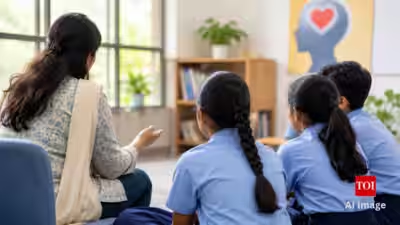
GURGAON: Haryana govt on Monday proposed a SAATH project to provide mental health and counselling support to students in distress after the horrifying assault on a kindergarten child by an eight-year-old boy in Panchkula last week.But UMEED centres, the state’s established framework for counselling, with psychology teachers appointed in 16 districts, including Gurgaon, effectively wound down two years ago after an education department order to “revamp” the service.Since then, according to sources, regular counselling has effectively been restricted to schools where an incident was reported or where counselling was specifically required.Directorate of School Education set up the UMEED counselling and wellness centres in 2018 for student well-being, psychological safety and institutional accountability.The move was part of long-term reforms after widespread outrage over the death of a seven-year-old student, who was found with injuries to his neck outside a washroom at a private school in Gurgaon on September 8, 2017, and later succumbed to his wounds.
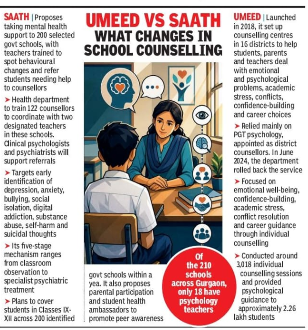
UMEED vs SAATH: What changes in school counselling
Under the framework, permanent post-graduate teachers (PGT) in psychology holding a diploma in counselling were deployed to UMEED centres set up at District Institutes of Education and Training (DIETs) and designated schools to offer structured mental health support.The teachers served as district counsellors for govt schools and were posted at main or easily accessible schools. They had to visit others in the district to conduct sessions.As per the directorate’s instructions, these teachers were supposed to visit two to four schools every week or counsel students who were brought to them by schools.The department shared their personal contact numbers so that students facing difficulties could directly reach out to them for help.HASLA state president Satpal Sindhu, who heads the Haryana School Lecturer Association, said the visits would follow a structured schedule. “The department used to issue weekly lists specifying which schools each counsellor had to visit. They were required to cover the allotted schools and submit reports to the district authorities,” he said.But on June 20, 2024, the directorate ordered the repatriation of teachers posted at the centres. The order said the 16 teachers in as many districts, including Gurgaon, Faridabad, Panchkula, Rohtak and Sonipat, were to be reassigned through the General Teacher Transfer Drive.The order, Sindhu said, rolled back an initiative originally meant to address high stress, anxiety and mental health issues among schoolchildren.“In 2024, their (the teachers’) counselling duties were stopped. These teachers are now posted in their respective schools and are working strictly as psychology teachers, teaching students from classes IX to XII,” he said.District counsellor posts, however, continue to exist, with each district assigned one counsellor for govt schools, who must also be a psychology teacher. But the regular school visits and counselling under UMEED have stopped.Sindhu said the discontinuation was allegedly justified because the teachers had insufficient workload. “Student counselling is not an idle activity but a specialised responsibility requiring professional expertise.Instead of discontinuing this important initiative, the department should have strengthened the counselling system and utilised these qualified professionals for both teaching and student counselling,” he said.After the October 28 incident, education minister Mahipal Dhanda has called a priority meeting after Diwali to discuss weekly counselling and behaviour monitoring of students in school and higher education institutions.Under the proposed mechanism, teachers will be assigned weekly counselling responsibilities and meet students individually and in groups. They will observe behavioural changes and identify signs of aggression, emotional distress or other problems that require intervention.The exercise will also examine students’ exposure to mobile phones, social media and the internet, including violent videos and online fights that may influence their behaviour.“The proposed mechanism will cover both school education and higher education institutions. It is important that teachers do not limit their role to academics but also remain aware of the emotional and behavioural well-being of students,” Dhanda said.Principal secretary (school education) Vijay Dahiya said the department would review the status of the posts of district counselling heads and take steps to strengthen counselling in schools. He said the govt was also planning a state-level expert body of child psychologists, behavioural experts, mental health professionals and other specialists.The proposed committee will look beyond the Panchkula incident and assess children’s mental health, behavioural patterns and counselling requirements across the state.District counsellor Rajni said the Panchkula incident was a reminder that both parents and schools need to pay closer attention to children’s behaviour.“Sometimes, children are unable to distinguish between the fictional world they see on screens and real life. This can affect their understanding of behaviour and consequences. There is a need to organise awareness programmes for children. Along with making them psychologically stronger, it is equally important to help them understand the difference between right and wrong,” she said.A shortage of trained professionals, however, remains a challenge.In Gurgaon, only 18 govt schools have psychology teachers, against a total of 210 in the district, making it difficult to extend mental health awareness and behavioural counselling programmes to all students.