






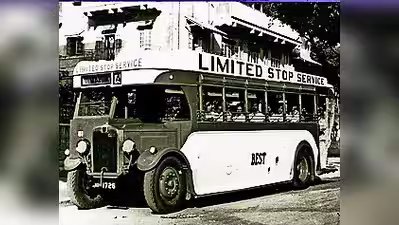
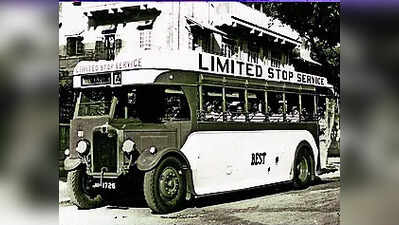
In Chhoti Si Baat (1976), Basu Chatterjee’s classic ode to Bombay office romance, Amol Palekar’s character, Arun, practices a ritual that feels like a myth in modern Mumbai: he waits in an orderly queue at a bus stop.Today, those polite queues have dissolved into chaotic scrums, commuter etiquette is an endangered species, and the iconic red-and-silver fleet is a shadow of its former self. But there was a time when riding the bus wasn’t a battle — it was a pleasure.The legendary No. 123, which ran from RC Church to Tardeo, down the sweeping arc of Marine Drive, holds a special place in city historian Deepak Rao’s memory.“I’d travel the full route to meet a friend in Tardeo,” Rao recalls. “It was the kind of scenic journey you’d proudly take a guest on to show off the best of the city.”Before it wore a number, the 123 was simply Route C — a relic from the pre-1960s era when a fledgling bus service relied on the alphabet. As Bombay sprawled and the transit network expanded, the alphabet gave way to the roomier numerical system we know today.The 123 was the backdrop to Aspi Deboo’s youth. “During my Sydenham College days in the late 1970s, my friends and I would rush to grab the front-row seats on the upper deck. The breeze hitting your face was pure joy,” the 67-year-old recalls. Back then, a 50-paise ticket bought an unforgettable ride that usually ended with an orange crush by the sea.Now, with the classic double-deckers replaced by modern single-deckers, Deboo feels an era has ended: “An air-conditioned e-double-decker simply doesn’t have the same charm.”For others, the bus was a lesson in discipline. Khushru Kapadia remembers a time when he spent his 4-anna bus fare on bhelpuri instead, opting to travel ticketless on the train. His freewheeling days ended when an acquaintance spotted him riding the train’s footboard and ratted him out to his mother.“She came right to the school and thrashed me!” Kapadia chuckles. He was a devoted bus traveler from then on. “I was ten when I started taking the A4 Ltd from Malcolm Baug in Jogeshwari to Sarala Sarjan High School in Vile Parle.”His love for buses grew when double-decker routes finally extended to Andheri. On Sundays, his mother would take him and his brother on the 83 or 84 Express for a joyride to Flora Fountain. “We’d take a single-decker from Jogeshwari to the Andheri depot, and then race to the top deck for a seat right in front of the open windows.”With the wind rushing in, these coveted front-row spots were the city’s “original AC compartments,” jokes Ambadas Garje, curator at the BEST Museum. But the open windows brought surprises, too; low-hanging tree branches would occasionally sweep through the top deck, startling dozing passengers awake.Driving these giants was no easy feat. “Double-deckers were far more challenging to drive than single-deckers,” explains Garje, who joined BEST as a driver in 2007 on the No. 6 (Colaba to Chembur). “As a driver, you had to be constantly vigilant of both the road traffic and the overhead branches.”To prevent upper-deck collisions, BEST operated special tree-pruning buses. According to BEST historian Rajendra B. Aklekar, these were actually retired double-deckers with their top decks sliced clean off.Aklekar, author of The BEST 75 Years – Tram, Bus & Energy, notes that when motor buses were first launched in July 1926, passengers treaded lightly: “Motor buses were a bit like the metro today — a novel technology that took time to catch on. People were initially terrified of their speed. They were also slightly more expensive than trams and had limited stops.”By the 1970s, however, the BEST bus had become the beating heart of Bombay. “The all-night buses, like the No. 1 from Colaba to Santa Cruz, and the No. 302 from Sion to Mulund, were lifelines for workers on the night shift, especially those who worked the mills and docks,” says Garje.Gillian Fernand, a former resident of Byculla Railway Colony, remembers the bus window as a portal both into public and private life. Double deckers from Byculla to VT (before the JJ Flyover), offered a glimpse into people’s homes and life on the streets.The commute was always entertaining — and only once excruciating. Fernand recalls an ill-advised family joyride to Juhu Chowpatty on a Ganesh immersion day. “It was a gruelling six-hour crawl,” she laughs. “It didn’t just take us through the city — it showed us the entire city on the streets.” But it did not dim her bus-love. “Give me the bus over the train any day.”(With inputs from Somit Sen)