









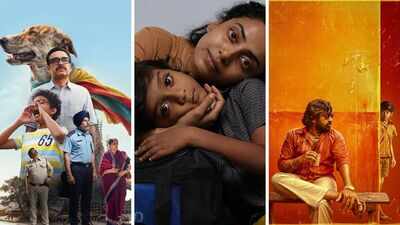
For decades, children’s cinema has been treated as a separate category, with stories simplified for young viewers and adults expected to simply tag along. But perhaps Indian cinema is beginning to rethink this approach. A welcome change is emerging in how filmmakers write children into their stories — not merely as devices to evoke emotion, but as individuals with their own perspectives, fears, vulnerabilities and sense of understanding.To illustrate this much-needed shift in narrative, we have chosen three films across Malayalam, Hindi and Tamil cinema — Balan: The Boy, Ohh My Dog and Baththa. These recent releases share an important quality: they don’t underestimate their youngest characters or their audiences. Instead, they tell honest, emotionally engaging human stories that children can relate to and adults can appreciate at a different level. Their child protagonists are not merely supporting characters or convenient devices to move the plot forward. They make choices, respond to their circumstances and actively shape their own journeys. More importantly, the films recognise that children are capable of engaging with emotions such as loss, uncertainty, fear, separation and loyalty. They do not feel the need to dilute every difficult situation with humour or resolve it through a neatly packaged moral lesson.Ohh My Dog takes a different route, building its narrative around two parallel journeys that turn the familiar boy-and-dog relationship on its head. In Assam, young Apu (Maahi Rai) sets out to find his missing dog, Momo. In Patna, the search takes a reverse turn when Oscar, a faithful adopted indie dog, sets out to find Prince (Nikhil Kumar), the young construction worker who has disappeared. Their respective quests become stories of loyalty, companionship and resilience, set against the realities of very different social and urban landscapes.
One cannot return the unconditional love that a dog gives you. That’s what makes Ohh My Dog a film made for everyone
Amit Rai, director of Ohh My Dog
Directed by Chidambaram, Balan: The Boy moves away from the conventional coming-of-age template to explore the transient world of a young boy, Balan (Adhisheshan K R) and his protective mother (Farzana Palathingal). It looks at childhood not as a sheltered period untouched by adult anxieties, but as a phase in which children absorb everything happening around them. Balan may not fully understand the uncertainty and displacement shaping his family’s life, but he is aware of their emotional impact. The film acknowledges how children internalise their surroundings long before they can make sense of them.
Balan: The Boy was a niche film, not meant for a wide audience. It was a film that was meant to convey a dependency that comes from childhood conditioning
Chidambaram, director ofBalan: The Boy
With Baththa, director Balaji Tharaneetharan takes a rather unusual route to explore childhood, compassion and human transformation. Set in 1986 Madras, the Tamil film brings together a feared local gangster, Baththa (Vijay Sethupathi), and eight-year-old Sabari (Sai Prithiv Raj), whose paths cross in an unexpected turn of events. When Sabari accidentally locks the gangster inside his school’s bathroom, an unlikely relationship begins to unfold.The film’s strength lies in how it allows a child’s perspective to drive an adult’s transformation. Rather than making Sabari a precocious child dispensing wisdom, it lets his natural innocence and actions do the talking. Through humour, nostalgia and tenderness, Baththa explores how sometimes the simplest interactions can bring about the most profound changes.
Even though we may not always realise it, children see the world differently from adults. While writing Baththa, I was conscious of portraying how the same situation could be perceived differently by a child. In fact, my first draft was written entirely from the boy’s point of view. But I felt that to bring out the ideas I wanted to explore, the film also needed an objective point of view. I wanted it to appeal to both children and adults. We need to move away from labelling films as ‘children’s films’ and, in the process, limiting their reach
Balaji Tharaneetharan, director of Baththa