




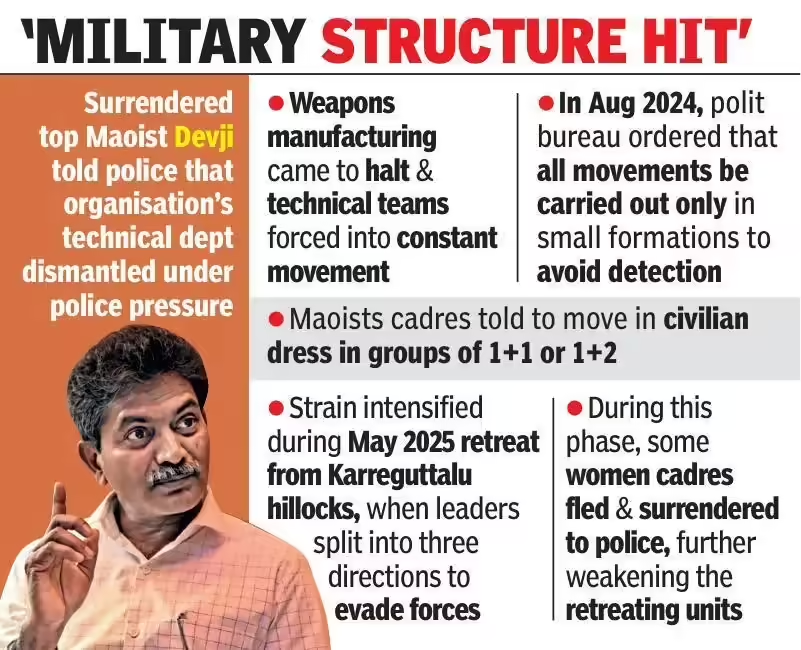
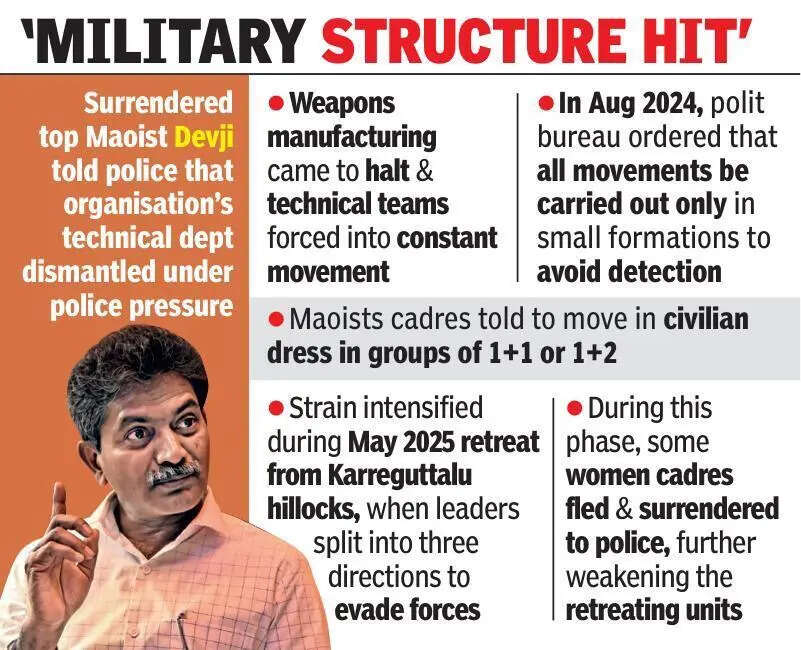
Hyderabad: Surrendered senior Maoist leader Tipiri Thirupathi alias Devji has told the Telangana police that the outfit’s last attempts to survive Operation Kagar collapsed under the twin strain of military setbacks and political disarray, with sustained security pressure breaking its core operational capacity, even as internal divisions slowed decision-making at a critical stage.According to Telangana police sources, Devji said the pressure on the ground forced the Maoist leadership to scale down movements into small formations, suspend arms manufacturing, and retreat through fragmented escape routes that left cadres exposed. He also pointed to low morale, disputes among senior leaders, and the absence of a clear strategy on whether to press on, seek a ceasefire, relocate ageing cadres, or even dump weapons.Military structure hitDevji told the police that the organisation’s technical department was dismantled under police pressure. As a result, arms manufacturing came to a halt, and technical teams were forced into constant movement. He said the polit bureau, in Aug 2024, ordered that all movements be carried out only in small formations to avoid detection by security forces. Cadres were instructed to move in civilian dress in groups of 1+1 or 1+2. The strain intensified during the May 2025 retreat from the Karreguttalu hillocks, when leaders split into three directions to evade central forces. During this phase, some women cadres fled and surrendered to the police, further weakening the retreating units.Retreats exposed gapsAccording to police sources, Devji described severe communication failures during the retreat towards the National Park area. Teams faced delays in receiving leaders due to breakdowns in communication, affecting coordination at a time when the leadership was already under pressure. While camped in the National Park, the leadership learned of the death of general secretary Nambala Keshava Rao alias Basvaraj, he said. Attempts to regroup were followed by further losses, including top Maoists Sudhakar and Mylarapu Adellu in exchanges of fire. The account suggests that once the retreat phase began, the movement was unable to maintain cohesion between teams, leaders and fighters, turning withdrawal into a series of uncoordinated moves under pressure.Internal divisionsDevji also told the police that military setbacks were compounded by internal divisions within the leadership. He referred to friction between leaders from Chhattisgarh and those from Telangana or the Andhra-Odisha Border, with some Chhattisgarh leaders resenting the movement of Telangana and AOB cadres and, at times, refusing them shelter.He said morale within the party had declined sharply due to ideological differences and disputes among central committee members. At the same time, decision-making was slowed amid disagreement over the survival strategy. While one view favoured dumping weapons and staying in villages, another insisted that arms be retained for self-defence.The lack of clarity extended to the political line as well. Devji said there was no consensus on how to respond to the failure of mass movements, declining student recruitment, and a situation in which more people were being drawn towards govt reforms. According to police sources, he said the polit bureau in 2024 issued a circular directing that elderly and ailing cadres be moved to safe locations or encouraged to surrender to police if shelter could not be secured.He also said the party’s economic policy was to retain funds for a maximum of three years, mainly in the form of gold coins, to preserve what remained. Devji further stated that a 2018 central committee decision to withdraw forces from Chhattisgarh to other regions was never fully carried out, leaving cadres exposed to the full force of Operation Kagar.