









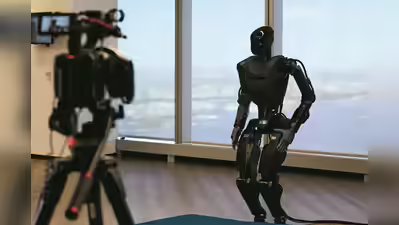
In 1920, the term “robot” made its debut in a Czech play; 106 years later, robots made their debut on the battlefield.This Jan, videos circulated online showing Russian soldiers surrendering to an unmanned, armed Ukrainian robot. About a month later, two humanoid machines became the first ever to be deployed in an active combat zone. They were sent to an undisclosed location on Ukrainian frontlines and evaluated by the US military.Foundation, the two-year-old American startup that made the humanoid robots, signed a $24 million Pentagon contract in April and plans to roll out tens of thousands of units over the next few years.Humanoid robots and cyborgs have been a sci-fi staple for decades, from RoboCop to the Terminator, from Star Trek’s Data to the androids haunting the neon-lit streets of ‘Blade Runner’ in search of identity. But till now, they were intangible, always just out of reach.Where the Ukrainian robot looked crude and improvised, Foundation’s robot, Phantom Mk1, closely resembles the Star Wars battle droid, replete with a forward-leaning head, a featureless face and a tactical, utilitarian frame — at once sufficiently alien and unsettlingly human.This jump from the theatre of the imagination to the theatre of war might seem absurd, but military conflict has always accelerated technological innovations: radar, jet engines, satellites, the internet and drones are all products of war. Foundation is simply striking while the iron is hot. “You need robots that can act in highly kinetic environments … a robot that can take tumbles and falls, can carry a lot of payload, [and] is waterproof, dustproof,” says Sankaet Pathak, co-founder and CEO of Foundation.
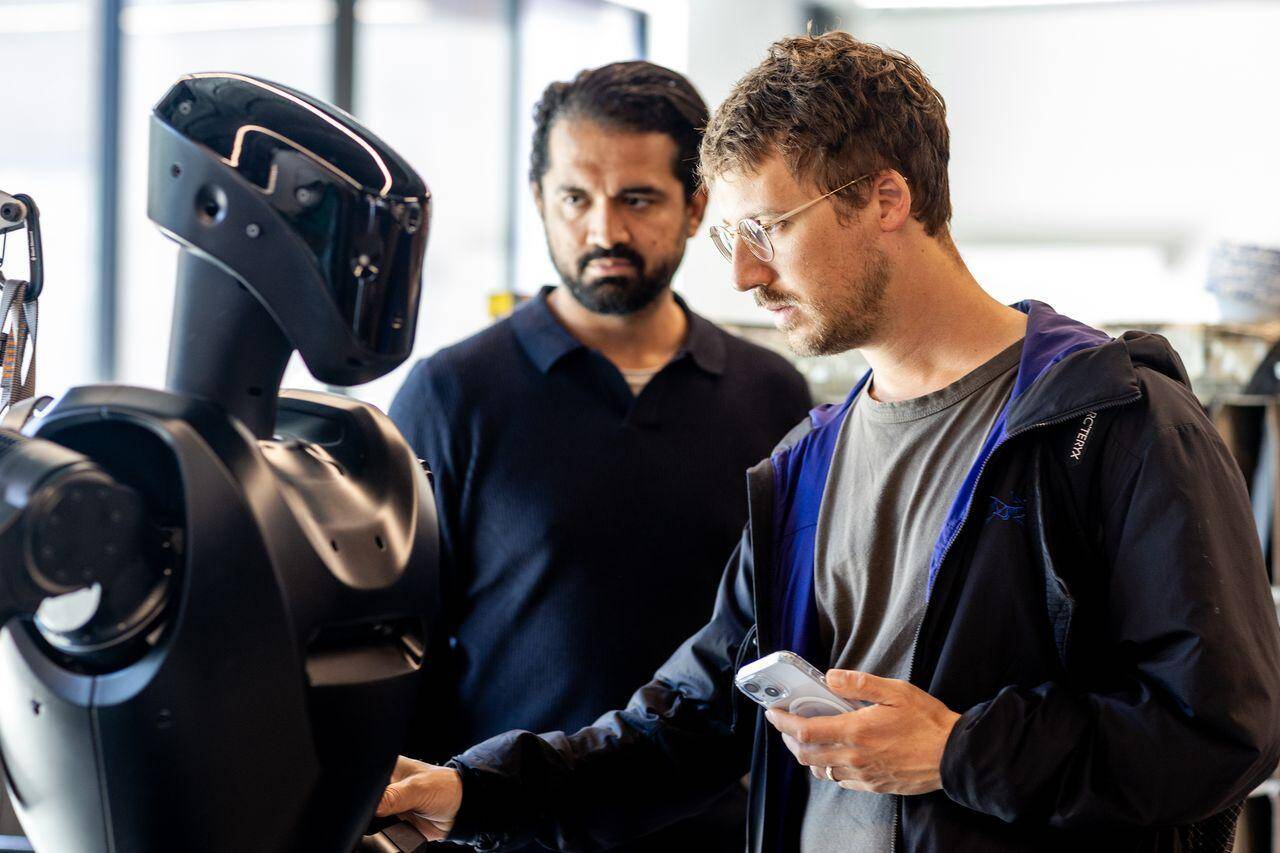
Foundation CEO Sankaet Pathak (centre) looks on as an employee interacts with the Phantom Mk1
It took Foundation some 13 months, from its founding in 2024 to testing robots for the US military. And it probably helped that between 2024 and now, the world has constantly been on edge. “If it weren’t for conflict, the desire to make big, drastic changes in the military is usually pretty low,” Pathak says on USA’s desire for non-human combatants.Yet experts caution that the technology remains in its infancy. “It’s not very mature, and it’s not established. It may take a decade probably (to mature),” says Arshad Javed, associate professor of mechanical engineering at BITS Pilani, Hyderabad campus. Javed describes humanoid robotics as “very challenging”, pointing to energy systems, dynamic balancing and cybersecurity as unresolved hurdles.The Phantom Mk1 is about six feet tall, weighs 80kg and can carry a payload of 40kg. It currently has a battery life of under an hour, but the next iteration (Mk2), to be unveiled soon, will last six hours, Pathak says.That battery life is significant. According to Javed, “energy is the backbone” of any autonomous robotic system operating without a tether. “Anybody who is talking about space robotics, underwater robotics, or this kind of unstructured environment, you need to be sustainable in terms of energy,” he says..Foundation’s says its robots will not limited to the military and are the right fit for any heavy industrial use, such as construction. Pathak says industry and military need mobility, endurance, payload capacity and dexterity. “The hardware problems you need to solve (for construction and military) are actually quite complementary.”While the convergence of industrial robotics and defence technology has catalysed a once-distant change, there’s no need to worry about ‘Terminator’-style T-800 robots. Not yet. “It (the Phantom) is pretty close to RoboCop, really.”But Jacob Parakilas, a researcher with the not-for-profit RAND Europe, tempers this enthusiasm with reality. “Wheels and tracks are simpler mechanically than legs,” he explains, noting that this simplicity “gives them an inherent resistance to damage”. They also help reduce a robot’s visibility and exposure to enemy fire in combat. “[This] can be mitigated by engineering, but that adds to the cost and complexity.”Javed echoes that concern, noting that “the problem becomes multiplied” when machines must balance dynamically on two legs while carrying payloads in unpredictable terrain. While advances in computing have made progress possible, he says these remain “challenging problems”.Parakilas says robots such as Phantom need to prove their value in absolute terms to be worthwhile. “The rate of attrition of all types of systems in the Ukraine war suggests that the ability of a battlefield asset to be produced in quantity, maintained close to the front, and upgraded quickly and iteratively are all crucial to overall success.”Battlefields are incredibly hostile to sophisticated machines, with obstacles, shrapnel, debris, cyber-attacks and unstable communications. Javed identifies cybersecurity as a critical issue, warning that autonomous systems “cannot be fully autonomous, you need to somewhere communicate, and so on, and it can be hacked.”But resilient robots certainly are possible, says a professor of robotics at an American university, who asked not to be identified. Many of the component technologies behind humanoid systems already exist in increasingly mature forms, while advances in soft robotics, swarm intelligence and machine perception continue pushing machines closer to once-human domains.Ethical questions remain on autonomous combat machines, and Pathak seeks to assuage that concern by explaining that the Phantom was developed as a human-in-the-loop model, with a human operator. “Before the Phantom performs any action, the humans have to sign off on it,” he said. “All the decision-making still sits with the human.”Isaac Asimov imagined robots governed by moral laws written directly into their minds. Philip K Dick imagined androids struggling with identity and empathy. Somewhere along the way, machines have started walking into war.