











For 17-year-old Mohammed Munzir from Sun City, Bandlaguda, playing on a full-sized football ground has always remained just a dream. While traditional grounds such as Gymkhana and Barkas exist, they are 15-20 km from his home, making regular travel impractical.The closer sporting ground at Vijayanagar Colony has a hard mud surface, so he never trained there either. Instead, he spent years playing almost exclusively on five-a-side and seven-a-side artificial turf.It was only during the recent Telangana Football Association (TFA) selection trials that he stepped onto a regulation-sized football field for the first time. “I had only played on turfs before. During the recent TFA selections, everything was different — the size of the ground, the running, the positioning and the pace of the game,” Munzir recalls. No access to tournaments Elsewhere, 15-year-old K Jayanth Ravi from Alwal is in a similar situation. Every evening after school, he trains on a football turf in Alwal because there is no proper full-sized ground nearby.
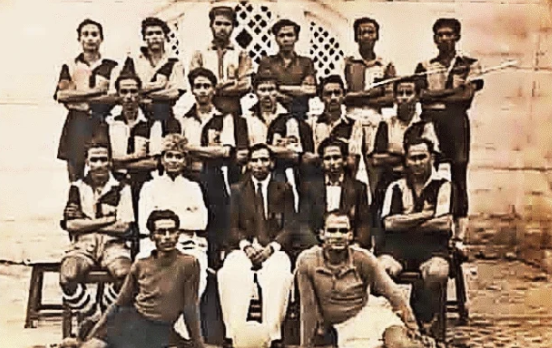
The 1952 Hyderabad football team, with many of its members going on to play in the 1956 Olympics semifinal
Although he occasionally travels to the football grounds in Bolaram or Trimulgherry, most of them are again hard mud grounds that increase the risk of injuries, making them unsuitable for regular training.Their stories reflect a growing problem in Hyderabad. Although football remains one of the city’s most loved sports, many young players are growing up without regular access to full-sized football grounds or enough competitive tournaments. Forgotten forceHyderabad was once one of India’s foremost football hubs. Coached by the legendary Syed Abdul Rahim, the Hyderabad City Police team dominated Indian football in the 1950s, winning many national titles.Since India’s 1948 London Olympics campaign, Hyderabad and Secunderabad have produced at least 14 Olympians, including Rahim’s son Hakim and Peter Thangaraj, besides 21 internationals, nine national coaches and three FIFA panel referees.Six footballers from the city captained India — SK Azizuddin, Syed Nayeemuddin, Shahid Waseem, Mohd Habib, Shabbir Ali and Victor Amalraj. Hyderabad also produced stalwarts like Yousuf Khan and Tulsidas Balaram.Football grounds at Fateh Maidan, Trimulgherry, Gymkhana, Vijayanagar Colony, Parade Grounds, Bollarum, Osmania University and across the Old City and Secunderabad once bustled with players every evening.Today, however, experts say Hyderabad lacks a robust league structure and enough competitive football, resulting in it lagging behind Bengaluru, Kolkata, Kerala and the Northeast.

Not enough competitive football TFA secretary Ganpathi Phalguna says a shortage of grounds has also made organising leagues difficult.“Many of our league matches are conducted at Sreenidhi because getting grounds in Hyderabad has become extremely difficult. Sometimes we are forced to conduct tournaments outside the city because suitable venues such as Gymkhana grounds and LB stadium fields simply aren’t available due to private booking and other functions,” he says.“Our players train on small grounds and then are expected to play 90-minute matches on full-sized pitches. Naturally, they struggle physically.”Experts also criticised the current league system run by TFA, saying players play too few matches. “Divisions league with only 10 teams stretches over nearly six months, yet each team plays just five or six matches. How do I keep young players motivated with so little competition?” says K Srikanth Chakravarthy, secretary of Tarnaka Football Club.“Telangana has not progressed beyond the first stage of the Santosh Trophy for nearly 15 years. The state camp is held for barely 10 to 15 days before the tournament. There isn’t even a publicly listed panel of coaches. Where is the will to run the organisation properly?” Asif asked. Unsuitable grounds The shortage of proper football grounds is the biggest concern flagged by players, coaches and administrators.Former India captain and founder of Old City-based Abbas Union, Shabbir Ali, says Hyderabad still has traditional football venues such as Gymkhana Ground, Sporting Ground at Vijayanagar Colony, Barkas Ground, Goshamahal Police Stadium, City College Old Boys Ground and several grounds in Azeez Nagar.“These grounds have played a key role in the city’s football culture. But at the same time, there is a need for regular maintenance. More importantly, leagues should be organised on time and conducted in a proper, consistent manner. Regular competitions are essential,” he says.Experts agree that while commercial football turfs have become popular across Hyderabad, they cannot replace full-sized football grounds. ‘Hope for revival’ D espite the challenges, veterans believe Hyderabad can still regain its lost glory. Amalraj believes the city’s passion for football is strong, while Shabbir Ali says Hyderabad continues to produce talented youngsters. “The govt should make annual football tournaments compulsory in schools. Grassroots development has to start there. Unless children begin playing at a young age, we cannot expect Hyderabad to produce national-level footballers again.” The only way Hyderabad can regain its footballing legacy is by creating more 11-a-side grounds and TFA organising more tournaments, says Aliuddin.‘TFA must work with schools to tap grounds’Former footballer and Trimulgherry-based Hyderabad Globe Football Club Syed Sadi Aliuddin recalls a time when football grounds were spread across the city.
“There was Goshamahal Police Stadium, Lal Bahadur Stadium, Fateh Maidan, City Police Ground, Osmania University grounds and Gagan Kiri Ground. These were the grounds where Hyderabad football was built. Today, many have disappeared or are no longer available,” he says.Chakravarthy believes Hyderabad already has enough grounds, but they are not being used effectively. “This situation cannot improve unless the TFA changes its approach. People keep saying there aren’t enough grounds, but that’s simply not true.”According to him, Hyderabad has thousands of private schools with football grounds.“Instead of citing a lack of infra, TFA should work with schools to make those grounds available for league matches. It has to be a win-win for both the school principals and the association. Cricket has built such partnerships with schools and is now even hosting a statewide T20 league, so why can’t football?” asks Chakravarthy. “Everything is controlled centrally. There is a monopoly in decision-making instead of a proper league system,” Joshua says.