






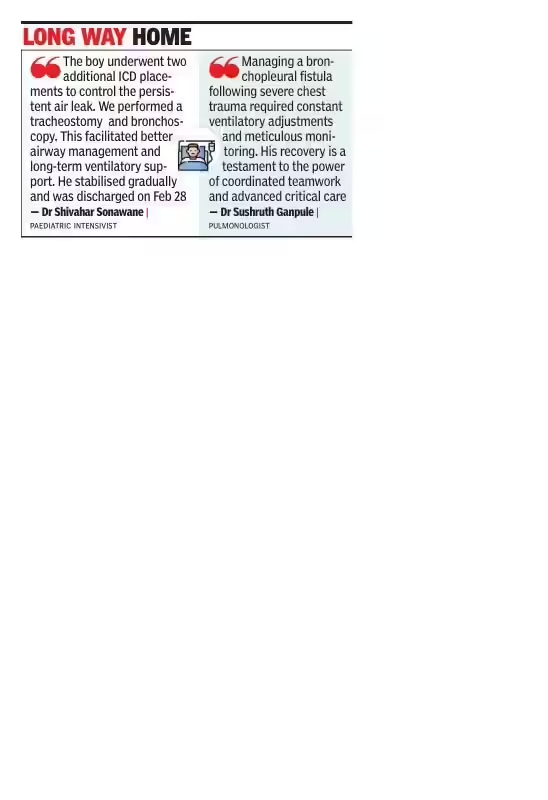
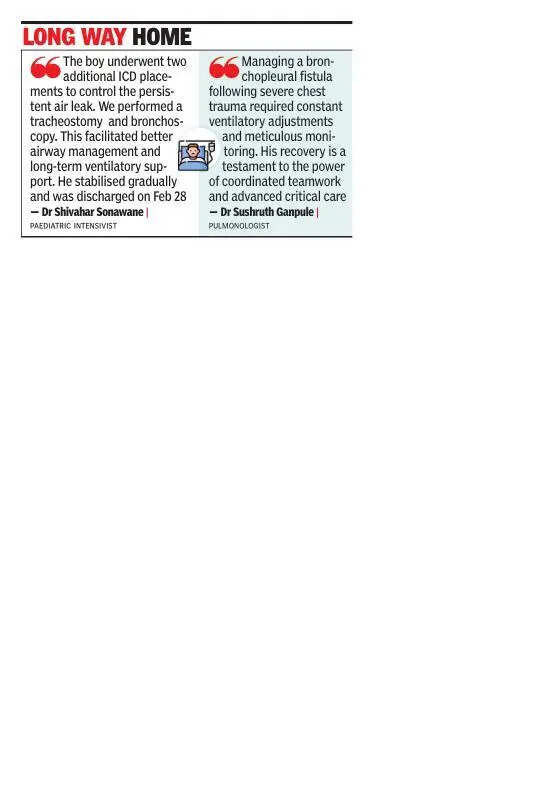
Pune: A 12-year-old boy who had suffered severe chest trauma after multiple injuries following a road accident on Feb 8 survived the life-threatening complications with the coordinated efforts of a team of city doctors recently. He was discharged after 20 days of hospitalisation and 12 days of ventilator support.The accident had caused a severe ribfractureon the boy’s right side of the chest,hemothorax(wherein blood collects in the chest cavity), fracture of the left collarbone, lungcontusion (bruise of the lung tissue) on both sides and a head injury.He was then rushed to a nearby hospital, where emergency life-saving procedures were performed. An intercostal chest drain (ICD) — which is a medical tube — was inserted between the ribs (intercostal space) into the chest cavity to remove unwanted air, fluid or blood.The boy’s condition deteriorated despite the interventions. In the next 24 hours, he developed a bronchopleuralfistula, a complex condition where an abnormal connection is formed between the bronchial tubes (airways of lungs) and the pleural space (a space lining the lungs), making ventilation extremely difficult. He was referred to a specialty hospital for advanced critical care management and was admitted on Feb 9.DrTejasHambir, consultant in neonatology andpaediatricintensive care at Jupiter Hospital and the treating consultant, said, “The boy was in a critical condition upon arrival. His oxygen saturation levels had dropped to50% despite maximumventilatorysupport. We observedsevere air-leak syndrome, making his treatment challenging.”Over the next several days, a multidisciplinary teamcomprisingintensivists,paediatricspecialists, surgeons and pulmonologists worked continuously to stabilise him. Multipleventilatorystrategies were employed to manage thebronchopleuralfistula and improve oxygenation.Paediatricintensivist DrShivaharSonawane said, “The boy underwent twoadditionalICD placements to control the persistent air leak. We then performed a tracheostomy — which is a process where a small opening is made in the front of the neck into the windpipe (trachea) to help a person breathe — and bronchoscopy — a procedure that lets doctors look directly inside the airways and lungs using a thin tube called a bronchoscope. This facilitatedbetter airway management and long-termventilatorysupport. Gradually, the boy’s condition began to improve.” He was successfully stabilised and discharged on Feb 28.PulmonologistDrSushruthGanpule said, “Managing abronchopleuralfistula following severe chest trauma required constantventilatoryadjustments and meticulous monitoring. His recovery is a testament to the power of coordinated teamwork and advanced critical care.”The case highlights the importance of rapid referral, specialised critical care and collaborative teamwork in managing complex trauma cases in children.