








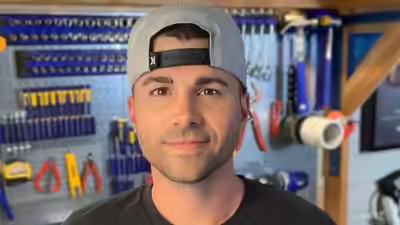
Science classes are often remembered for textbooks, diagrams and memorising formulas. Mark Rober wants children to remember something different, namely the excitement of discovering how the world works. The former NASA engineer and one of YouTube’s most popular science creators has launched a free educational initiative worth $60 million aimed at making science engaging, hands-on and accessible to students. Called Class CrunchLabs, the programme offers classroom-ready STEM lessons, experiments and teacher training at no cost to schools, reflecting Rober’s belief that every child deserves the opportunity to experience the joy of scientific discovery.
From NASA engineer to science educator
Before becoming a YouTube sensation with millions of followers, Mark Rober spent nearly a decade working at NASA’s Jet Propulsion Laboratory. During his time there, he contributed to several projects, including work related to the Curiosity rover mission to Mars.After leaving NASA, Rober joined Apple before eventually focusing on science communication full-time. His videos, known for combining entertainment with engineering challenges, have attracted hundreds of millions of views and helped spark interest in science among young audiences worldwide. From glitter bombs designed to catch package thieves to elaborate engineering experiments, Rober built a reputation for making complex scientific concepts entertaining and easy to understand.
A $60 million investment in curiosity
Rober’s latest venture represents one of the most ambitious projects of his career. Through Class CrunchLabs, he has helped create a comprehensive STEM curriculum designed for students in grades 3 through 8.The initiative reportedly required around three years of development and involved collaboration with educators, curriculum specialists and science teaching experts. Rather than creating a simple collection of online videos, the team built a complete classroom programme featuring lesson plans, experiments, assessments and teaching resources.The approximately $60 million investment highlights the scale of the effort. Rober has described the project as an attempt to bring the excitement of scientific discovery into classrooms and give teachers tools that make learning more engaging for students.
What is Class CrunchLabs?
Class CrunchLabs is designed to bring hands-on learning into classrooms. Lessons encourage students to explore scientific concepts through experiments, engineering challenges and problem-solving activities rather than relying solely on traditional lectures.The curriculum includes structured lesson plans, classroom activities, teacher guides, assessments and video content featuring Rober and other science communicators. It was developed in partnership with educators to ensure it aligns with classroom standards and can be integrated into existing teaching programmes.One of the featured units, called “Carnival of Collisions,” introduces students to concepts such as force, motion and collisions through interactive activities and experiments. The broader goal is to help children learn by doing rather than simply reading or listening.
Completely free for teachers
One of the most remarkable aspects of the initiative is that teachers can access it entirely free of charge. Schools are not required to pay subscription fees or purchase expensive packages to participate.According to the programme’s organisers, the curriculum was not designed as a profit-making venture. Many of the activities are built around low-cost and commonly available materials, making them practical for schools with limited resources. This approach allows teachers to focus on delivering engaging lessons without worrying about additional financial burdens.The decision to make the programme free reflects Rober’s view that high-quality science education should be available to every child, regardless of their background or where they attend school.
Making science fun again
At the heart of the project is a simple idea: children learn best when they are curious and actively involved. Rober has spent years demonstrating that science can be exciting, surprising and enjoyable. His online videos often transform scientific principles into memorable challenges, experiments and demonstrations that capture viewers’ attention.Class CrunchLabs brings that same philosophy into the classroom. Instead of treating science as a collection of facts to memorise, the programme encourages students to ask questions, test ideas and discover answers through experimentation. By making learning interactive, Rober hopes to help children develop a lasting interest in science and engineering.Many educators have expressed concern about declining interest in STEM subjects among students, particularly as technology becomes increasingly important in everyday life. Encouraging young people to engage with science, technology, engineering and mathematics is seen as crucial for preparing the workforce of the future.Programmes such as Class CrunchLabs could help address that challenge by making science more approachable and enjoyable. By providing free resources, teacher support and hands-on learning opportunities, the initiative has the potential to reach millions of students and inspire future innovators.The project is about more than classroom lessons. It is an investment in curiosity, creativity and opportunity. By spending $60 million on a programme that generates no direct profit, the former NASA engineer is betting that giving children the chance to fall in love with science is one of the most valuable investments that can be made in the future.