










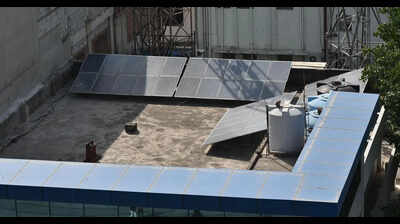
Gurgaon: Haryana’s push for clean energy continues to gather momentum, but the expansion of rooftop solar installations faces several bottlenecks. The state has issued 81,735 rooftop solar connections under the Pradhanmantri Surya Ghar Muft Bijli Yojana. Of these, Dakshin Haryana Bijli Vitran Nigam has released 36,130 connections against a target of 1,22,000, while Uttar Haryana Bijli Vitran Nigam has issued 45,605 connections out of its target of 1,00,000.During a review meeting, special energy secretary and managing director of the power distribution corporations, Vikram Singh, assessed the scheme’s progress and addressed the challenges slowing down the installation process. One of the biggest obstacles turns out to be securing loans for 2 kW and 3 kW solar systems, largely due to CIBIL score requirements and prolonged documentation procedures. Issues with loan sanctions for systems above 3 kW were also raised during the meeting.To ease the process, banks were directed to simplify ownership verification, reduce excessive paperwork and appoint dedicated officers to handle rooftop solar loan applications. Representatives were also told to accelerate sanctioning and disbursement so that households are not burdened by delays. “By speeding up banking processes, the benefits of the scheme can be extended to a larger number of people,” an official said.Singh instructed all DISCOM teams to clear pending applications, maintain strict quality standards and ensure that installations are completed within the stipulated timeframe. To streamline coordination and prevent delays, the corporations decided to hold meetings on the first Wednesday of every month.Regarding the need for timely correction of errors in beneficiaries’ names and addresses, adoption of transparent working practices and improving the meter supply and procurement process, the officer said, “District-level nodal officers have been proposed to enhance coordination between banks, DISCOMs and vendors.”Singh also directed officials to intensify field-level awareness campaigns to educate households on the benefits of rooftop solar, both for reducing electricity bills and for promoting green energy adoption.In just five months, Gurgaon received 7,497 applications for rooftop solar installations, a record rise that officials say reflects a shifting mindset among urban consumers. Circle 1 received 4,142 applications until May 13, of which 2,560 systems have already been sanctioned and connected. Subsidies have been disbursed to around 2,360 applicants. Circle 2 recorded 3,355 applications, with 1,646 installations activated. Together, Gurgaon now has over 4,200 operational rooftop solar systems.The Haryana govt is preparing to convert all govt buildings, autonomous educational institutions and registered gaushalas into fully solar-powered premises by 2026-27. The move is expected to reduce electricity expenditure and accelerate the state’s transition to a decentralised energy model.A survey of 4,523 govt buildings has revealed a combined solar potential of 122 MW. Installing rooftop systems across these establishments will allow them to generate their own power, cut operational costs and set a benchmark for energy-efficient governance.