









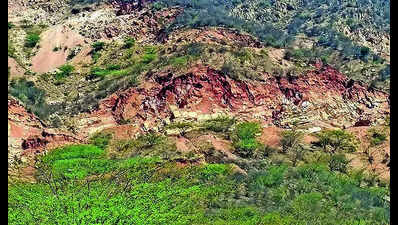
Gurgaon: In a shift in its annual afforestation strategy, Haryana govt has asked all districts to identify contiguous land parcels of at least five hectares for plantation during the monsoon.The move marks a departure from the earlier practice of carrying out plantations across multiple smaller, scattered sites. Officials said the new approach is aimed at creating larger green blocks that are easier to monitor, protect and maintain. Forest officials have been asked to identify suitable sites ahead of the plantation season.The decision was taken in a meeting between ACS (environment) Sudhir Rajpal and the state forest department. “The decision was communicated and districts have been asked to follow the guidelines while preparing their plantation plans,” said a senior forest department official. It was discussed in the meeting that since smaller parcels are difficult to monitor, forest department will only carry out plantation over 5ha, even as local bodies will take care of the small patches.The directive, however, has raised concerns among forestry experts, especially in Gurgaon and Faridabad, where large vacant land parcels are scarce because of rapid urbanisation and the Aravali landscape.“Land availability in Aravali districts is a major concern. In the Aravali hills and foothills, plantation has already happened over the years. What is needed now is protection and rejuvenation of existing forests. This move is not practical for these districts,” said MD Sinha, former chief conservator of forests, south Haryana.Officials familiar with the exercise said that while large land parcels may be available in some districts of north and west Haryana, identifying contiguous stretches of five hectares in highly urbanised districts could prove difficult.“Plantation planning has to be based on land availability. If a panchayat has two acres, or a school, waterworks or roadside stretch can accommodate trees, plantation should happen there. In the past, afforestation on smaller available parcels collectively contributed significantly to green cover. Insisting on a minimum five-hectare patch may restrict plantation opportunities rather than expand them,” said RP Balwan, also a former chief conservator of forests in south Haryana.Beyond the logistics, experts also questioned whether fresh plantations should be the primary focus at all in ecologically sensitive parts of the Aravalis, where invasive species and forest degradation pose a more urgent threat.“Removal of lantana and subabul should be the focus, especially in Faridabad. These invasive species are spreading like slow poison and affecting native biodiversity. Restoring existing forests will yield better ecological outcomes than simply planting more saplings,” said forest analyst Chetan Agarwal.The concerns arrive against a backdrop of sustained pressure on Haryana’s green cover. The state already has one of the lowest forest covers in the country at around 3.5%, with much of it existing as narrow strip forests along roads, highways, canals, railway lines and field bunds. Data from the Union environment ministry shows that more than 1,150 hectares of forest land were diverted for over 1,280 projects in Haryana between April 2021 and Oct 2025. Forest cover declined by 14 sqkm between 2021 and 2023 alone.Haryana’s Forest Policy had set an ambitious target of raising tree cover to 20% by 2020 — a goal that remains unmet. Gurgaon, despite a tree cover of 12.9% of its geographical area, continues to rank among the country’s most polluted cities.Environmentalists argue that annual plantation drives often place greater emphasis on plantation targets than on sapling survival, ecological restoration and protection of existing forests. Natural regeneration, invasive species removal, water conservation and on-ground protection, they said, must become central to forest management.Forest department officials said district-level site identification is currently underway, and the number of locations meeting the five-hectare threshold will become clearer before the monsoon arrives.Whether the new policy delivers larger, healthier green blocks — or simply shrinks the pool of viable plantation sites — may depend on how much flexibility districts are given to work with the land they actually have.