











By Manvi.VyasHYDERABAD: Now at the centre of the Central Board of Secondary Education (CBSE) on-screen marking (OSM) row affecting 18.5 lakh students nationwide, Hyderabad-based Coempt EduTeck, formerly known as Globarena Technologies had earlier courted controversy for mishandling the results of the Telangana Intermediate examinations in 2019.The flawed results led to 23 student suicides across the state.Officials familiar with the earlier episode say CBSE appears to have repeated the same mistake made by the Telangana government seven years ago, deploying the company’s technology without adequate testing.The issue had, in fact, been flagged by a three-member expert committee appointed by the Telangana government after the 2019 fiasco. The panel found “systemic failures, procedural collapse, and glaring negligence” on the part of both the company and the board. Yet, academics point out, the company was never blacklisted.
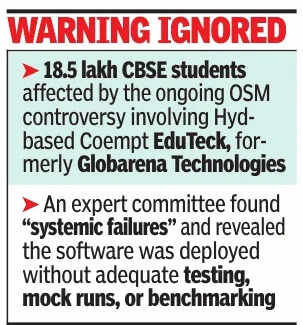
Warning ignored
Company not blacklisted even as panel found it did not meet baseline criteria
Instead, the company rebranded itself and continued securing major digital evaluation contracts in several states, including the controversial Council of Higher Secondary Education (CHSE) Odisha Plus II eevaluation project, before eventually landing the CBSE contract.The expert committee, comprising GT Venkateshwar Rao, then managing director of Telangana State Technology Services, Prof A Vasan, now dean (Administration) at BITS Hyderabad, and professor Nishanth Dongari of IIT Hyderabad submitted its report on April 26, 2019.The panel found that Globarena did not even meet the baseline work-experience criteria. More alarmingly, despite being awarded a Rs 4.35-crore project involving the results of 8.7 lakh students, no formal agreement was ever signed between the Intermediate board and the company. The entire operation functioned solely on the basis of a work order.The report noted that the software had begun showing faults asearly as Oct 2018, nearly six months before the results were declared. The Telangana State Board of Intermediate Education (TSBIE) repeatedly flagged deficiencies in multiple modules, but the company’s response remained “unsatisfactory”.Despite these warnings, the results were declared on April 18 without “adequate testing, mock runs, or benchmarking against previous years’ data”. The committee described the failure to benchmark results as “the biggest mistake in the entire process”.
Serious flaws found
What followed was complete chaos. In 531 cases, Geography students’ practical marks disappeared from mark memos. In another 496 cases, students found the code “AP” printed instead of marks. For 4,288 mathematics, economics, commerce (MEC) students, mathematics marks appeared as single digits.The committee concluded that these errors stemmed directly from “serious flaws in the software’s design and implementation”.The report exposed a near-total collapse of oversight within the board. Its Electronic Data Processing (EDP) monitoring team was abruptly sent back to parent departments in June 2018, leaving the software development process effectively unmonitored during crucial stages.According to the report, the platform operated without standard operating procedures or approved software specifications, and was launched without mock runs or integrated load testing, failures that directly triggered widespread data errors.TSBIE former commissioner Syed Omer Jaleel, who took charge after the fiasco, said the findings reflected a complete breakdown of due diligence. “The software was never properly tested. The firm secured the project with no backup and no technical support. The software was also supposed to be tested by the board, which never happened,” Jaleel told TOI .A former senior official associated with the case confirmed that despite the committee’s findings, no formal blacklisting proceedings were initiated against the company. That failure is now back in the spotlight amid the CBSE controversy.According to Jaleel, India still lacks a national mechanism to prevent tainted firms from resurfacing under new identities and securing fresh public contracts. “If you change your name and address, there is no way others can identify you as the same old entity,” he said, urging examination bodies to thoroughly verify the track record of companies before awarding contracts.Repeated calls and text messages to the firm’s CEO, VSN Raju, went unanswered.