









Bengaluru: Karnataka has sharply intensified food testing and enforcement in the past two years, with the state analysing nearly 1.2 lakh samples between 2022-23 and Oct 30, 2026, amid growing concerns over quality and hygiene in Bengaluru’s rapidly expanding food and hospitality sector.Of the nearly 1.2 lakh samples tested during the period, 1,769 failed the prescribed standards. The findings led to proceedings before adjudicating authorities and courts, with some cases still pending.Food safety department data shows that testing increased significantly from 2024-25. The number of samples analysed rose from 6,851 in 2022-23 and 9,172 in 2023-24 to 45,696 in 2024-25 — a nearly five-fold jump from the previous year. Testing stood at 39,762 in 2025-26. The decline in testing was mainly due to a fall in surveillance sampling as the department focused on enforcement. In the current financial year, 18,105 samples had been tested as of Oct 30.Food safety came into sharper focus following the efforts of food safety and drug administration commissioner Srinivas K and health minister UT Khader. The move assumes greater significance in Bengaluru, where lakhs of restaurants, food outlets and streetside establishments cater to a large and constantly expanding population.Srinivas, while speaking to TOI on the sidelines of the National Conference on Food Safety and Drug Regulation here Thursday, said inspections and testing had been intensified from 2024-25 using the available infrastructure and manpower.
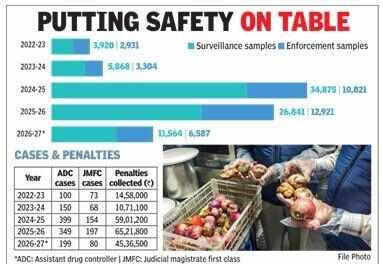
“From 2024-25, we rigorously increased inspections and testing with the available infrastructure and staff. Testing is a continuous process and the numbers keep getting added as the year progresses. Enforcement sampling, which involves first-time testing, has also increased from 2024-25. This financial year, we still have a good 4-5 months left, and both enforcement and testing numbers will increase,” he said.Of the 1,769 samples that failed the prescribed tests during the period, 1,197 cases were registered before the assistant drugs controller, while 572 were filed before judicial magistrate first class (JMFC) courts.Officials said the cases included samples that resulted in suspension, notices or penalties. However, some violations were minor and resulted only in notices being issued to the establishments concerned.Penalties collected through enforcement proceedings have also risen steadily. The department collected Rs 14.6 lakh in 2022-23, Rs 59 lakh in 2024-25, and Rs 65.2 lakh in 2025-26. As much as Rs 45.4 lakh was collected in 2026-27 as on Oct 30.Food sector expands rapidly, active licences rise to 4.2LThe number of food businesses operating under the state’s licensing and registration framework has risen 53% in four years, reflecting the rapid expansion of the state’s food sector and efforts to bring more establishments under the food-safety net.
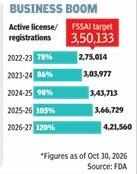
Active food licences and registrations increased from 2.7 lakh in 2022-23 to 4.2 lakh in 2026-27. The growth has been steady each year, rising to 3 lakh in 2023-24 and 3.4 lakh in 2024-25 before exceeding the Food Safety and Standards Authority of India’s (FSSAI) target of 3.5 lakh in 2025-26. Karnataka recorded 3.7 lakh active licences and registrations that year, reaching 105% of the target. The figure climbed further to 4,21,560 in 2026-27, taking the state to 120% of the FSSAI target. Karnataka now has over 71,000 active licences and registrations above the prescribed target.The rise points to the growing number of restaurants, eateries, street-food establishments, and other food businesses across the state, particularly in Bengaluru, where the food and hospitality sector has expanded rapidly. Department officials attributed the increase to sustained efforts to bring more food businesses into the formal food-safety framework through licensing and registration. The move is also aimed at ensuring that a larger share of food establishments is covered by inspections, testing and enforcement.