









Hyderabad: Govt spent just 0.8% of its total health expenditure (as a percentage of GSDP) on healthcare in 2023-24, placing it second lowest nationwide among states, according to the national health accounts (NHA) report released by the central health ministry on Sunday.While Karnataka recorded a lower share – at 0.6% – than Telangana, Gujarat, Haryana, Maharashtra, Punjab and Tamil Nadu were also jointly at 0.8%.
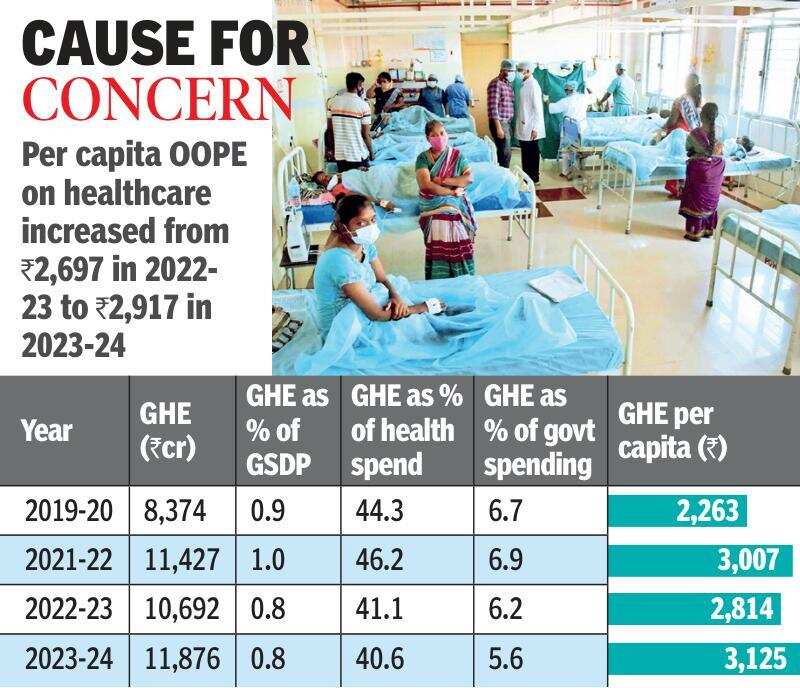
Even as many states increased their spending during the corresponding period, Telangana’s spending on health from its economy remained unchanged from the 2022-23 NHA report and dropped down from 1.0% in 2021-22.For instance, Andhra Pradesh raised its share from 1% to 1.2% during the same time period, Odisha from 1.8% to 2.1%, Rajasthan from 1.2% to 1.5%, Uttarakhand from 1.5% to 1.6%, Goa from 1.6% to 1.9% and Sikkim from 1.7% to 2.3%.In the NHA, while state govt’s share is around 68% of the GHE, central govt accounts for about 32%.City-based public health experts said that the low spending could affect the quality of services in govt hospitals and limit improvements in facilities and staff strength. They highlighted that in simple terms, out of every ₹100 the govt spent, only 80 paise went towards healthcare in 2023-24.Dr Karthik Nagula, president of the Healthcare Reforms Doctors Association (HRDA), said low public investment forces more people to depend on private hospitals. He added that rising per capita out-of-pocket expenditure (OOPE) showed the growing burden on households.According to the 2026 National Sample Survey (NSS), released by MoSPI in April, Telangana led nationwide in average hospitalisation expenditure in India – at around ₹55,000. The state socio-economic survey 2026 showed that at present, nearly 10% of household loans in Telangana are taken for health-related expenses, most of them arising from emergencies.“Private healthcare costs in Telangana were already high, making it difficult for many families to afford treatment, especially for serious illnesses and long-term conditions. Building new hospitals and medical colleges is not enough because if the govt did not increase spending on public healthcare and improve facilities in govt hospitals, more patients would be forced to approach private hospitals, where consultation, diagnostic tests, medicines and hospitalisation could be expensive. This would further add to the financial burden on families, particularly those from low- and middle-income groups,” he added.Experts noted that Telangana is a classic case of “missing middle” in healthcare delivery, as over-reliance on high-cost corporate hospitals and an under-capacity govt health sector are forcing patients into high-cost pathways even for moderate conditions.Rising out-of-pocket expenditureThe burden on households also remained high in the recent health accounts. Per capita OOPE, which is the money people shell out of their pockets for healthcare, increased from ₹2,697 in 2022-23 to ₹2,917 in 2023-24. In total, households spent ₹11,086 crore directly on healthcare, accounting for 37.9% of the state’s total health expenditure of ₹29,281 crore, with the govt accounting for 40.6% of total health expenditure.Experts also highlighted that although Aarogyasri and many insurance schemes offer cashless treatment, patients still have to pay for basic items such as gloves, syringes, IV sets and other medical consumables. “Insurance companies usually classify these as ‘non-payable items’ and do not include them in the package. Post-treatment support is also limited. Under Aarogyasri, coverage often ends within 10 days of discharge. After that, patients must pay for follow-up check-ups, tests, medicines and long-term treatment. Because of these gaps, many families continue to spend heavily on healthcare even when they have cashless insurance coverage,” said Dr D Srinath, chief adviser, Federation of All India Medical Association (FAIMA) and former president of the Telangana Senior Doctors Association (TSRDA).Meanwhile, Telangana govt’s health spending increased by 11%, from ₹10,692 crore in 2022-23 to ₹11,876 crore in the latest report. However, health received a smaller share of the overall govt budget, falling from 6.2% to 5.6% – out of every ₹100 the govt spent, only ₹5.6 went towards healthcare in 2023-24, compared with ₹6.2 the previous year.Medical experts also said that nearly 85% to 90% of out-of-pocket health spending of a family in India goes towards medicines and diagnostic tests, with the burden higher in states such as Telangana. “Patients with chronic illnesses such as diabetes, hypertension and kidney disease face recurring expenses on medicines, tests and follow-up visits,” said Dr Kiran Madhala, secretary-general of TTGDA.The emphasis now needs to be on increasing investment in adequate budget allocation and primary healthcare, improving govt hospital infrastructure, filling vacant doctor posts and ensuring better patient care, experts said. They added that stronger primary health centres and early detection of diseases could reduce the need for expensive treatment at bigger hospitals and lower the financial burden on families.