






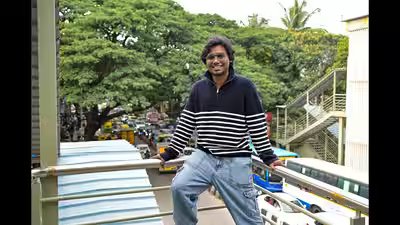
Manjeet Sarkar’s road to comedy began with an odd mix of influences: YouTube, Dave Chappelle, the film Masaan, and a decision to leave home without a plan. He grew up in a refugee village in Bastar, Chhattisgarh, where he worked hard to win scholarships, later moving to Mumbai and then Bengaluru, where he spent years on odd jobs and open mics. Over the years, his comedy has tackled caste, class, identity, mental health and being called out. In a chat with Bangalore Times, Manjeet sheds light on finding his voice, the price of political comedy, why he dislikes being labelled a “Dalit comedian” and the themes he wants to take on next. Excerpts:You often speak about your childhood in Bastar. What’s your origin story?I come from a place in Bastar, Chhattisgarh. Education wasn’t really part of our culture because we needed more breadwinners. But when the school started mid-day meals, I figured out that that if I went to school, I could escape child labour.I left home in seventh grade after someone offered to fund my higher studies, and around 2016, I landed in a pharmacy course in Odisha. That’s where I was introduced to free internet and a cheap phone. I watched YouTube all day: documentaries, speeches of Malcolm X and Martin Luther King Jr. Then one day I discovered Dave Chappelle. I didn’t understand most of what he said, but it gave me goosebumps. I thought, “I don’t know what this guy is doing, but I want to do it.”Soon after, I watched Neeraj Ghaywan’s Masaan. For the first time, I saw someone telling my story, not through a pitiful lens, but as a story about love. Then I found out its writer, Varun Grover, was also a comedian. I thought, “This is the second call for me to be a comedian.” So I packed my bags, lied to my parents about getting a scholarship and ran to Mumbai.And how did you land up in Bangalore?I couldn’t sustain living in Mumbai for more than five months, so I came to Bengaluru thinking it’d be cheaper. I took odd jobs, starting at a call centre, and did open mics every day. I fell in love with the city within a year, and however much I travel for tours, I always call Bengaluru my home.The city is part of who I have become. I’ve tried out material in random parks. One time, a sweet couple was eating at a cafe and I walked up and asked, “Can I try some jokes?” They couldn’t say no, so I started telling jokes while they were literally eating spaghetti. That’s how this city saved my career.How did you find your voice in comedy?Like most other comedians, I started with jokes on college friends, cab drivers, girlfriends, parents and house helps, even though I couldn’t relate to them. I did that for four years, until one night I was questioning my career choices and, a little inebriated, went on stage and talked about how I had no money, how my school days were traumatising, and how we never had a house help because my mother was one.Three people in the audience looked uncomfortable. I vaguely remember asking, “You all are upper caste, I assume?” They said yes. I said, “Then take a joke. Like you used to take our lands.” Somebody recorded it, it went viral, and that’s how I found my calling. I realised the best thing I could do was be myself on stage.How do you decide where the line is between calling someone out and hurting someone?Intention. Words are tricky, and people bring their own experiences and prejudices to them. But the whole idea of comedy is that you don’t punch down. The question is: are you offended, or do you feel called out? If your ego is hurt because I said something true that you didn’t want to hear, that’s not my problem. If I hurt you through a genuine mistake or ignorance, I’ll apologise.You have also spoken about the cost of being political in comedy. What do you give up when you choose to speak about politics or taboo subjects?You don’t get brand deals. I don’t get called for corporate events or panel shows. That’s the reality. I have to keep asking myself whether I’m doing this for money or because I want to. If I wanted money, I’d have taken a regular day job.The moment I started speaking my truth, it started sounding “political.” It’s just my life. My country made my life political. Talk about your marriage and it’s not political. Talk about an inter-caste marriage and suddenly it is. It all depends on how people want to see it.You have described yourself as one of the first comedians from your community to make it. Does that come with a sense of responsibility?People from my community look up to me because I happen to be among the first. I decided never to talk about the basic challenges I faced because I don’t want to scare them away. If you’re the first from a marginalised community in any industry, you have to take a few bullets.Comedy is a very individual art form. It’s very lonely. The only responsibility I take is not saying something hurtful that makes it harder for upcoming artists. I tell my audience that if they ever hear me joke that “women can’t drive,” they should call me and ask me to shut my mouth forever. The rest is a bit of a burden. I’m just a stupid guy saying stupid things.What was the moment when you thought, ‘I have made it’?When I performed at the United Nations in Bangkok in 2023. I thought the invitation email was spam, until they called and said they were literally calling from the UN. It was my first time performing outside India, and I ended up making fun of the UN. They laughed, but I don’t know if they’ll call me back. I was the first Indian comic invited, and that was the day I thought, “Okay, I made it.”You have pushed back against being called a ‘Dalit comedian’. Why?I hate it when my identity comes before my profession. Before you buy a ticket, do you think, “Oh, it’s a female comedian.” No, it’s a comedy show. What makes Sumukhi Suresh or Urooj Ashfaq or Zakir Khan or me different is the material we perform. Putting identity before profession puts people in a box instead of recognising their strengths.Mental health keeps showing up in your comedy. What are you trying to do differently when you talk about it?My mental health bit is about pushing people to go to therapy, irrespective of their gender or background. I’m not making money out of it. Mental health has been part of my comedy since my first special because it never left me. When I had a panic attack, people in my village thought it was a seizure and made me smell their chappal. It’s not their fault, it’s how we were taught.I also talk about how people from my community struggle to find therapists who understand our point of view. I want to create a safe space to talk about triggers, however uncomfortable, and make it feel normal.What’s next for you?My dream is a food and lifestyle show. The closest thing is Show Me Around, where I explore a city’s history and talk about comedy. History, comedy and food are the three things I love most, and Anthony Bourdain has been my inspiration.