








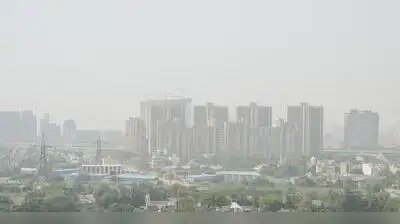
Gurgaon: The city’s air quality improved to the moderate category on Thursday, with the air quality index (AQI) dropping to 193, a day after it touched 216 — the city’s highest reading this month. Delhi, Noida and Ghaziabad, however, continued to record ‘poor’ air quality.According to data, Gurgaon’s AQI rose from 132 on Monday to 184 on Tuesday and 216 on Wednesday before improving on Thursday. The latest reading marked a temporary respite, although pollution levels remained high in parts of the city.The AQI is calculated as an average of readings from the city’s four active monitoring stations. On Thursday, NISE Gwal Pahari station recorded an AQI of 248, followed by Teri Gram at 217. Sector 51 recorded 186, while Vikas Sadan registered 112.The improvement came amid elevated pollution levels across the National Capital Region. Delhi recorded an AQI of 223, while Noida and Ghaziabad registered 242 and 221, respectively, all in the poor category.The city recorded a minimum temperature of 14 degrees Celsius on Thursday, three degrees below normal, according to India Meteorological Department (IMD). It was the lowest minimum temperature recorded in Haryana that day. The department said the state’s average minimum temperature had risen by 0.5 degrees Celsius from the previous day.Experts cautioned that the improvement may be short-lived as winter approaches and meteorological conditions become less favourable for dispersal of pollutants.“Gurgaon’s AQI falls in the moderate category, but it is close to the poor category threshold of 201. This improvement is likely to be temporary, reflecting short-term changes in local emissions rather than a significant reduction in pollution levels. The AQI is expected to return to the poor category in the coming days, depending on changes in local emissions and meteorological conditions,” said Manoj Kumar, air analyst at CREA.Jinitha Varghese, programme manager at EnviroCatalysts, said Dussehra celebrations, including effigy burning and firecrackers, added to the pollution load, with some pollutants dispersing by the next day.“Diwali is still ahead and winter conditions are setting in. Cooler nights and a lower mixing height will start trapping pollutants close to the ground. Wind speeds are dropping, and calm conditions will favour pollution build-up instead of dispersing. North-westerly winds have also started coming towards the city, bringing smoke from stubble burning. All this is happening on top of high emission load from the city and nearby areas coming from transportation, industries, power generation and waste sector,” she said.Varghese cautioned against interpreting the lower AQI as a sign of sustained improvement. “This brief relief should be seen as an early warning, not a sign of improvement. The coming weeks will test our preparedness to prevent severe winter pollution episodes,” she said.Central Pollution Control Board classifies AQI readings of 0–50 as ‘good’, 51–100 as ‘satisfactory’, 101–200 as ‘moderate’, 201–300 as ‘poor’, 301–400 as ‘very poor’ and 401–500 as ‘severe’.Experts warn that once the AQI crosses 300, prolonged exposure can lead to breathing difficulties, worsen asthma and increase the risk of lung and heart ailments, especially among children, older adults and people with pre-existing health conditions.