








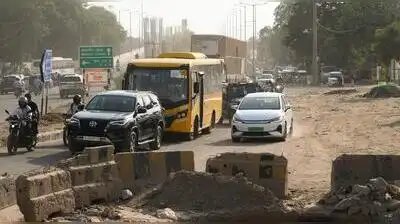
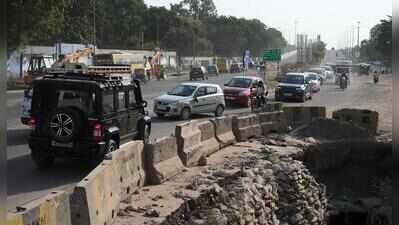
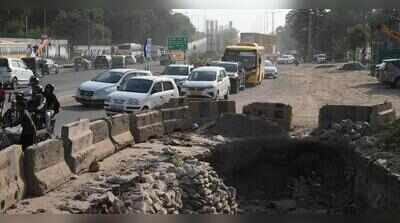
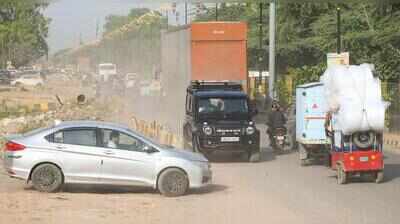
Gurgaon: A stretch that once took barely 10 minutes now forces commuters onto longer detours, while those who brave it crawl through traffic, negotiate barricades and choke on dust.More than 17 months after work began on a 2.8km drainage line along Old Delhi-Gurgaon Road, the project remains unfinished. It has squeezed traffic into barely one lane in some sections and turned one of the city’s key arteries into a daily ordeal for commuters.The problem is most visible between Atul Kataria Chowk flyover and the Sector 17-18 junction, where the road is effectively reduced to a single lane, hemmed in by barricades along the unfinished drain work. The stretch connects residential sectors 21, 22 and 23, Palam Vihar and several housing societies. It also carries traffic towards Maruti’s factory, Udyog Vihar, Delhi and NH-8, affecting both residents and office-goers.Jersey barriers along the drain work have reduced the usable width, leaving vehicles to squeeze through a narrow passage. During peak hours, the bottleneck causes snarls, and wrong-side driving compounds the problem. Dust from the work reduces visibility and adds to road safety risks, with no effective dust-mitigation measures visible at the site. Although some of the dug-up portion has been filled and barricades installed, the stretch remains difficult to negotiate.For some residents, the disruption has made the direct route virtually unusable. Saket Singh, a resident of Gurgaon One, said he now avoids the stretch altogether.“The stretch has become so difficult to navigate that we prefer to avoid it altogether. With the drainage work occupying a most part of the road, effectively only one lane is available for traffic. We now take a longer route via the highway and Sector 17-18 road. From Sector 14 market, which used to be just a 10 minutes drive to our home, now requires a detour,” he said.“Vehicles kick up dust everytime it passes and it drops visibility, especially in the evening and at night. Motorists have to drive cautiously, particularly with the road narrowed by barricades and traffic moving through a limited space,” said Sanjeev Chaudhary, a resident of Sector 22B.With the winter pollution season approaching, dust from the work zone and slow-moving traffic add to the burden in a city that faces tighter restrictions under graded response action plan (GRAP) when air quality turns poor. The absence of dust-control measures also raises concerns about how the work will be managed as pollution levels rise.“Bad roads and traffic congestion also add to air pollution. Vehicles stuck in jams continue to emit exhaust fumes. If the road is made motorable and traffic flows smoothly, pollution caused by congestion can also be reduced,” said Amit Duggal, a resident of Sector 21.GMDA issued the work order for the project in May last year, but progress was slow from the start. The authority imposed a penalty on the contractor in Nov, yet the pace did not improve, with only 6-7% of the work completed. GMDA terminated the contract in May this year and blacklisted the agency. It is now preparing to engage another agency, prolonging the uncertainty over when the road will be restored to normal use.A GMDA official admitted that progress had been unsatisfactory. He said the authority was preparing a fresh estimate to invite tenders for the remaining work. “We are hoping to complete the project by the next monsoon. Road levelling had been carried out and crash barriers installed along the stretch to improve safety. We will also take up dust-mitigation measures at the site to minimise the impact on commuters,” the official said.