









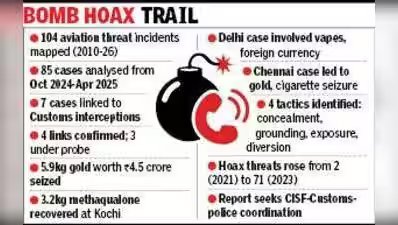
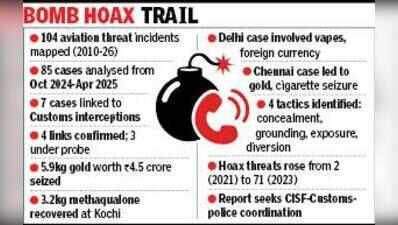
Ahmedabad: Bomb-threat hoaxes may be used by smuggling networks to disrupt airport security responses, delay flights, conceal contraband and exploit gaps in Customs surveillance, a report mapping 104 aviation threat incidents between 2010 and 2026 has found.The Aviation Bomb Threat & Customs Interdiction Report examined 85 core cases between Oct 2024 and April 2025 and identified seven incidents, or 8.2%, with a confirmed, probable, or suspected link between a bomb threat and a Customs interdiction. These cases involved gold, psychotropic drugs, foreign currency, vapes and cigarettes.Of the seven cases, four had confirmed links, while three were deemed probable or remained under investigation. The report puts seizures in connected cases at about 5.9kg of gold valued at over Rs 4.5 crore, 3.2kg of methaqualone valued at Rs 3.2 crore, along with foreign currency, commercial vapes, and cigarettes.The report identifies four methods through which a bomb hoax could be used to facilitate or protect a smuggling operation.The first involves placing a threat note near concealed contraband, such as in an aircraft lavatory or another compartment. By warning of a bomb in that location, smugglers may discourage passengers or crew from accessing the area, allowing the contraband to remain undisturbed until an accomplice can retrieve it.One confirmed case using this modus operandi involved Air India flight AI-349 from Dubai to Mumbai on October 18, 2024. Cabin crew found a handwritten note claiming that a bomb had been placed in the rear lavatory. Security and Customs teams searched the aircraft after it landed in Mumbai. Officials recovered 1.85kg of gold paste, valued at Rs 1.42 crore, from behind a mirror panel in the rear lavatory.According to the report, the threat note was deliberately placed there to deter passengers and crew from accessing the lavatory compartment, preventing the concealed gold from being discovered before a cleaner or transit accomplice could retrieve it. However, the note triggered a full inspection by bomb-disposal and Customs teams, leading to the recovery. Investigators found that the note’s location corresponded with the mirror cavity where the gold was concealed, establishing what the report describes as a direct link between the bomb hoax and the smuggling attempt.The second method involves making a hoax call to ground or delay a flight after Customs officers detain a carrier or accomplice, potentially giving others involved time to respond.The third uses emergency deboarding and baggage screening to create confusion, during which carriers may abandon bags containing contraband. The fourth involves sending multiple threats to divert CISF, police, bomb-disposal and Customs personnel towards aircraft isolation bays, potentially stretching surveillance resources in other parts of the airport.Another confirmed case was reported at Delhi airport on Nov 2, 2024, involving IndiGo flight 6E-2114 bound for Bangkok. An anonymous caller claimed that explosives had been placed in checked baggage. The report says the call followed the detention of an accomplice by Customs after officers recovered 120 commercial vapes and undeclared foreign currency — $18,000 and €5,000.Authorities identified and arrested a passenger near the boarding gate. Telecom tracing reportedly located the caller inside Terminal 3. Investigators classified the threat as an attempt to delay the flight following the Customs detention, rather than an unrelated security scare.At Kochi airport, a threat concerning Air India Express flight IX-412 from Sharjah on Dec 12, 2024, led to aircraft isolation and full baggage screening. Customs officials recovered 3.2kg of methaqualone tablets from double-bottomed suit bags. The seizure was valued at Rs 3.2 crore. Although officials found the contraband during the security response triggered by the threat, the report says it could not conclusively establish a deliberate connection between the two. It therefore classifies the link as probable, not confirmed.At Chennai, a threat involving SpiceJet flight SG-88 from Bangkok on Jan 24, 2025, led to emergency deboarding. Customs officials recovered 40,000 cigarette sticks and 650gm of gold bangles coated with silver paint after two passengers allegedly abandoned shoulder bags near the deboarding point. The goods were valued at about Rs 52 lakh.The report also refers to a 2020 Hyderabad airport case in which a package treated as a possible explosive device was examined by the Bomb Detection and Disposal Squad (BDDS). Officers found 1.5kg of gold bars concealed inside an electric motor.The study places the cases against a rise in reported hoax threats. It cites Ministry of Civil Aviation data showing four nationwide incidents in 2020, two in 2021, 13 in 2022 and 71 in 2023.The report cautions, however, that the reported connections do not establish that every bomb-threat incident is linked to smuggling.It calls for coordinated response protocols involving CISF, airport police, Customs Air Intelligence Units and bomb-disposal teams during aircraft isolation, baggage screening and evacuation.“Between Oct 2024 and April 2025, Indian aviation experienced an unprecedented surge in bomb threat hoaxes, impacting over 80 flights across domestic and international sectors. While the overwhelming majority of these threats were malicious hoaxes aimed at causing operational disruption, rigorous multi-agency analysis reveals a critical operational intersection between aviation bomb threat protocols and Customs Air Intelligence Unit (AIU) interdictions,” the report states.