









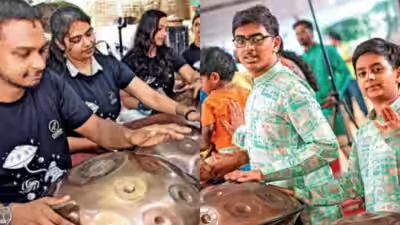
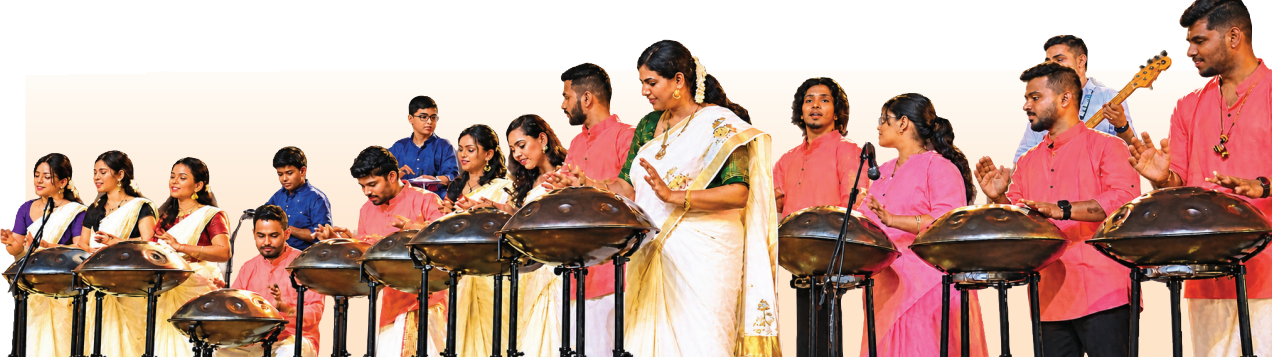
Twenty-six handpans turned a Bengaluru festival stage into a sea of metallic sound. At the centre of the 24-member ensemble were brothers, Ranganathan S, 15, and Sriniketan S, 11. They had spent months rehearsing, travelling across the city several times a week and helping coordinate compositions for the ensemble.At its debut public performance at Bengaluru’s Ganesha Utsava, the ensemble played five songs with 26 handpans alongside mridangam, ghatam, drums, guitar, synth and djembe. Their repertoire included Carnatic compositions along with ‘Varaha Roopam’ from the film ‘Kantara.’Led by the Nadamaya Brothers, who were playing two handpans each, the performance offered the city’s growing handpan community an opportunity to demonstrate that an instrument still on the fringes of mainstream music can function as a lead instrument. Their journey began during the pandemic.
PASSION FOR MUSIC
Ranganathan, who was nine then, had already been experimenting with the keyboard when a neighbour invited him to see an unusual percussion instrument he had begun crafting.His first impression remains vivid. “It looked like a spaceship,” he recalls. Intrigued by its shape and sound, he quickly picked up the basics. Within a few hours, he was exploring melodies on an instrument he had never encountered before. Soon, his younger brother followed.Sriniketan says he was initially drawn to the instrument because his elder brother was playing it. “I was inspired by watching my brother play the handpan. I have been learning to play the handpan for the past three years now. What I love most is that it combines percussion and melody, so you can play both at once without needing two separate instruments,” he says.Today, both brothers practise for at least two hours every day, often spending considerably longer when preparing for a public performance. Ranganathan, having completed his Class 10 examinations ahead of schedule, has taken a gap year to focus entirely on music, combining handpan practice with Carnatic vocal training and Vedic studies.Age, however, is not the only reason why the brothers have attracted attention within the handpan community. Fellow performers describe them as among the country’s most accomplished young handpan players. While other ensemble members handle rhythmic and harmonic layers, the brothers perform the lead melodies, navigating complex arrangements and Carnatic-inspired compositions on chromatic handpans carrying more than 40 notes.Their rise mirrors the growth of Bengaluru’s handpan community itself.At the centre of this growth is Chirag Vaitheeswaran, founder of Chirp Handpans, regarded by the handpan community as one of India’s pioneering indigenous handpan makers. His fascination with the instrument began in 2013, when he encountered one on a beach in Gokarna. At the time, handpans were difficult to obtain, with long international waiting lists and high import costs.He embarked on a painstaking quest to build one himself while working at Microsoft. For nearly two years, he estimates that he produced nearly 200 failed shells before crafting a successful instrument. His Bengaluru workshop now employs 14 artisans and has delivered more than 1,300 instruments crafted entirely from Indian-sourced materials.Making the instrument accessible contributed to the growth of Bengaluru’s handpan community through workshops and impromptu jam sessions. Players began looking beyond the instrument’s familiar association with meditation, yoga retreats, and ambient soundscapes.“I truly believe this instrument has the power to touch people across age groups and backgrounds, and I’m excited to be part of a community that’s helping introduce it to more people,” says ensemble member, Shruthi Shetty.The ensemble itself is designed to highlight the melodic and rhythmic capabilities of the handpan, with different performers assigned roles like those in an orchestra. The arrangement, inspired partly by steel-pan ensembles in Trinidad and Tobago, seeks to demonstrate that the instrument can support complex musical performances rather than simply create atmosphere. That vision resonates strongly with Ranganathan.His ambition is to take Indian handpan music to international audiences and expand its repertoire through Carnatic music, film songs and original compositions. He believes familiarity is key: audiences first recognise a song and then begin paying attention to the instrument producing it. “If it stays in the background, it won’t become famous,” says the teenager. “I want it to become like the flute or the mandolin.“What is a handpan?The handpan is still an unfamiliar instrument for many people. Resembling a metallic flying saucer, it is played entirely with the hands and produces deep, resonant tones that blend melody and rhythm. The handpan is tuned to a specific scale, allowing even first-time players to create harmonious sounds, making it accessible.Origin: Inspired by the steelpan from Trinidad and Tobago, as well as traditional instruments like the Indian ghatam and Indonesian gamelan, people across the world started refining and creating their own versions of handpans. The creators combined elements of the Caribbean steelpan (steel drum) with the Indian ghatam (a clay pot percussion instrument, mostly used in Carnatic music).Meaning of its name: “Hang” means “hand” in the Bernese German dialect, describing how the instrument is played.Material: It is built from two glued-together steel shells made of a treated metal, called nitrided steel.