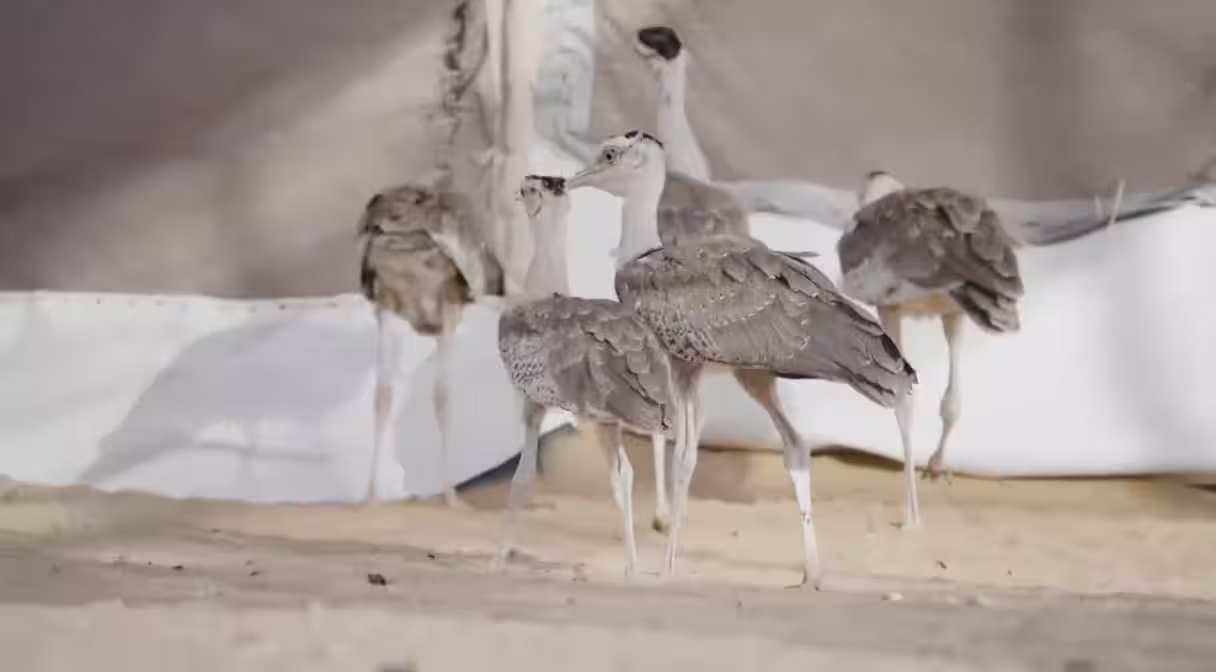








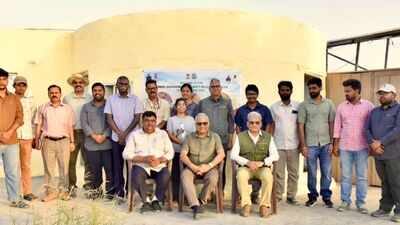
JAISALMER: In a first in the country, two captive-bred male Great Indian Bustards (GIBs) were released into the wild in Jaisalmer’s Desert National Park on Sunday, marking a historic milestone in India’s efforts to bring the critically endangered species back from the brink of extinction.Union Environment, Forest and Climate Change Minister Bhupender Yadav initiated the landmark release during Wildlife Week 2026 at Sudasari. The two seven-month-old GIBs, each weighing around 5kg and measuring about one foot in height, were fitted with satellite tags before being released from a soft-release facility into their natural habitat.As the black bands covering their eyes were removed, the birds initially appeared startled. Within moments, however, they took their first steps towards freedom and flew into the open sky, marking the beginning of a new chapter in India’s GIB conservation programme.The emotional moment was witnessed by leading scientists and GIB experts, including Dr Sutirtha Dutta, Dr Tushna Karkariya and Hrishika Sharma, who became visibly emotional as the birds took flight after years of dedicated conservation work.Rajasthan forest minister Sanjay Sharma,Dr. Gobind Sagar Bhardwaj, Director of the Wildlife Institute of India (WII),,DG Forest Santosh Tiwari, Chief Wildlife Warden K.C A Arun Prasad, ADG Wildlife Ramesh Pandey, CCF Anup K.R., senior forest officials and scientists were present during the historic first releaseThe first-of-its-kind release represents a major shift in the country’s GIB conservation strategy. For nearly a decade, efforts had focused on building a viable captive-breeding population. The programme has now entered its next and most challenging phase — restoring captive-bred birds to their natural habitat and eventually rebuilding the wild population.The release was carried out under highly controlled conditions inside a Restricted-to-Humans (RTH) enclosure, with human presence kept to a minimum to avoid disturbing the birds. Scientists will closely monitor their movements, behaviour, feeding patterns and adaptation to the ecosystem through satellite tags. The experience gained from this pilot release will be used to refine protocols for future releases.Yadav said the milestone was the outcome of nine years of sustained scientific effort to raise captive-bred GIBs to a stage where they could be rewilded.“Today, we have reached a major milestone regarding the Great Indian Bustard project. Our scientists have been working tirelessly for the past nine years to ensure that birds produced through the conservation breeding programme could be raised to a stage where they were ready for rewilding,” he said.Yadav thanked Prime Minister Narendra Modi for entrusting the project to the ministry and said the immediate priority was to monitor the two males’ behaviour and dietary habits and ensure that they adapted successfully to the ecosystem.WII director Dr Gobind Sagar Bhardwaj said the last breeding population of the GIB exists in Jaisalmer and that captive breeding was undertaken as an insurance measure alongside in-situ conservation.The WII, in collaboration with the Rajasthan Forest Department, began captive breeding in 2016. Bhardwaj said the programme now has around 98 captive-bred chicks despite the global survival rate of captive-bred bustards being barely 48%.“We have successfully bred the populatio-n in captivity. The next step is to revive the wild population,” he said, adding that the two released birds would be closely monitored before more GIBs are gradually released.